
You are using an out of date browser. It may not display this or other websites correctly.
You should upgrade or use an alternative browser.
You should upgrade or use an alternative browser.
Electrical Safety Group/My electrical safety
- Thread starter panyg1
- Start date
In the absence of any useful information/data, I'm even more sceptical about AFDDs than I am about SPDs. However, as you say, IF (and I've yet to see any evidence) they do prevent a significant number of fires (I'm yet to be convinced) then they would have to potential to "prevent, or even mitigate, injuries or deaths to human beings or animals".And then there are AFDs, which do "prevent, or even mitigate, injuries or deaths to human beings or animals". If they prevent fires caused by arcing. Do we know how many of those there are?
Since these things have appeared, I need to try to educate myself a bit about arcs. My current 'understanding' is that an arc may arise when a current flow is broken, and persist only so long as current is flowing through the arc (which requires a voltage to be driving that current). In the case of AC voltage/current, this would seem to imply that an arc can only persist for a maximum of half a cycle - in fact, probably closer to quarter of a cycle in opractice, since an arc is presumably most likely to arise if the current is close to its maximum when the circuit is broken - and that (5ms - 10ms) doesn't sound like long enough to start a fire. What am I missing?
Repeatedly "re-starting" would be the obvious answer to 'what am I missing?' - but I don't see why it should re-start if the gap is finite, hence no current to 'break'.A gap small enough for an arc to start and stop 100 times a second?
You seem to be talking about 'voltage jumping a gap' (more the realm oif electrostatics), rather than an arc due to breaking a current - and I think it would have to be a pretty tiny gap fro 230 V to 'jump it (without any prior current flow), wouldn't it? ... and, even if it happened, would an arc occurring across a tiny tiny gap be capable of starting a fire?

Plasma ( ionised air ).What am I missing?
An arc created as the switch contacts separate will ionise air which will provide a path for current to flow.
With AC mains if the plasma remains until the next half cycle then there will be current though the plasma which will maintain the plasma.
Most incidents of plasma end when the switch contacts have moved apart further. Other plasma incidents such as a cut cable can last for minutes as the distance between Live and Neutral does not increase as the cable's insulation is burnt.
an arc may arise when a current flow is broken, and persist only so long as current is flowing through the arc (which requires a voltage to be driving that current). In the case of AC voltage/current, this would seem to imply that an arc can only persist for a maximum of half a cycle
In principle an arc can persist for longer if the plasma doesn’t have enough time to cool and become non-conducting before the current increases in the next half cycle.
According to Wikipedia, the threshold frequency above which this can happen is of the order of 100 Hz. So for AC mains, arcs will tend to self-extinguish - which is a good thing for safety.
I wonder if this is a happy coincidence, or whether this was known and taken into account when 50 - 60 Hz was chosen?
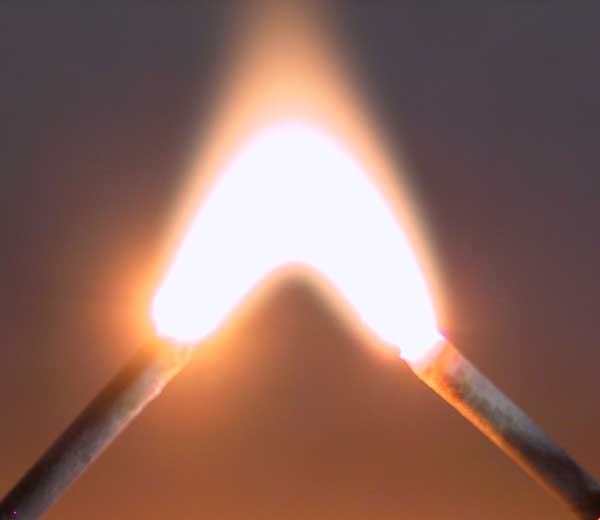
Electric arc - Wikipedia
Yes, I understood that much, but I thought (perhaps wrongly) that the plasma would disappear 'almost immediately' after the arc ceased.Plasma ( ionised air ). .... An arc created as the switch contacts separate will ionise air which will provide a path for current to flow. ... With AC mains if the plasma remains until the next half cycle then there will be current though the plasma which will maintain the plasma.

- Joined
- 18 Apr 2022
- Messages
- 7,407
- Reaction score
- 1,132
- Country

About 80 microns, I believe. So yeah, pretty tiny.I think it would have to be a pretty tiny gap fro 230 V to 'jump it (without any prior current flow), wouldn't it?
Can we not assume that even if small, the chances are non-zero? i.e. that AFDDs would not be "required" if there was zero chance? That they ever work at all does not mean that they are "worth" implementing, but that doesn't mean that "not being worth it" means they never work.... and, even if it happened, would an arc occurring across a tiny tiny gap be capable of starting a fire?
Do inaudible but detectable arcs presage a loose or damaged connection overheating? If such a connection is overheating do the conditions for arcs (vapourised metal, plasma, charged particles) persist for long enough either side of zero-crossing to allow an arc to restart?
As I've just written, it sounds as if my mistake may have been in assuming the plasma would disappear 'almost immediately' once the arc ceased.In principle an arc can persist for longer if the plasma doesn’t have enough time to cool and become non-conducting before the current increases in the next half cycle.
Ah - maybe I was not quite so 'wrong' in my thinking?According to Wikipedia, the threshold frequency above which this can happen is of the order of 100 Hz. So for AC mains, arcs will tend to self-extinguish - which is a good thing for safety.
 If so, maybe my scepticism about AFDDs is somewhat justified?
I would suspect the former, and that it's probably more likely that 50-60 Hz arose because around 3,000 rpm was a reasonable/convenient speed to run 'simple' generators?I wonder if this is a happy coincidence, or whether this was known and taken into account when 50 - 60 Hz was chosen?
I agree with all that. As we so often discuss, 'zero risks' are pretty uncommon in the real world. However, even if technically 'non-zero' a risk can be so small as to render attempts to reduce it further very questionable - particularly if (as is often the case) implementing those 'reducing measures'; comes at a very appreciable cost - a cost which could probably be used more beneficially for society in other ways.Can we not assume that even if small, the chances are non-zero? i.e. that AFDDs would not be "required" if there was zero chance? That they ever work at all does not mean that they are "worth" implementing, but that doesn't mean that "not being worth it" means they never work.
Possibly - but, again, I would like to see 'evidence', rather than speculation.Do inaudible but detectable arcs presage a loose or damaged connection overheating?
We just been discussing that. It would seem from what we've been told that the plasma is only likely to persist for long enough with frequencies above about 100 Hz.If such a connection is overheating do the conditions for arcs (vapourised metal, plasma, charged particles) persist for long enough either side of zero-crossing to allow an arc to restart?

Sorry we’ll corrected. You know me well enough to realise that and recognised my typo. Old hands and eyes operating a tiny iPhone... who will not gain from the outcome ... ?

DIYnot Local
Staff member
If you need to find a tradesperson to get your job done, please try our local search below, or if you are doing it yourself you can find suppliers local to you.
Select the supplier or trade you require, enter your location to begin your search.
Please select a service and enter a location to continue...
Are you a trade or supplier? You can create your listing free at DIYnot Local
Similar threads

- Replies
- 21
- Views
- 2K

- Replies
- 4
- Views
- 11K
