
Yes. 50p is big deal for people. You wouldn't even give me an answer that's worth 0p.So you tried to save 50p on some tyre valves? Ok.

You are using an out of date browser. It may not display this or other websites correctly.
You should upgrade or use an alternative browser.
You should upgrade or use an alternative browser.
Enamel for alloy wheel?
- Thread starter DiyNutJob
- Start date

You wouldn’t even accept an answer if it were from the worlds top expert and you were being paid to accept it. Your 'conversation' would end. Admit it, you’re lonely and the only way you can get to talk to people is to argue with them. How sad. Still, page 4 now. Keep going, you might drag a few more into your lonely sad world. 
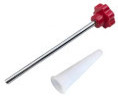
Having sorted valve stem extraction, now let's look at valve stem insertion. Throughout the process, tyre fitting paste is continuingly applied and reapplied to all surfaces that are subject to friction. The paste is superior to washing up liquid for this application. Oil is finer and might work even better. But, oil should not be used for rubber.
The job is aided by this tool. But, the tool is incompatible with my wheel: the thick and robust guide/compression tube is too fat for the recessed space available.
An adaptor is 3D printed using petg. A 2mm thick wall with random seam positions is strong enough to resist the expansion of the compressed valve stem rubber. To smooth the adaptor interior from print artefacts, a large drill bit is used. The sharp spiral edge of the drill bit acts like a circular knife. Cut using a sawing motion.
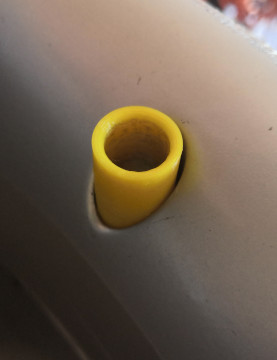
The first step is to compress the valve stem to produce a rubber protrusion. The protrusion acts as an alignment guide for the target hole.
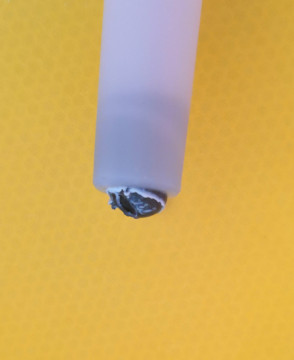
The valve stem is transferred to the adaptor by giving it an almighty push until it can go no further.
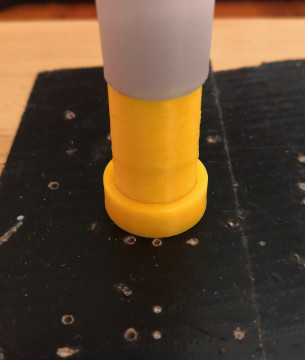
Transfer complete.
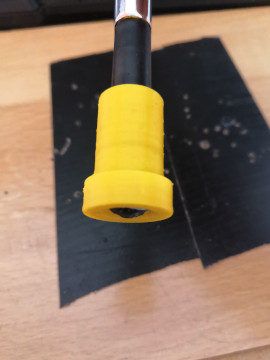
The detachable base of the adaptor is removed to reveal a protrusion. The base helps to obtain a 4mm protrusion that is still tapered.
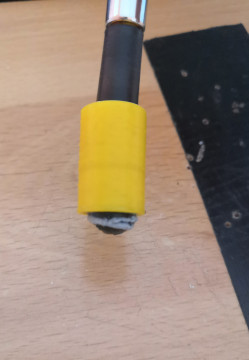
Now ready to install.
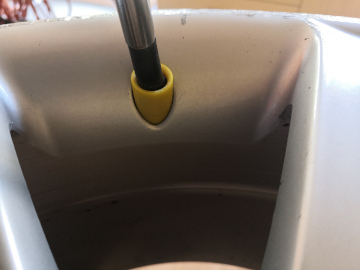
Installation completed with mallet. No need to go crazy with it, just hammer, check, hammer, check to ensure there is advancing movement. Excessive force could result in the puller steel crashing onto the edge of the valve stem hole damaging it.
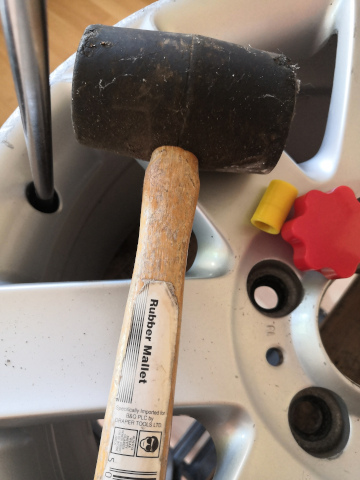
The job is aided by this tool. But, the tool is incompatible with my wheel: the thick and robust guide/compression tube is too fat for the recessed space available.
An adaptor is 3D printed using petg. A 2mm thick wall with random seam positions is strong enough to resist the expansion of the compressed valve stem rubber. To smooth the adaptor interior from print artefacts, a large drill bit is used. The sharp spiral edge of the drill bit acts like a circular knife. Cut using a sawing motion.
The first step is to compress the valve stem to produce a rubber protrusion. The protrusion acts as an alignment guide for the target hole.
The valve stem is transferred to the adaptor by giving it an almighty push until it can go no further.
Transfer complete.
The detachable base of the adaptor is removed to reveal a protrusion. The base helps to obtain a 4mm protrusion that is still tapered.
Now ready to install.
Installation completed with mallet. No need to go crazy with it, just hammer, check, hammer, check to ensure there is advancing movement. Excessive force could result in the puller steel crashing onto the edge of the valve stem hole damaging it.
Last edited:
 That’s the wrong valve for an alloy wheel. Tgat valve is for a steel wheel.
Difficult to explain it to you. You are stuck in the 50's or something.
OK, my original idea was better: that of using paint. The bead sealant has a very short working time and difficult to work with. By the time I finished waiting for the dribble to stop from the brush, it is already half cured. I managed to get a very rough coat on the bead seat along with lumps and brush hairs. But, I think it will probably work given the added material. If undisturbed, the sealant probably makes a good seal against moisture. At least for this bead seat, it shouldn't corrode further. For the bead seat on the outer face of the wheel, I will leave it untouched. There are only a few spots of corrosion on that which don't interfere with the tyre bead in a major way.
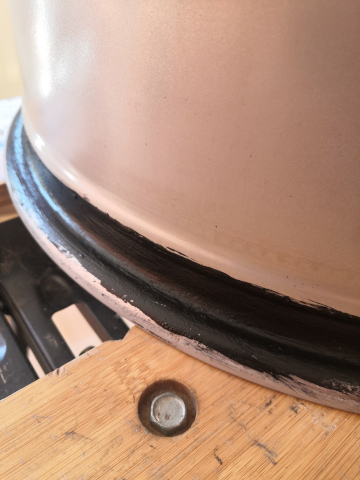
OK, my original idea was better: that of using paint. The bead sealant has a very short working time and difficult to work with. By the time I finished waiting for the dribble to stop from the brush, it is already half cured. I managed to get a very rough coat on the bead seat along with lumps and brush hairs. But, I think it will probably work given the added material. If undisturbed, the sealant probably makes a good seal against moisture. At least for this bead seat, it shouldn't corrode further. For the bead seat on the outer face of the wheel, I will leave it untouched. There are only a few spots of corrosion on that which don't interfere with the tyre bead in a major way.
View attachment 417767
What did you use to apply it?
The back of your neck?
If the back of you neck can do that, may be I can hire you for the job?
I have a new cunning plan. I think spot painting using the sealant will be possible. It's compressible enough that a high spot produced by painting won't matter. The reason for painting the whole bead seat was an attempt to make everything on the same level. This will not be achievable.
Anyway, I have moved on. I got the tyre back on for one side easy peasy. Now completely stuck on the second side. I have neither the weight nor the strength to wrestle with that. Will design some wedges to assist in keeping the bead down in the groove. It's so near yet so far. I am only one step away from inflation.
I have a new cunning plan. I think spot painting using the sealant will be possible. It's compressible enough that a high spot produced by painting won't matter. The reason for painting the whole bead seat was an attempt to make everything on the same level. This will not be achievable.
Anyway, I have moved on. I got the tyre back on for one side easy peasy. Now completely stuck on the second side. I have neither the weight nor the strength to wrestle with that. Will design some wedges to assist in keeping the bead down in the groove. It's so near yet so far. I am only one step away from inflation.
You’ve put it on the wrong place on that rim.OK, my original idea was better: that of using paint. The bead sealant has a very short working time and difficult to work with. By the time I finished waiting for the dribble to stop from the brush, it is already half cured. I managed to get a very rough coat on the bead seat along with lumps and brush hairs. But, I think it will probably work given the added material. If undisturbed, the sealant probably makes a good seal against moisture. At least for this bead seat, it shouldn't corrode further. For the bead seat on the outer face of the wheel, I will leave it untouched. There are only a few spots of corrosion on that which don't interfere with the tyre bead in a major way.
View attachment 417767
It's exactly where I want it. Let me give you a test. What do you predict is the consequence if it's in the "wrong" place?You’ve put it on the wrong place on that rim.
Last edited:
Carry on then. <snigger>It's exactly where I want it.
You? Give me a test?Let's me give you a test.
Yes. Will you pass or fail? Show me what you can do.You? Give me a test?
Nope. You won’t listen anyway so just carry on with your leaning journey but make sure you let us all know what you’ve done, I’ll just tell you when you've done it wrong and you can find out why for yourself.Yes. Will you pass or fail? Show me what you can do.
All you are saying is that you have no ability whatsoever.Nope. You won’t listen anyway so just carry on with your leaning journey but make sure you let us all know what you’ve done, I’ll just tell you when you've done it wrong and you can find out why for yourself.
No, I’m saying you have no ability. I know what I’m doing, you obviously don’t. How much have you laid out so far for a fix that you could have got for free?All you are saying is that you have no ability whatsoever.
Similar threads


- Replies
- 29
- Views
- 4K
- Replies
- 0
- Views
- 843
- Replies
- 1
- Views
- 954
