Energy Saving Lights, Flickering When Turned Off

Joined
7 Oct 2007
Messages
1,042
Reaction score
15
Location
Yorkshire
Country
United Kingdom
Evening All,

Thought I was going mad when I first noticed this but last night I noticed that the energy saving bulb in the hallway was faintly lighting up every now and then for a split second.

I then noticed that it was happening in the spare room.

Both lights had only been switched off for about 10 mins beforehand.

Does anyone know what may be causing this? Are there any basic tests I can do to try and diagnose the problem?

Many Thanks
 
it usually happens on 2-way switched lighting circuits. It is caused by a very slight coupling between the wires, a compact fluorescent accumulates the leakage until there is enough for a momentary flicker.

If the earth wire is properly connected at both ends, it can reduce the transfer, so have a look behind the switch and see if there is an earth wire connected (pre 1970-'ish lighting circuits may not be earthed)

some brands of light seem more prone to the flickering. Try a bulb-shaped Philips one and see if that helps.

One way of stopping it (if you have several lampholders on the same circuit) is to put a low-power filament bulb in one of the lampholders, it discharges any slight voltage. There are other things you can do but they are more trouble.
 
ESBs are a waste of money, and rarely save money, the light they give is inferior to incandescent bulbs, and if they are mostly used in the winter when the heating is on, then the power saving is a figment of faulty calculations.
 
it usually happens on 2-way switched lighting circuits. It is caused by a very slight coupling between the wires, a compact fluorescent accumulates the leakage until there is enough for a momentary flicker.

If the earth wire is properly connected at both ends, it can reduce the transfer, so have a look behind the switch and see if there is an earth wire connected (pre 1970-'ish lighting circuits may not be earthed)

some brands of light seem more prone to the flickering. Try a bulb-shaped Philips one and see if that helps.

One way of stopping it (if you have several lampholders on the same circuit) is to put a low-power filament bulb in one of the lampholders, it discharges any slight voltage. There are other things you can do but they are more trouble.

Thanks JohnD

Ever wish you didnt notice something?

Just checked at the switch for earth, earth has been cut back :roll:

This is a 1 way light switch by the way.
 
ESBs are a waste of money, and rarely save money, the light they give is inferior to incandescent bulbs, and if they are mostly used in the winter when the heating is on, then the power saving is a figment of faulty calculations.

Why does the heating being on make a difference? Or is it just that the 'savings' are actually due to the heating not having been used as much in coincidence?
 
Great, talk about can of worms, will definitely be seeking the advice of an electrician (getting quote for a lighting rewire!)

From a quick inspection of all light switches roses and fittings I have found.

Earths connected in most roses :)
Earths connected in SOME switches :?
Metal Switches with no earths :cry:
No actual path to earth on any of the above. :shock:

All light fittings the have metal are double insulated, so thats something.

Will get the metal lighswitches off tommorrow and try and replace with plastic, hopefully with screwcaps if you can get them?
 
what is your consumer unit like?

how old is the wiring?

I have very rarely seen plastic screwcaps in the UK.

Do you know anyone in Oz?
 
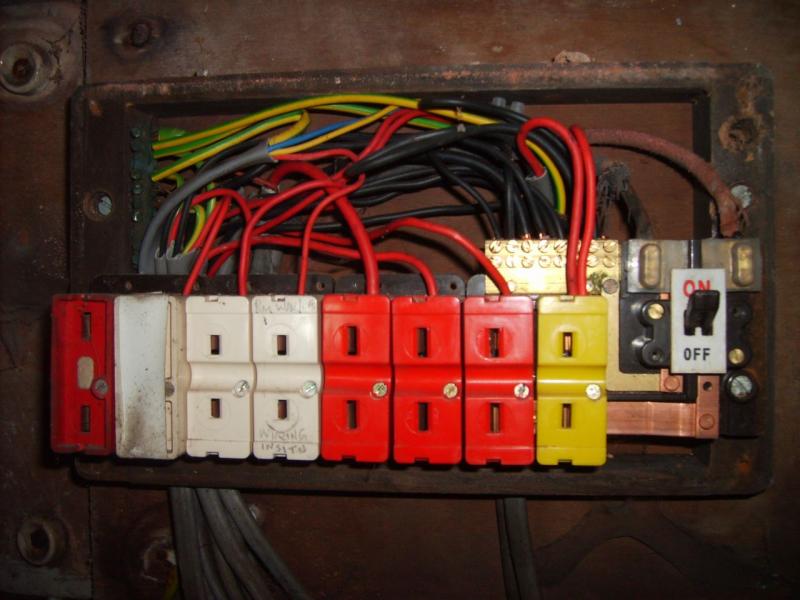
CU is an old wylex in the cellar, with the pop out button type breakers.

I've not dared have a look inside it yet as I dont have anything decent temp light wise.

I'm not sure how old the wiring is, most of it is twin and earth black and red.

Its been rewired since lead cable, as there is loads in the loft thats been left after a rewire.

Dont know anyone in Oz!
 
OK

What I was thinking was it might be useful to see if the earthwires of the lighting circuits are connected to the brass earth block, and also if the main earth is connected to something reliable (preferably an earthing point provided by the electricity supplier).

If not, it might be easy or not so easy to rectify it.

You say thay your lighting circuits are in T&E but some earths not connected, so it might have been done by someone who had been used to unearthed lighting circuits, say in the late 1960's or early 1970's.

Most earthing and bonding is a fairly straightforward DIY job, and is not notifiable work.

The push-button MCBs are probably 1970's or 80's so it could be worse.

Is your CU grey or cream metal, or white or brown plastic? And is it marked Wylex or MEM or some other brand?

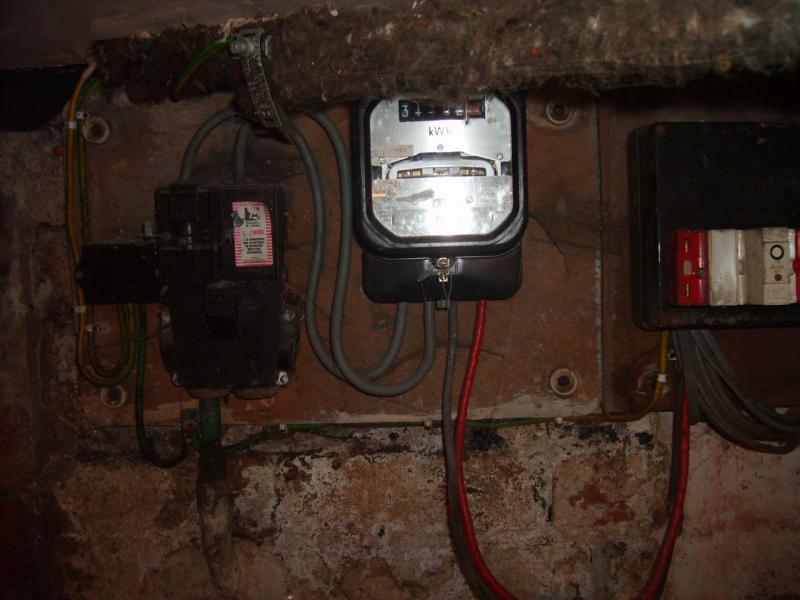
Also, have a look round the main switch, it should say "total load not to exceed NN amps" where NN may be 60 or 100 or some other number. the number gives an indication of age, and size and type of main switch. A photo of the outside, and the meter, the incoming service head, and the cables around them, especially any bare copper or green-and-yellow sheathed ones, and anything seemingly clamped onto the incoming supply cable and any gas or water pipes, will be useful.

You are right not to open the CU until you have good torch or lantern with you. If opening it, beware that old Wylex CUs (which yours most probably is) have exposed brass incoming terminals and screws at the top of the main switch when you open the cover (later ones have a translucent plastic push-on cover, or a brown plastic escutcheon to the main switch that prevents accidental contact). Apart from that, and any wrongful connections, the main switch cuts power to everything inside, but a pic would be very interesting when you can do it.

You may (not) be comforted to know that unearthed lighting circuits, and poor bonding, are very common faults in older houses.

 
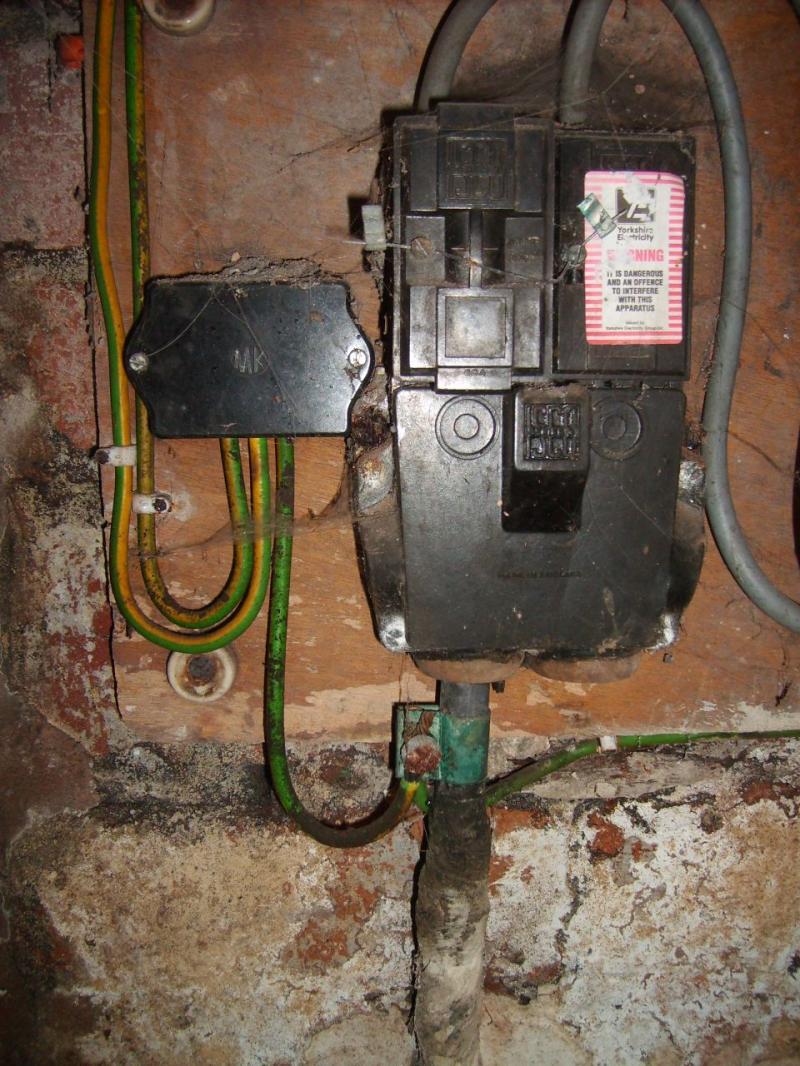
Here we go then.


Earth bond wires can be seen here.


CU With cover off


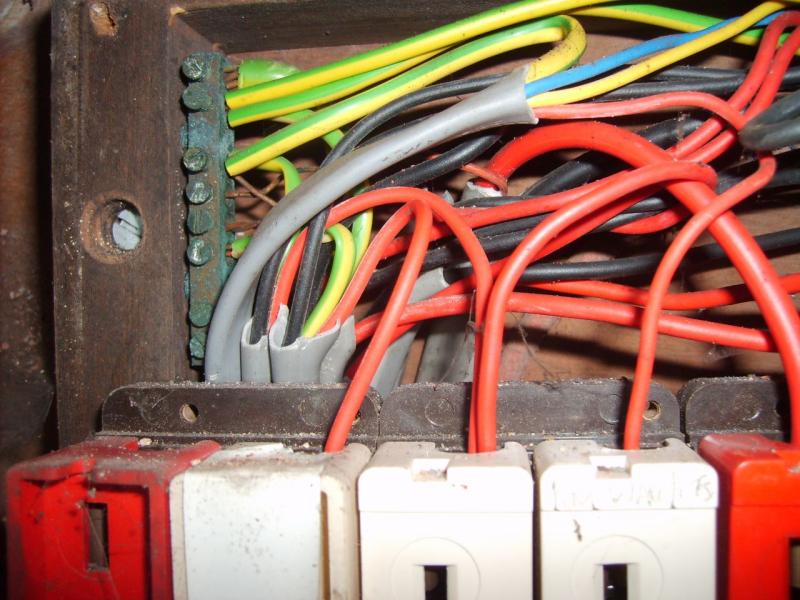
Looks like the lighting wires are definitely connected to the earth terminals. Lighting MCB is white one, third from left.
 
OK, the earth wires look OK in the CU. But you said you have earth points seemingly unconnected? With luck you will find a ceiling rose where the CPC is cut back, and you can fix it. If you are not lucky there will be a junction box hidden under the floor :x

you can get a reasonable indication of whether earth wires are connected by doing a voltage test P to E (s/b 230v ish, may be a bit less depending on quality of earth) or E to N ( should only be a few V and may vary). Once you have measured the voltage at the CU you will be able to recognise it at other points.

If you test at multiple points you should be able to work out where the break is.

Note that this is not fully reliable since there may be parallel paths, mostly through bonding of water pipes in bathrooms and kitchens.

I can't see why you have a 3-core Red/Yellow/Blue cable in there :?

Another major point:
Your meter tails to the CU are horrible. Looks like perished rubber insulation and might be brittle, think I can see a split at the top of the main switch. Avoid touching, bending or moving them. They are also undersized and might be 10mm or even 6mm. They predate the CU. I expect you are starting to think about saving up for a CU replacement as the brown Wylex is overdue for replacement. As the tails go into the meter you will not be able to change them without having the meter unsealed. You can ask you supplier if you can have the meter opened to fit new tails (use 25mm) but they may charge, or refuse unless an electrician is involved. You could have a 100A isolator fitted at the same time, I like them but opinions differ.

I can't make out the earthing at the service head. Lighting is poor. I think you have a clamp round the incoming cable sheath and there is an earthing block, I can't see if it attached to the service head, or just fixed to the board close to it. Main earth should be 16mm and main bonds s/be 10mm. I expect yours will be undersized.

off topic, you might like to pull off that felt pipe insulation and fix stiff foam like Climaflex, it is more effective and does not generate dust.
 
Thanks again for all the useful info.

Here is a better view of the earthing situation.


You are correct about the tails, they are a mess.


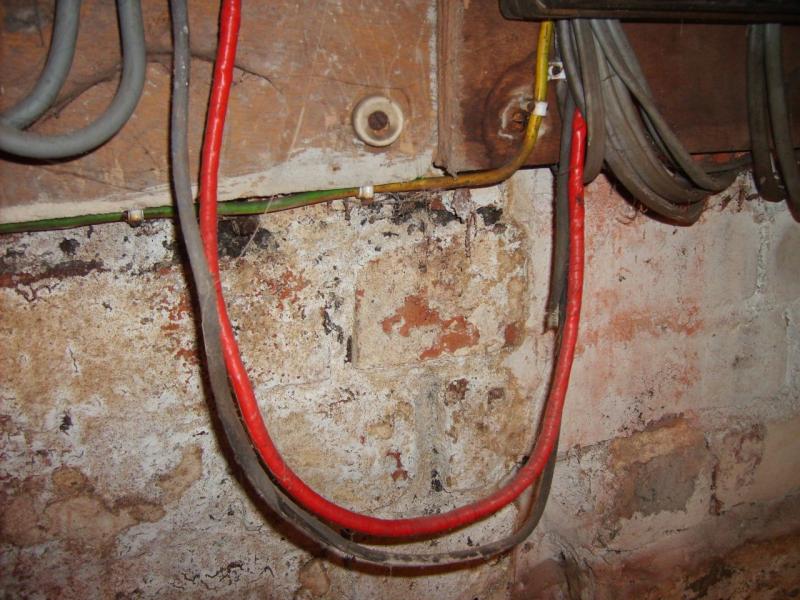
The red is just insulation tape.

I should have said before, I have an earth loop impedence / psc meter here. I've used it to test all the sockets with good results so I know the socket earth are fine.

-UPDATE-

I've just found myself an earth, the kitchen ceiling rose which for some reason I forgot to test yesterday does have an ok earth 0.99 with a 208A PSC

I presume that this is one of the first lights in the circuit as its the closest, apart from the cellar strip light which i cannot find a JB for.

I suppose more testing is required but it doesnt look as bad as I first thought, the worst part would be taking up the floting floor we put down in the main bedroom 3 months ago.

Where CPC's have been cut back at the sockets, is it acceptable practice to extend them with crimp connectors where possible? I could get away with this on a few of the switches.
 
yes, crimping is a good permanent solution, but you must use ratchet crimpers, not the ones sold in Halfords.

You can also use a soldered joint.
 

If you need to find a tradesperson to get your job done, please try our local search below, or if you are doing it yourself you can find suppliers local to you.

Select the supplier or trade you require, enter your location to begin your search.


Are you a trade or supplier? You can create your listing free at DIYnot Local

 
Back
Top