EV charge point 60A-100A or not?

Joined
29 Jan 2011
Messages
360
Reaction score
53
Location
Yorkshire
Country
United Kingdom
One of our neighbours/friends is looking to get an EV charge point installed and was asking me what might be needed, and I have to confess it's not a subject I've ever looked at. But what was obvious on both our house and theirs is the supply fuse is 60A, and when I look at articles regarding EV points, it often suggests taking that up to 100A which seems fairly beefy - and a potential bill from the DNO (Northern Powergrid in our case).

I don't know anything about the peak/ave load figures for their property at this point in time, but I have had a quick look around and both bathroom showers are mixers off a combi, so there is just an electric oven (hob is gas), washing machine and a tumble dryer as significant loads. So I'm kinda thinking that the EV charger is the equivalent of just adding an electric shower, and that doesn't feel excessive and maybe a 60A is still fine in this case. Obviously if there was an electric shower as well as the charger, then the need to go up from 60A is much clearer.

Does this feel about right based on the limited info I've provided?

Thanks.
 
It seems suppliers don't all read from the same song sheet, there is no reason why one should not charge an EV with a 60 amp supply, if a CT coil is used to reduce or stop the charge if the rest of the house is using too much.

However, we see some DNOs refuse to allow a charge point to be fitted because the supply is shared, in theory if you have a 60 amp fuse, you can draw 60 amps, in practice diversity is used, and the DNO does not expect every house to use the maximum at the same time, and this was true back in the last century, but the way we are using grid power, with solar panels and EV chargers has entirely changed what can be expected.

And it seems back in the 60s records were not always kept as to what has been done, so back in around 2010 my son wanted his supply moved, as building an extension, and he paid the money, and fitted a new meter cupboard ready, and then the workers arrived, and it seems he was bundled, but it was not on the records, and no way leave had been issued to allow cables to go around the side of his house to next doors.

His house was easy, supply cable would be shorter, and all in place, but next door was a problem, it would mean digging up next doors new drive. Also next door had the meters and fuses in a place where it was near impossible to get a cable to from front of house, lucky sons extension was stalled, lack of money, as it took over a year to sort out, lucky price was frozen, as it must have costed a fortune to get the new supply to next door.

But the DNO have been caught out a few too many times, so they are now more careful when giving permission etc.

The large problem is the neutral load, a supply to 150 homes back in the 60s would have very little load on the neutral, the three lines would have a large load, but this is the nature of a three phase supply. Today there are people like me, who use nothing in the day, but have a large load overnight in my case charging the solar batteries. So the load changes due to number of EVs or solar on that phase.

So today you simply don't know until you apply to the DNO. We as users have no idea how the power gets into out homes, we have a goverment saying do this and that, who have no idea what problems doing this or that will cause. Be it parking in front of a drop curb, parking on the walkway, cables on walkway, cables above the walkway, loss of PEN, and dangers as a result.

You must remember this 1791374409658.pngwhere he clearly miss read advice, but sometimes it is not so clear, and goverments make errors. We were told drive diesel not petrol then the advice reversed. So ask the DNO not a forum, I have made many mistakes, and to make a mistake, so someone buys an EV then can't charge it at home, is serious, so ask the DNO.
 
@ericmark Good points. I was just after a gut feel at this stage, as it will go for DNO check asssuming our friend takes the idea forward. Both yours and @flameport responses provided the gut feel and the point about CT clamps which I wasn't aware of, so thanks to both of you.
 
Yes, as Eric has alluded to, we all give our opinions about the why and wherefore and though we might have specific knowledge we are not infallible so asking your DNO should be your first start and take it from there we are advising you the best we can . Run the question thru (so called) AI might give you additional info and opinions too
 
If you have gas central heating it’s unlikely to be an issue. If you have storage heaters it might be
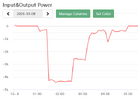
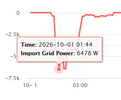
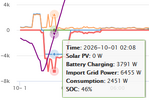
Very true, we tend to just consider our own homes, looking at my own 1791451722890.pngI already use 4.4 kW overnight at cheap rate, add 7 kW to that and looking at 50 amps, so getting close to the mark, here I peaked to 1791452013005.png6.4 kW so add 7 to that and at 58 amps, that's getting close to the mark. I call them the big three, washing machine, tumbler drier, and dishwasher, all three have a delay timer, so can set before going to bed to run when we have off-peak, summer we don't worry so much, but still we get 12p/kWh for export and pay 8.625p/kWh for off-peak import, so better exporting during the day and importing overnight. Winter we run out of battery, so can pay 32.277p/kWh using the items during the day.

The real point is what the charger can do? The same goes for what a solar inverter can do, I could not allow my supplier to control my inverter even if I wanted to, it has not got that option. The same goes for an EV charger, some you can allow the supplier to control, and as a result get an even lower tariff to my 8.625p/kWh overnight, son went with Octopus for whole package, as their charge rate is so low if you do, really unfair trading, as an independent electrician can't compete.

But this means Octopus control when your car is charged, which could result in a supply overload even if not in your own house, as it may charge your car during the day, as electricians we have no idea what the DNO infrastructure is like coming to our homes, only people who know are the DNO, and from YouTube videos it seems they have made errors, but if their error they put it right.

Personally I would follow sons example and let the billing agent do it all, i.e. Octopus. All we can do is guess.
 
Your gut feel sounds right. With gas heating and no electric shower, a 7 kW charger (about 32 A) on a 60 A fuse is often workable if the charger has a CT clamp on the meter tails, so it backs off when the house gets busy. The installer will do a maximum demand assessment. If the new maximum demand stays at or below 60 A, the supply isn't looped and the cut-out is in decent condition, they can usually connect and then notify the DNO within 28 days. Otherwise it's an application first.
One Northern Powergrid point: since July 2023 they fit 80 A fuses on domestic supplies and won't fit 100 A ones. They say an 80 A fuse handles normal domestic loads up to 100 A for short periods. So 'go to 100 A' isn't on offer there, and load management is usually the better route. Worth checking early whether the house shares a looped service with next door, because that changes the route.
Alan P.
 
One of our neighbours/friends is looking to get an EV charge point installed and was asking me what might be needed, and I have to confess it's not a subject I've ever looked at. But what was obvious on both our house and theirs is the supply fuse is 60A, and when I look at articles regarding EV points, it often suggests taking that up to 100A which seems fairly beefy - and a potential bill from the DNO (Northern Powergrid in our case).

I don't know anything about the peak/ave load figures for their property at this point in time, but I have had a quick look around and both bathroom showers are mixers off a combi, so there is just an electric oven (hob is gas), washing machine and a tumble dryer as significant loads. So I'm kinda thinking that the EV charger is the equivalent of just adding an electric shower, and that doesn't feel excessive and maybe a 60A is still fine in this case. Obviously if there was an electric shower as well as the charger, then the need to go up from 60A is much clearer.

Does this feel about right based on the limited info I've provided?

Thanks. online games
I think your reasoning makes sense. With gas cooking and mixer showers, the overall electrical demand may be manageable on a 60A supply, especially if the EV charger has load balancing to reduce its output when other appliances are running. It seems worth getting an electrician to assess the actual load before assuming an upgrade to 100A is necessary. Smart charging could save the cost and hassle of a supply upgrade.
 
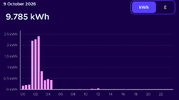
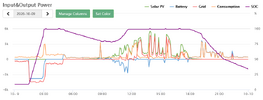
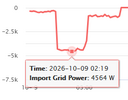
1791802789409.pngThis from the smart meter, or this 1791802880282.png from the solar software will give you a far better idea of electric use to what any electrician can tell you, unless he puts in a data logger, which is really doing the same thing.

In my case 1791803205368.png I am already using 4.5 kW during the off-peak, to charge my batteries, If the tumble drier, washing machine, and dishwasher also run at the same time, scrolling back, I can see nights where the use was higher 1791803472863.pnghere using 6.455 kW, and for 60 amps 13.8 kW is the limit. A short overload will not blow the fuse, it does take time, but as seen with my house, charging batteries takes time.

One would not want to charge an EV using standard rate, so the smart meter is really a must, so what we need to see is your smart meter readings, but as I have done, make sure the MPAN number does not show on here.
 
Please permit me to make some comments on "Home" EV charging,
particularly concerning different information from different sources.

To this "end" I posed the questions (to Google)
"Level 1 EV Charging Australia"
and
"Level 1 EV Charging UK"

Answer 1.
How Level 1 Charging Works in Australia
  • Power Output: Supplies up to 2.4 kW of AC electricity using a standard 230V–240V single-phase outlet.
  • Charging Speed: Adds roughly 10–20 km of range per hour, meaning a 10-to-12 hour overnight charge recovers around 100–150 km.
  • Installation: No special installation or electrical work is required because it uses existing household wall sockets.
  • Also Known As: Commonly called a "trickle charger" or "granny charger". Many electric vehicles come with a portable Level 1 cable included in the boot.

Practicality and Use Cases
  • Daily Commuting: Energy.gov.au notes that the average Australian driver travels about 33 km a day, which can easily be replenished overnight using Level 1 charging.
  • Apartments & Strata: As outlined by Solar Choice, Level 1 charging is a low-cost, low-infrastructure solution for apartment parking bays without heavy-duty Level 2 wiring.
  • Limitations: It is too slow for heavy long-distance travel, frequent high-mileage driving over 100 km daily, or quickly recharging a fully depleted large EV battery over a short weekend turnaround.
Answer 2.
Key Specifications & Performance
  • Power Output: 2.3 kW – 3 kW (AC)
  • Charging Speed: Adds about 3 to 5 miles (5 to 8 km) of range per hour.
  • Full Charge Time: Up to 24 hours depending on the size of the electric vehicle's battery.
  • Connector Type: Typically uses a standard UK 3-pin plug on one end and a Type 2 (Mennekes) connector on the vehicle side (standard across modern UK/European EVs).
The most significand difference between these two "answers" seems to be that, in Australia,
  • Supplies up to 2.4 kW of AC electricity using a standard 230V–240V single-phase outlet.
  • Adds roughly 10–20 km of range per hour, meaning a 10-to-12 hour overnight charge recovers around 100–150 km.
While, in UK
  • Power Output: 2.3 kW – 3 kW (AC)
  • Charging Speed: Adds about 3 to 5 miles (5 to 8 km) of range per hour.
  • meaning a 10 - 12 hour overnight charge recovers around 50 - 96 km (in the UK)
(Even so, do many people drive more than 50 km/day in the UK?)

Hence, for (about) the same rate of charge, the distances achieved are quoted as being double in Australia than in the UK.
Now, I doubt that the EVs available an Australia are twice as efficient as those available in the UK ?!?!?

Level 1 Charging works from a "Standard" Socket outlet.
Level 2 Charging requires the installation of a "Dedicated" higher capacity "supply".

If you check the answers to these questions for the two countries,
both answers specify about 7 kW (32 A)
which, in the UK case, gives at least 25 Miles (40 km) per hour of charging.


My point in all of this discussion is that very few people are likely to need much more than "Level 1" EV charging, on a regular basis.
Even fewer would need more than "Level 2" EV charging.

Hence, 60 A charging capacity is likely to be complete "overkill".
 
I've mentioned my CU upgrade and EICR report in several older posts. When I arranged for the earthing connection and main fuse to be looked at by the DNO (electrician's recommendation as it was leaking badly) I requested a fuse upgrade from 60A to 100A as I was considering an EV. I was told that they would need to do a survey first. A guy came along with a very complicated plan of the whole street and finally agreed that I could have 100A as he recommended that the whole cutout be replaced. He said that his decision was based partly on the number of 100A fuses already in the road and probable future demand.
 
I have two towns I can do shopping in, Welshpool and Newtown, 8 miles and 12 miles, but route to Newtown is over the hills, and so uses a lot more fuel specially in a heavy car, I know electric has regenerative braking, but also corners etc, so it is far cheaper and faster to go to Welshpool.

The films of Australia so long flat straight roads, so I can see how miles per kW will change Australia to UK for all vehicles, not just electric.

But the main problem here, is the PME (TN-C-S) supply, which is safe enough inside the equal potential zone of the house, but not so safe once we leave the zone, so charging a car on the drive presents a danger unless so detection device is used to disconnect the earth with a loss of PEN, we have had devices to disconnect the lives (line and neutral) but in the main, we never disconnect the earth.

So the ESQCR has for years required that vehicles made of a conducting material caravans, and boats, are not allowed a TN-C-S supply, this has been with BS7671 extended to all similar buildings, like portocabines where they have metal which can be touched while outside the zone.

EVs seem to be the odd one out, in the main we must ensure we can't touch more than 50 volts AC, for some inexplicable reason this has been set at 75 volts for vehicles, the problem is voltage can be between 210 to 254 volts so with a single phase supply, it is hard to make a EV charging point disconnect with under or over voltage without it also disconnecting when there is no fault. Methods have been tried, but the easy way remains using an earth rod.

But then we have the problem with street furniture, what every earthing system is used, it needs to be the same between two items which can be touched together. So the installer needs to assess the risk, an OpenReach box on the pavement near to where the car is charged, can alter what is required, and getting OpenReach, the council, or anyone else to declare what earthing system they are using, is not going to be easy. So only option is to have the earth disconnect if a loss of PEN is detected, and any charger plugged into a 13 amp socket, is going to struggle to get any loss of PEN detection system to work without having an earth reference.

But if your home is TT, then there is no problem, so can't ban granny chargers, as with some homes there is no problem, and the chance that on the odd time you visit granny, we also have a loss of PEN, is very low, so as a granny charger when visiting someone they are OK, but not for daily use, as the risk becomes too high.

However in the garage, you are in a zone, so granny charger is OK when parked in the garage, as to batteries bursting into flames, that's another problem.
 
I have two towns I can do shopping in, Welshpool and Newtown, 8 miles and 12 miles, but route to Newtown is over the hills, and so uses a lot more fuel specially in a heavy car, I know electric has regenerative braking, but also corners etc, so it is far cheaper and faster to go to Welshpool.

Hardly a surprise, as Welshpool is closer and by implication the route is less hilly, so your observation applies equally to ICEVs. And to the amount of puff consumed if pedalling a traditional bike.


The films of Australia so long flat straight roads, so I can see how miles per kW will change Australia to UK for all vehicles, not just electric.

Eh?

I assume you meant miles per kWh, but even so, eh?

mpKwh... mpg... identical concept, different units. Multiply mpg by 44 for petrol or 49 for diesel to convert to miles per kWh.
 

If you need to find a tradesperson to get your job done, please try our local search below, or if you are doing it yourself you can find suppliers local to you.

Select the supplier or trade you require, enter your location to begin your search.


Are you a trade or supplier? You can create your listing free at DIYnot Local

 
Back
Top