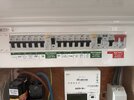
EV Charger - enough room

Joined
3 Mar 2013
Messages
3
Reaction score
0
Location
London
Country
United Kingdom
I’m looking to have an EV charger installed at my property. The charger would be located directly on the other side of the wall from the consumer unit, so cable runs should be minimal.


We had a new consumer unit installed around a year ago, and I'm wondering whether it's possible to connect the charger to this existing unit, or if a larger unit would be required to accommodate the installation?


Thanks in advance
 

Attachments

  • IMG_2476.jpeg
    IMG_2476.jpeg
    219.7 KB · Views: 72
I’m looking to have an EV charger installed at my property. The charger would be located directly on the other side of the wall from the consumer unit, so cable runs should be minimal.


We had a new consumer unit installed around a year ago, and I'm wondering whether it's possible to connect the charger to this existing unit, or if a larger unit would be required to accommodate the installation?


Thanks in advance
There would need to be a double pole switching dedicated RCD. To this end an RCBO which also breaks the neutral (which BG do indeed manufacture) would need to be fitted adjacent to the circuit breaker for the surge arrester and main switch (assuming that there are spare unprotected neutral terminals in the DB), which would also require the rest of the devices to be moved across. It would also need replacement busbar to increase the length, so possibly doable. Dual RCCB wasn't a good decision by the installer.
 
We had a new consumer unit installed around a year ago,
Unfortunately whoever installed that provided the worst option possible from one of the cheapest manufacturers. Zero possibility of adding anything to that and it's questionable whether it even complies as it is.


whether it's possible to connect the charger to this existing unit,
No.
 
Your photo shows everything except how many spare spaces there are at the left hand end. Are there just the two we can partially see?
 
Unfortunately whoever installed that provided the worst option possible from one of the cheapest manufacturers. Zero possibility of adding anything to that and it's questionable whether it even complies as it is.
Can't they just get a new busbar, slide everything along and then add a new RCBO next to the main switch?
 
My son wanted an EV charging unit, and he changed to consumer unit first, so there was room, all to no avail as the installer was instructed by his employer he must fit a dedicated consumer unit for the EV point.

If someone else was to fit the EV point, he would not get the tariff offered when all done by the supplier.

An EV charging point can have a range of protections built in, so what is required in the CU can vary, however I look at your CU and question if I would want it anyway. Two RCD's has always been a problem.
Every installation shall be divided into circuits, as necessary, to:
(iii) take account of danger that may arise from the failure of a single circuit, such as a lighting circuit
(iv) reduce the possibility of unwanted tripping of RCDs due to excessive protective conductor currents produced by equipment in normal operation
This is from the 2008 edition so it has been required for some time, having all the lights on one RCD and all sockets on the other, does stop the lights tripping due to a fault on the sockets, but the whole idea of splitting into circuits is so one fault does not take out all, and it is far more likely that the RCD will trip to the MCB tripping, so I would be considering if that CU is really a good idea to start with?

I also have a cheap consumer unit, in my case fusebox, and the RCBO's fitted are in the main type AC, I have changed one to a type A bidirectional, but at £20 each and 14 of them it is an expensive exercise to replace them all. Whole unit 1756511490551.pngwhich is cheaper to buying the RCBO's.

 
Can't they just get a new busbar, slide everything along and then add a new RCBO next to the main switch?
Perhaps, and that might also require a new neutral bar, and there may not be enough space inside for that, and it all depends on what's been done there already.

Even if it was possible, it's still leaves most of the loads on a single RCD including the 'shed' which presumably is outside.

The entire thing is one of those pre populated affairs sold by the likes of Screwfix and someone has just shoved existing circuits onto the devices supplied with little consideration as to whether they were appropriate.
Hence nonsense such as the 50A circuit for the cooker, a boiler on 32A, smoke detectors on 16A and the pointless 'spare' MCB which should have been a blank.
Plus the existing blanks at the left side are the useless clip in types rather than the proper full size ones.

It would certainly be interesting to see what cable sizes have been used for the cooker, boiler and smoke detector circuits.
 
Well spotted @flameport I had not looked at the size of the MCB's.

What the problem is now, which to do first? As I said, my son changed CU before the EV installer arrived, with the whole idea all could be supplied from the new CU as correct RCBO fitted etc.

But Octopus, it seems, tell their installers exactly what they can do, and they are forced to fit a dedicated CU what ever is already fitted.

So, as to which is done first, not sure. I will guess you have no installation certificate for that CU, and no compliance or completion certificate, no electrician would want that workmanship to be registered as being done by him.

It depends on who is installing the EV outlet. As to which is done first, or if done as one job.
 
Can't they just get a new busbar, slide everything along and then add a new RCBO next to the main switch?
No obvious reason why not.
It is down to what the manufacturer permits. A consumer unit is a type tested device, if something is done which was not included in the type testing, then it is no longer a consumer unit, it is just a distribution unit.

I simply do not know what says we should use type tested units where ordinary people are in control. Maybe you do?

However, as @flameport has pointed out, there is a bit more involved here. I, for one, would not be happy doing any work in that consumer unit, I would not want my name to show as the last person to have worked on it.

So all the discussion about what can be done, is rather pointless, it is down to the electrician doing the work, and you can see why Octopus want their electricians to use dedicated consumer units, and simply not touch the existing.
 

If you need to find a tradesperson to get your job done, please try our local search below, or if you are doing it yourself you can find suppliers local to you.

Select the supplier or trade you require, enter your location to begin your search.


Are you a trade or supplier? You can create your listing free at DIYnot Local

 
Back
Top