
Fixing brass light, but no visible earth wire in the original installation

Joined
9 Oct 2024
Messages
7
Reaction score
0
Country
United Kingdom
Morning all!

I’m trying to instal a new light in our entry corridor. It’s made of a bass base. When I remove the previous plastic light, I can’t find any earth wire… I’m wondering how safe would be the new brass light without any earth wire connected? Would it also be out of current regulations? Please any advice on how to make it safe?
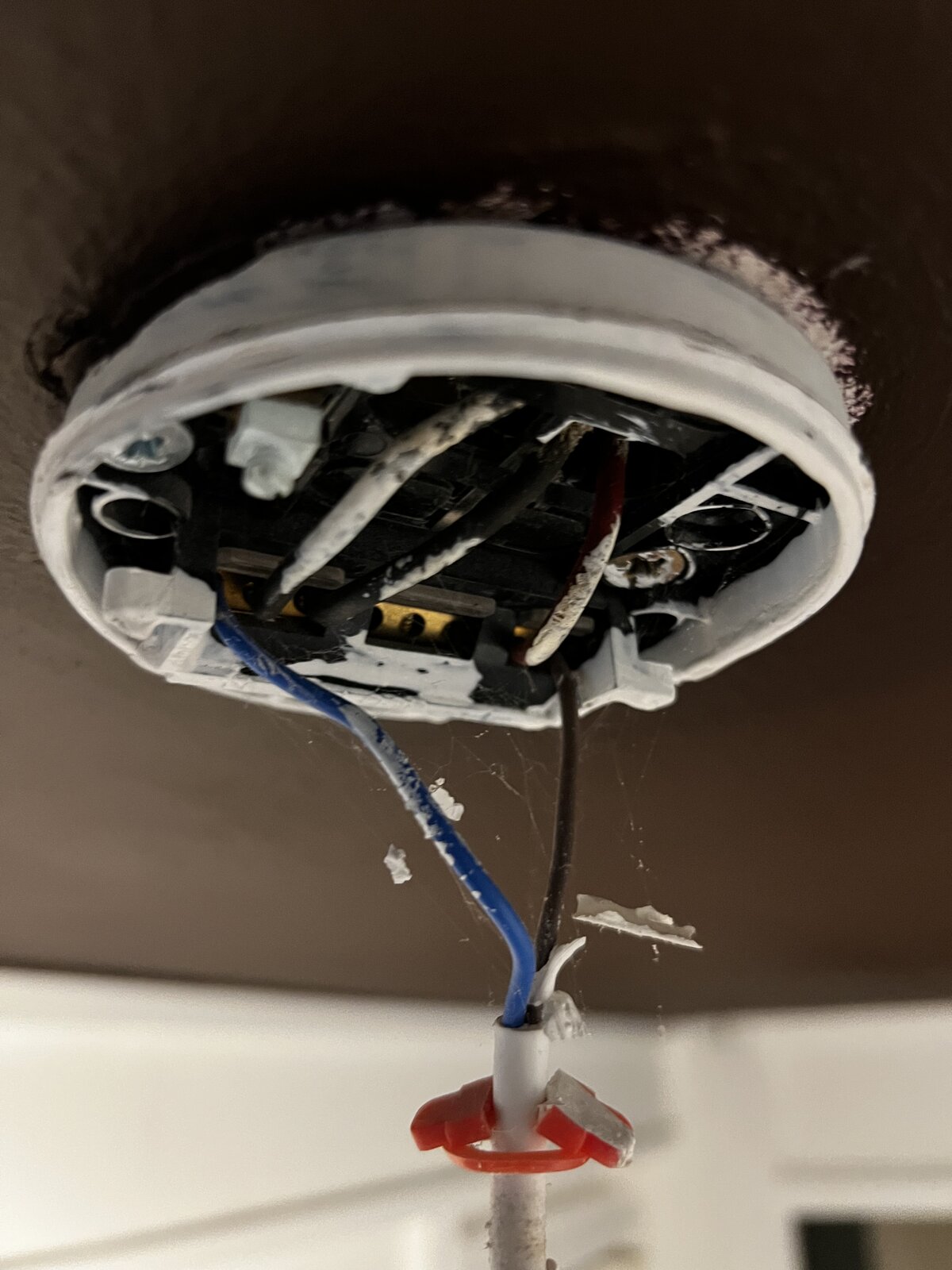
IMG_6813.jpeg
4772A593-BE11-4FE3-837D-823911774AD1.jpeg
 
The light MUST be earthed. There is no earth visible on that ceiling rose so, at first glance, you cannot fit that light.
Outline possibility is to remove the ceiling rose and see if there is a CONNECTED earth in the cables feeding the rose. In that case, you'll need to bring the earth to the light.
If there's no earth at all then you'll need to return the light and get a Double Insulated or plastic light fitting.
 
is there a bare earth wire in the silver terminal on the left ?

is there a round conduit box behind it?
 
Thank you very much both for your help. Sorry I was working till late this week and didn’t get a chance to look behind until this morning and I found an earth cable behind!. However it looks like there are 3 cables connected to the same connector (2 dark green and one green and
IMG_6837.jpeg
yellow). I noticed there are also 2 neutral wires. Do you advise me to connect everything together with 3 different wago? Would it be safe?
 
First job is to mark the black wire that connects to the brown on the existing light. That is the switched live, and you are in for a weekend of pain if you get the blacks mixed up!

Then disconnect the ceiling rose and bring all of the cable through the ceiling into the room. You may be able to connect to the terminal block on the new light without having to resort to an additional connector.
 
First job is to mark the black wire that connects to the brown on the existing light. That is the switched live, and you are in for a weekend of pain if you get the blacks mixed up!
There is a red wire connected to the Brown wire . The 2 blacks are connected to the blue neutral.
None of the black wires are switched live.
 
Outline possibility is to remove the ceiling rose and see if there is a CONNECTED earth in the cables feeding the rose.
This is the problem, as an electrician we clip on our loop impedance tester and press the button, and we know if the green/yellow wires are connected to earth. As a DIY person, you can measure the voltage line to earth, which should be around 230 volts, but it is a bit hit-and-miss as to if connected or not.

In days gone by, to change a bulb with power on could result in burnt fingers, but today with LED it is so easy to replace bulbs with lights on, and no gloves, danger is increased.

Pre-1966, filament bulbs did not need earths running to them, today the pendent can be without an earth, but the ceiling rose, and any parts fixed need an earth terminated to it, even if the pendent is not earthed. With a socket, it is so easy. Plug in one of these
1737796090411.png
press the buttons, and one knows reasonably safe. (OK, only really designed for circuits up to 20 amp, so not 100% with British ring final, but near enough for most people) but there is no simple plug in tester for lights.

So you need to ensure power off before changing bulbs, until the next 10 years (5 year in rental property) EICR is done.
 
Is this a flat or council premises, if so it may be a metal box cast into the ceiling structure, the cables would be in metal conduit, if so don't pull them.
There's likely one red switch live and two black Neutrals and NO permanent live.
The solid green is the earth
 
Is this a flat or council premises, if so it may be a metal box cast into the ceiling structure, the cables would be in metal conduit, if so don't pull them.
There's likely one red switch live and two black Neutrals and NO permanent live.
The solid green is the earth
It’s a council house and yes there is one red switch and two black neutrals. How do you advise me to connect them to the light? I was thinking to use 3 wago. The two black neutrals with the black from the light, the red with the blue, and the earth wires from behind with the earth wire from the light.
 
Not sure where your seing them colours.
The light in your pic has

Brown switch live connection
Blue neutral
Green/ yellow earth

Your house has It appears
One Red switch live
Two Black neutrals
And some green or g/y earthwires
 
This is the problem, as an electrician we clip on our loop impedance tester and press the button, and we know if the green/yellow wires are connected to earth. As a DIY person, you can measure the voltage line to earth, which should be around 230 volts, but it is a bit hit-and-miss as to if connected or not.

In days gone by, to change a bulb with power on could result in burnt fingers, but today with LED it is so easy to replace bulbs with lights on, and no gloves, danger is increased.

Pre-1966, filament bulbs did not need earths running to them, today the pendent can be without an earth, but the ceiling rose, and any parts fixed need an earth terminated to it, even if the pendent is not earthed. With a socket, it is so easy. Plug in one of these View attachment 370600press the buttons, and one knows reasonably safe. (OK, only really designed for circuits up to 20 amp, so not 100% with British ring final, but near enough for most people) but there is no simple plug in tester for lights.

So you need to ensure power off before changing bulbs, until the next 10 years (5 year in rental property) EICR is done.
Although the job has been done already, could this be tested with the above tester if it is temporarily wired to a wall socket? Easy enough to do.
 
Although the job has been done already, could this be tested with the above tester if it is temporarily wired to a wall socket? Easy enough to do.
How, why? The OP probably doesnt have one of those "above testers"
Better to get a multimeter and check continuity from a known earth to the light's Exposed Conductive Parts
 

If you need to find a tradesperson to get your job done, please try our local search below, or if you are doing it yourself you can find suppliers local to you.

Select the supplier or trade you require, enter your location to begin your search.


Are you a trade or supplier? You can create your listing free at DIYnot Local

 
Back
Top