
You are using an out of date browser. It may not display this or other websites correctly.
You should upgrade or use an alternative browser.
You should upgrade or use an alternative browser.
Fixing TT earthing problems and gas bonding for an EV charger
- Thread starter StuB
- Start date

These companies cannot make up their own wiring regulations.
Bonding conductors shall not be looped between services unless installed as a single continuous conductor.
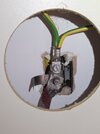
Here's a better photo of the gas bonding I've found.
Hopefully that's acceptable for Octopus.
Well apparently not....
(This is something that interests me because I also have incoming gas and water that are near each other but remote from the CU. Do we know where this "continuous conductor" idea comes from?)
You can always connect the gas with the continuous conductor and loop to the water.
People have been talking about that alleged requirement for as long as I can remember, but I don't know where it came from.(This is something that interests me because I also have incoming gas and water that are near each other but remote from the CU. Do we know where this "continuous conductor" idea comes from?)
I thought that it had probably been made up by some old version of the OSG, but I can't find it in either my 17th ed. copy nor the current one, and it's certainly not in BS7671 (and I don't think ever has been). Is the infamous NICEIC (in one of its guises) perhaps responsible for having invented this one?
In any event, as EFLI has pointed out, if you're really concerned you could have a 'continuous conductor' connecting two or more remote extraneous-c-ps to the MET.
You can always connect the gas with the continuous conductor and loop to the water.
People have been talking about that alleged requirement for as long as I can remember, but I don't know where it came from.
I thought that it had probably been made up by some old version of the OSG, but I can't find it in either my 17th ed. copy nor the current one, and it's certainly not in BS7671 (and I don't think ever has been). Is the infamous NICEIC (in one of its guises) perhaps responsible for having invented this one?
In any event, as EFLI has pointed out, if you're really concerned you could have a 'continuous conductor' connecting two or more remote extraneous-c-ps to the MET.
Thanks for the replies again, they're much appreciated.
Am I correct in thinking that you are both suggesting using the same wire and looping through the gas earth point to the water one using a single cable to fulfil their single continuous conductor?
If so I may have a problem doing that as in the last photo I posted the cable on the left comes from the CU and the one of the right goes to the water.
I can't tell if there are two wires going into that ring connector or just one that is looped and if I had to cut it at the ring connector to do it again the cable would be no longer be long enough to reach the water pipes or certainly not right by the stop tap anyway.
The water pipe does run in the wall near to where the gas pipe earthing currently is so it may be possible to cut a hole in the plasterboard to expose the water pipe and move the water earthing point so the single existing cable is used.
It seems a silly thing to do as it would be in a less accessible position and would be a bit of a sod to do although it would be still be within 600mm of where it enters the property.
No.Am I correct in thinking that you are both suggesting using the same wire and looping through the gas earth point to the water one using a single cable to fulfil their single continuous conductor?
If you are wrongly told that it is not allowed to bond the gas pipe with anything other than a continuous wire, then bond the gas with the continuous wire and then connect another from gas to water.
So the gas is already bonded with a continuous wire.If so I may have a problem doing that as in the last photo I posted the cable on the left comes from the CU and the one of the right goes to the water.
If you are wrongly told that it is not allowed to bond the gas pipe with anything other than a continuous wire, then bond the gas with the continuous wire and then connect another from gas to water.
But he has been told that "Bonding conductors shall not be looped between services unless installed as a single continuous conductor"; it's not specific about gas.

- Joined
- 22 Jan 2007
- Messages
- 24,555
- Reaction score
- 3,685
- Country

Yes, as Octopus have confirmed, bonding not required.Looking at the photos of our supply pipe they look to be yellow plastic so hopefully that covers it anyway
They are even wronger than I thought, then.But he has been told that "Bonding conductors shall not be looped between services unless installed as a single continuous conductor"; it's not specific about gas.
Those regulations obviously do not mention looping nor single conductor.
As I mentioned earlier, it is allowed to actually use the water pipe as a main bonding conductor.
How they think that could be achieved as a single conductor I have no idea.
These companies cannot make up their own wiring regulations.
I certainly was - and that is something that is often done (not the least because it is 'sensible').Am I correct in thinking that you are both suggesting using the same wire and looping through the gas earth point to the water one using a single cable to fulfil their single continuous conductor?
However, EFLI has interpreted (I suspect incorrectly) what has been suggested - namely that he seems to think that it is being said that the bond to the gas pipe must be 'continuous' but the bond to the water pipe does not need to be - and so has made a different suggestion. Nevertheless, if one does as you and I have suggested, then that satisfied the perceived 'requirement', no matter how it is worded/interpreted.
However, as has been said, no-one is aware of any actual regulatory requirement for anything to be 'continuous', so I really don't think you should worry whether it is continuous or not. Let's face it, even if a bonding conductor is 'continuous' from the pipe to the CU (main Earthing Terminal) then there will still be several 'joins' in the path between the path and 'anything that matters' (touchable metal parts of parts of the electrical installation.
That is correct.namely that he seems to think that it is being said that the bond to the gas pipe must be 'continuous' but the bond to the water pipe does not need to be - and so has made a different suggestion.
I can only remember the continuous myth relating to the gas as it is somehow more important - or maybe water companies know there is no such rule.
Yes but I had assumed that neither the existing gas nor water bond was long enough to do that.Nevertheless, if one does as you and I have suggested, then that satisfied the perceived 'requirement', no matter how it is worded/interpreted.
Oh, I thought the myth applied to both.That is correct. I can only remember the continuous myth relating to the gas as it is somehow more important - or maybe water companies know there is no such rule.
That may, of course, be true. I was really talking, in general, about ways in which the myth could be satisfied, rather than specifically about the OP's (or endecotp's) situation.Yes but I had assumed that neither the existing gas nor water bond was long enough to do that.

I asked Octopus to clarify what they will accept for the gas bonding and they came back with the following.
Looking at the photos of our supply pipe they look to be yellow plastic so hopefully that covers it anyway however as the surveyor reported the earthing to be good on the gas when the earths were disconnected from the consumer unit I went looking for any bonding.
Using a snake camera I've just found that it is already bonded behind a cupboard where the supply enters the house using the cable that then runs on to the water stopcock.
View attachment 406758 View attachment 406761
It looks to me like the cable(s) is crimped to a ring connector and I'm not sure whether it is two cables that have been crimped together or one that has folded back on itself.
From the discussions earlier in this thread my understanding is that both should be acceptable as a single continuous conductor but I hope they see it that way too.
The cupboard is low down and has big drawers in it so I think I'll put a hole cutter through the back of the cupboard to make the joint accessible and to be able to get a better photo. I'll take care not to damage either the cables or the gas pipe mind.
When I did my 16th our lecturer read that out to us, probably from that same document (although we were working to 16th 2004) and made his interpretation, something to the effect of:
If there is a join in a bonding conductor it should be permanent and permanent can be achieved by crimping, soldering, braizing, etc. He even mentioned two wires into one crimped lug makes it permanent and therefore continuous.
It appears to me that has been done in your case and I feel any inspector or even octopussey should have no issue with that installation.
This was certainly something which was regularly and vehemently enforced 20 years ago. However something I used to find which caused issue was an earth bar associated with a submain where services entering the area served would be bonded individually from that earth bar so very far from individual or unbroken from the MET but somehow a second inspection always seemed to override the first.
People have been talking about that alleged requirement for as long as I can remember, but I don't know where it came from.
I thought that it had probably been made up by some old version of the OSG, but I can't find it in either my 17th ed. copy nor the current one, and it's certainly not in BS7671 (and I don't think ever has been). Is the infamous NICEIC (in one of its guises) perhaps responsible for having invented this one?
In any event, as EFLI has pointed out, if you're really concerned you could have a 'continuous conductor' connecting two or more remote extraneous-c-ps to the MET.
Does this help?
From
From

EDIT I believed it appeared in later versions too.
Last edited:
Thank you all for your helpful replies once again, they're much appreciated.
Apologies if I've not been completely clear. There are only two earth cables from the CU, one goes to the earth rod outside and the other goes to the water pipe near the stop tap.
When Octopus surveyed the house they only found the water earth cable and we assumed it was a single continuous cable from the CU.
This cable crossed over the gas pipe here it enters the house so it should have been possible to loop it as suggested to the gas pipe and then on to the water pipe and leave it as a single wire.
On further inspection I've discovered that is is already doing this but I can't tell on the gas pipe whether it is two separate wires or just a looped wire in the ring connector.
If I had to cut off the ring connector to make it a single wire I don't think it would be long enough to reach the gas and the water pipe.
If the existing ring connector is accepted then I should be fine.
Yes but I had assumed that neither the existing gas nor water bond was long enough to do that.
Apologies if I've not been completely clear. There are only two earth cables from the CU, one goes to the earth rod outside and the other goes to the water pipe near the stop tap.
When Octopus surveyed the house they only found the water earth cable and we assumed it was a single continuous cable from the CU.
This cable crossed over the gas pipe here it enters the house so it should have been possible to loop it as suggested to the gas pipe and then on to the water pipe and leave it as a single wire.
On further inspection I've discovered that is is already doing this but I can't tell on the gas pipe whether it is two separate wires or just a looped wire in the ring connector.
If I had to cut off the ring connector to make it a single wire I don't think it would be long enough to reach the gas and the water pipe.
If the existing ring connector is accepted then I should be fine.

DIYnot Local
Staff member
If you need to find a tradesperson to get your job done, please try our local search below, or if you are doing it yourself you can find suppliers local to you.
Select the supplier or trade you require, enter your location to begin your search.
Please select a service and enter a location to continue...
Are you a trade or supplier? You can create your listing free at DIYnot Local
Similar threads
- Replies
- 21
- Views
- 3K


