Gravity or Pumped?

Joined
9 Oct 2025
Messages
9
Reaction score
1
Country
United Kingdom
Hi,

Looking for some advice please

I have gas central heating with a hot water cylinder and two tanks in the loft (cold water for cylinder and bathroom, another for rad expansion). I have an old boiler (maybe 20 years old) and a potterton EP2000 programmer - I have one thermostat for the CH by the programmer, and another thermostat on the cylinder for the hot water temp.

My question is whether this is a gravity fed, or gravity pumped system.

If I look at the pipework, I can see four pipes, CH out, CH return, HW out, HW return. The HW and CH out each have a red pump (where I can control the flow rate). I do not see any form of mechanical valve. When either the CH or HW program trigger, both pumps fire and start circulating water. When the hot water comes on the rads heat up, when the rads heat up the hot water also goes to the cylinder.

I am looking to replace the thermostat with a new smart one, and when I started looking at the wiring, I noticed that there is no HW off wire connected, but I do have two wires connected into CH on, so wonder if someone has wired this wrong, or whether I'm just on a really strange wiring config?

Anyway, this led me down the rabbit hole of, is this really a pumped system? As this influences the type of smart thermostat, and the way I have to configure it

Let me know if you need any photos or other info

Thanks in advance

EDIT: so it appears I am mistaken with my comment about 2 flow and returns. It’s only 1 flow and 1 return, I can see the flow split into the CH and HW circuit, and they join back up on the return - but I cannot see a valve anywhere.

A
 
Last edited:
Unless there is a non-return valve or a motorised valve, with two pumps if one only energised one with get reverse flow through the other one. I had the same problem.

There are three systems, in the main, there are some others, but we look at C Plan (DHW not pumped), Y Plan (three port valves used), and S Plan (multi 2 port valves).

With the C Plan, you can't turn DHW off. Nor can you adjust temperature independent of CH.

But multi pumps are rare, actually I have multi pumps, someone clearly thought they could select which pump ran, and so which part of the central heating gets hot, I had to have motorised valves fitted, and the wiring became rather complex. With relays etc.

Winter the boiler heats my DHW, but summer use an immersion heater, it works out cheaper in the summer to use electric mainly due to the amount of pipe work heated, plus the boiler on every fire up. So I have a smart thermostat, designed to do CH and DHW, and the DHW part is redundant.

There are very few smart thermostats which can run a C Plan, Hive has a special workaround, and the Nest and Tado you have access to the com terminal for the DHW which becomes the output. But twin pumps is a problem, so that needs working out first, or simply don't use the boiler for DHW.
 
Thanks for your reply.

I actually need to make a slight correction to my post, where I thought I had 2 flow and returns I actually only have 1 flow and 1 return, with the flow splitting into CH and HW, each with their own pump, and then they meet back up on the return - but because there is no valve, when anything calls for heat the water just goes around both circuits.

So right now, I should consider my system a c plan (gravity fed), but looks like a failed attempt at a y plan? And do I just need to get a plumber to come and chuck a mechanical valve in to make it a Y plan? Or is it way more complicated?
 
If you remove the HW pump and change to C-plan, a couple of things.
Gravity HW was (pretty historic now) piped 28 or even 35mm. If yours is 22mm it might not work too well. And as ericmark said, you will still get reverse flow through the HW cylinder when the pump runs.

How difficult it is to convert to a conventional fully-pumped system depends on the house layout. Personally, I would go for W-plan, with an either/or 3-port valve (not mid-position) and HW preference. The valve is cheaper and more reliable, and the wiring simpler. I never had any problem with it, even with young kids so lots of baths etc.
 
So this is the current pipework, in the bottom left is the feed out from the boiler where it then splits into two. Was wondering whether I could chuck a valve there, and then make sure I wire the pump to only come on when CH/HW is called? Or is a pump before the valve madatory?
image.jpg
 
I would raise a concern about the number of Valves in that system and their actual purpose. There needs to be a clear path, constantly rising, from the Boiler to the Vent pipe, looking at the pipe from the Boiler, bottom left, if that is the route, and contains a Valve, then you have the potential or a dangerous situation.

Difficult to work out what goes where out of shot, really need to see the pipework route I think to understand better what may be going where.
 
Is the photo on the first floor, with boiler on the ground floor? HW cylinder also on first floor?
Pipework is 22mm.
current pipework, in the bottom left is the feed out from the boiler where it then splits into two.
Doesn't look like that to me, but you're on site! Hard to tell what the various pipes do.

It would be a squeeze, but you might fit a 3-port directly above the current CH pump, and connect the pipework.
Usual layout is boiler - open vent - cold feed - pump. I can't tell from the pic where the vent and feed are.

Will you do it yourself?
 
boiler is on the ground floor, cylinder is one floor higher.

Pipes (from left to right);
Hot water to cylinder (left most pump)
Downstairs rads return
CH out (second pump) that splits into CH down and CH up
HW return
CH up return

All pipes with the valves on them are CH related, so if I turn them off, only hot water flows to the cylinder.

I would get a plumber in I think (depending on how much work is involved)

Thanks
A
 
I would raise a concern about the number of Valves in that system and their actual purpose. There needs to be a clear path, constantly rising, from the Boiler to the Vent pipe, looking at the pipe from the Boiler, bottom left, if that is the route, and contains a Valve, then you have the potential or a dangerous situation.

Difficult to work out what goes where out of shot, really need to see the pipework route I think to understand better what may be going where.
Thanks. I think my bottom left description was unhelpful! The boiler out is really sneakily hidden by that pipe going up. So the pipe with the valve (second from the left) is the CH downstairs return. Ill do another picture of the boiler out, but the path from the boiler to HW cylinder has no valve you can close
 
the path from the boiler to HW cylinder has no valve you can close

Is there a Vent incorporated into that run of pipework prior to the Cylinder though?

Needs to be a clear path, on a constant rise, from the Boiler to the Vent over the Feed and Expansion system. From that the pipework should Tee off and the cold feed is connected before going to the pump. Basically this is a safety requirement to allow any pressure, steam, boiling water etc to escape safely in the event of a fault condition with the Boiler.
 
Mine was a real mess, and all I could do was work out where each cable went, and re-wire. The heating engineer admitted he would not have known where to start, but for me, it was an interesting project.

I also have a relay. In the main, the motorised valve acts as a relay, but I wanted the pump and boiler independent, so needed two sets of contacts, and there is only one set in the motorised valve.

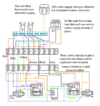
This is not the final plan, but this is how I slowly built up a plan of how it all worked 1760134414134.pngit took time, and I started in April so finished by the time the winter arrived.

So after all that work, it not really worthwhile heating DHW with the oil boiler, and my boiler heated the house and the flat independently, which was why mine was complex.

So I would have a look at how it works now, if working near enough, then leave it until the summer.
 
Is there a Vent incorporated into that run of pipework prior to the Cylinder though?

Needs to be a clear path, on a constant rise, from the Boiler to the Vent over the Feed and Expansion system. From that the pipework should Tee off and the cold feed is connected before going to the pump. Basically this is a safety requirement to allow any pressure, steam, boiling water etc to escape safely in the event of a fault condition with the Boiler.
I need to get the ladder out to head in the loft, but from what I can see from the airing cupboard (which is where the cylinder is), the main HW feed comes up from the pipes in the first picture, and it has a T with one part going into the coil mid way up the cylinder, and the other going straight up into the F&E loft (presumably vent?). At the top of the cylinder (where the hot water comes out) that had a T, one way to my bathroom, and the other way appears to also go back to the loft F&E again? I do have two separate tanks in the loft. Need to do a bit more following…. I assume I am expecting to see these pipes end up in the overhang into the f&e?
 

If you need to find a tradesperson to get your job done, please try our local search below, or if you are doing it yourself you can find suppliers local to you.

Select the supplier or trade you require, enter your location to begin your search.


Are you a trade or supplier? You can create your listing free at DIYnot Local

 
Back
Top