I have an oil boiler, rather old, with an external cylinder for DHW, so on having solar, hindsight and that's easy, I made a mistake, and had an iboost+ fitted.
I now look at the cost to change, and wonder how it will work, and if to try is throwing good money after bad? So let me expand a bit, two points, one is energy lost every time a boiler fires up, does not matter if one pint of water or 5 gallons, every time it fires, it looses energy as it heats up and cools down, so one wants a long burn, not a few short burns.
The second is heat lost in the pipework, again does not matter if one pint of water or 5 gallons, pipe work needs to heat then cool.
And the last one, is with solar and battery, when is the cheapest time to use energy? This depends on the tariff, but I pay 8.5p/kWh off-peak, and I get 12p/kWh to export, so I am better off heating water overnight, to using solar. So a simple timer would have been likely better to the iboost+.
But first consideration is pipework, these
have been considered, holds 10 litres, so it could possibly supply daily needs at the kitchen sink, and would remove all the losses. But I have 5 sinks in the house, only 3 used much, and turning hot water off to all but one sink could work, but the units take up space under the sink. I could supply them with hot water, so it only boosts the heat, as yet done nothing. Main thing is the iboost+ records how much it uses,
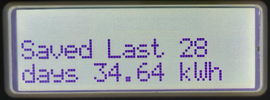
as 8.5p/kWh that's under £3 a month, (£2.94) is it really worth worring about? However the boiler, no thermostat on cylinder, so had to use time, and found if I ran boiler for ½ hour every day, I got enough hot water, in fact the boiler would cut out after 20 minutes, so going for 28 days, at 20 kW at 20 minutes per day, this is 186 kWh don't know oil cost per kWh or how efficient the boiler is, but using over 5 times the amount of energy was unexpected, and I stopped using oil to heat water in summer. In winter can't stop it, but I do no sequal a time, it just heats water when central heating it running.
Problem is I have nothing to show how much oil used. So comparing oil to electric is hard.
As to solar panels and batteries, my inverter is 5 kW, that will cover all but the shower, it is rare we use more that 5 kW, but running the washing machine and tumble drier at the same time it can happen, I did not consider inverter size against the stuff likely to be used when selecting, the 5 kW was more by luck than good judgment, the solar panels are 6 kW and I was advised unlikely to produce 6 kW very often so 5 kW inverter was enough, and that does seem to be the case. But do consider what loads you have, clearly many items at 3 kW so inverter needs to be more than that.
The battery, started with 3.2 kWh, and it was too small, max charge is 2 kW, so was seeing export when battery only half charged, and discharge 3 kW so 3 kW appliances plus back ground use, would go over the 3 kW, so doubled up, so now 4 kW charge limit and 5 kW (inverter limit) discharge limit.
The day can be split into 4/5 periods.
1) Battery charging from the grid for me 00:30 to 05:30.
2) Home running off battery, not enough solar to cover, 05:30 to around 10 am to 1 pm.
3) Battery fully charged, excess solar exported, 10 am to 5 pm varying by time of year.
4) Solar no longer covering demand running on battery.
5) Battery depleted running on peak rate grid.
We clearly want to reduce 5 to as little as possible, but batteries have a limited life, I use around 12 kWh per day, and so with 12.8 kWh of battery (maximum my system can use) I would never use peak rate grid power, however at 6.4 kWh I don't use much peak rate power, and unlikely to get pay back to fit a third battery, so I just have 2 (6.4 kWh) and my electric cost is around £200 per year, most of that due to standing charge, I have considered a third battery, but at around £1,200 I don't think I will get enough return.
UTC and BST and the off-peak starting at 00:30 means BST rarely use peak power, but there is a jump as summer-time starts and ends, as to if batteries last until 00:30.
There are however three level tariffs, with off-peak, standard, and peak, from 4 pm to 7 pm it costs a lot more to buy, but you also get a lot more to sell, if your system can be controlled by the supplier, then they do that for you, ensuring you are exporting at that time, but mine can't be controlled by the supplier, so I felt it was too much of a chance to take, doing the big three washing machine, tumble drier, and dishwasher overnight is near enough, but to watch battery level every day, and decide when to import and export, not into that.
Also seen the payment drop from 15p/kWh to 12p/kWh, not much of a drop, but it does mean you can't really plan years ahead, not even one year ahead, if solar panels are so good, why don't the energy supply companies have more massive solar farms? One would think easier for them to control their own panels to controlling yours, so how long will they still pay for themselves?



