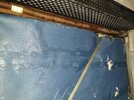
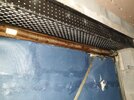
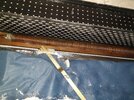
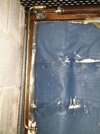
Why have you stuck breathable membrane to your garage door? I thought you were trying to insulate it?The insulation is st
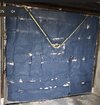
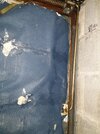
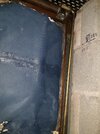
I have just stuck on the breathable roofing membrane to the garage door using the carpet glue


Why have you stuck breathable membrane to your garage door? I thought you were trying to insulate it?The insulation is st
I have just stuck on the breathable roofing membrane to the garage door using the carpet glue
The breathable membrane was stuck over the insulation. The insulation (kingspan) is stuck on the inside of the garage door.Why have you stuck breathable membrane to your garage door? I thought you were trying to insulate it?
Would grab adhesive (like Soudal Easy grab) work as well to stick the membrane to itself and the membrane to the metal door frame?Overlaps, use your polymer adhesive. Edges, I'd just use expanding foam again. Line it out and let it go tacky/expand (but not skinned over) then press the membrane onto it


I have now fitted around 130mm thick kingspan insulation to the garage door and stuck roofing membrane on the inside to cover the insulation. Whilst the door still opens/closes and can be locked closed the door itself, due to the added weight, will not stay 'swung open' (swung up) and closes under its own weight.Don’t know if it helps but my door is a one piece Horman (?) four point locking.
I fitted polystyrene to the metal faces using double sided tape covering the whole thing, using foil tape to join the sections together.
Then I used the slim silver insulation fabric to cover the door, it has to be tucked under the locking bars that go to the four corners. All edges and joints sealed with aluminium tape.
the bottom of the door has a rubber weather seal , there is a similar one at the top.
When adding seals you need to think about how the door opens in use.
The sides had a car type D rubber profile fitted, so when closed the door compresses the seal

Why?I would like to insulate a bifurcated garage swing up (up and over) door. I have breathable roofing membrane, mineral wool, bits of 150mm kingspan block insulation and various glues.
Could I use very small screws to attach the breathable roofing membrane to the inside of the garage door, pin mineral wool (or kingspan) to the mineral wool then lap the membrane over on the other side? The door swings up so I don't want to add too much weight to the door mechanism.
I also want to seal around the side and top of the door frame as it is very gappy at the top a bit of at the side
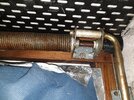
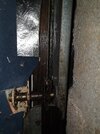
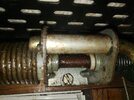
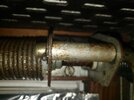
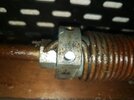
Here are better pics of where the spring (looks like coiled copper pipe) attaches into the block. Is there a youtube video that shows me how to do this?Could do with better pics of this end:
View attachment 403788
But basically that is where you adjust the spring tension. Somewhere in that block will be a grub screw or similar that clamps that block to the circa inch thick pole visible on the left of the pic (looks a bit like copper pipe in that pic) and you can also see a large silver lump with holes drilled in. You basic procedure is to find two metal rods that fit the holes well, insert one rod and hold it tense (in the opposite direction to what the spring will cause the block to spin ie in your case you will apply upwards pressure to the rod because the spring coil wants to rotate the block so the rod moves downward
When you have applied up pressure to the rod and released the grub screw, the block is free to turn. You push the one rod up until you can get the next rod in the next hole in the block, you insert the second rod, take the tension with it and remove the first, push the second rod up and rotate the block, then reinsert the first rod in the next hole
Thus you end up "walking" the block around in a circle using two rods alternately until you have tensioned the spring more. The more you load the spring to more it counterbalances the new weight of the door. Tension it just enough that it stays open
Such as?Several
Yes, products like that, or even the cheaper regular expanding foam. If you lay it out on both surfaces and give it a few minutes to expand and go tacky, it bonds well. You'll know if you've left it too long because it skins over and won't stick to you when you touch it
Be aware that gun grade foam needs a metal applicator gun into which the canister is screwed. I'd go as far as to say that they're useful to have kicking around even if you only plan on using them for one job, if they're about twenty quid; they are more controlled with their foam delivery and are self sealing.
You don't unscrew partially used canisters from the gun, just leave them on, unless you don't plan on using it for months (in which case remove the foam can and screw on a can of cleaner, run it though as per instructions)
See TS items 28840 and 30746
Here's a youtube video showing how to adjust the tension of a UK swing up doorSeveral

If you need to find a tradesperson to get your job done, please try our local search below, or if you are doing it yourself you can find suppliers local to you.
Select the supplier or trade you require, enter your location to begin your search.
Are you a trade or supplier? You can create your listing free at DIYnot Local