
It won't trip an RCD, but could prevent an RCD from tripping when a fault occurs.Why should that trip a type ac RCD or any RCD?

It won't trip an RCD, but could prevent an RCD from tripping when a fault occurs.Why should that trip a type ac RCD or any RCD?
It wouldn't - but see flameport's reply (but also my reply to him which I am about to write).Why should that trip a type ac RCD or any RCD?
As you will be aware, I've been trying hard to gain some understanding of the various 'Types' of RCDs, but am coming to wonder whether Type A ones are actually 'good enough' to achieve very much in many situations - so perhaps you can help me to understand? ...It won't trip an RCD, but could prevent an RCD from tripping when a fault occurs.
If that is true then the implication is that the RCD might well not trip if the underlying DC component of current is greater than 6mA. In the context of what we're discussing (a motor fed through a diode) I would imagine that the DC component is likely to be a lot more than 6mA, so does that mean that a Type A RCD would offer little/no benefit (over a Type AC) in such a situation?BS7671 says:
.... For RCD Type A, tripping is achieved for residual pulsating direct currents superimposed on a smooth direct current up to 6 mA.

Why should that trip a type ac RCD or any RCD?
As I've just written, on the basis of what little I know of the characteristics of a Type A RCD, it might even seriously affect the ability of a Type A RCD to trip!It will not cause it to trip, rather it will slightly affect its ability to trip.
I've been asking questions about the behaviours of these different Types of RCD ever since I first heard of them and, despite having done a fair bit of reading, I'm still not very much the wiser.Oh wow, it's strange to see someone else asking the same question I asked 100 years ago
Not only that, but the energy used by electronic devices is likely to be a small fraction of the total.For modern electronics which use DC, there is a small loss converting AC to DC. However this is tiny, and even if properties were connected to DC supplies the conversion would still be required, as whatever voltage was supplied to a building would not be what was required by the electronic device.


They are better than Type AC, but only of use in situations that do not have smooth DC.whether Type A ones are actually 'good enough' to achieve very much in many situations
It won't, and neither will anything else as they were never designed for or tested with anything other than 50Hz sinusoidal AC.BS7671 tells us nothing at all about the performance of Type AC RCDs in the presence of DC components (of any magnitude
Type A will work with pulsed DC which is what you get from a diode, there is no 6mA limit there.Type A ones are only guaranteed/'required' to respond to a residual current in the presence of a DC component of up to 6mA - which is presumably relative peanuts in the sort of context we've been discussing here.
Thanks for the explanations. My first reaction when reading your ......They are better than Type AC, but only of use in situations that do not have smooth DC. ... For most domestic properties they are good enough today, and certainly far better than the AC types of the past.
..... was that if the behaviour of Type AC RCDs with anything other than 50Hz AC is "undefined and unknown", then that would suggest that it might be possible that they actually work as well as Type A's with pulsating DC. However, having re-visited the video of your experiments about this (here), I see that such is not the case.It won't, and neither will anything else as they were never designed for or tested with anything other than 50Hz sinusoidal AC. Their behaviour with anything other than 50Hz AC is undefined and unknown.
Fair enough. It sounds as if I misunderstood what was being said - since I was considering the fact that that half-wave (or full-wave) rectified AC can be analysed/regarded as a complex mixture of AC components (probably spanning a theoretically infinite range of frequencies) superimposed on a "smooth DC component" (the average of the waveform over time). However it seems that, at least in this context, no waveform which has varying voltage all on one side of zero is regarded as having a 'smooth DC component', even though analytically it certainly does!Type A will work with pulsed DC which is what you get from a diode, there is no 6mA limit there. The 6mA refers to where a continuous DC current exists, such as that you would get from a battery or solar panel ....
That is obviously inevitable, qualitatively, but my uncertainties have always related to the quantitative aspects. In the video of your investigations of this (here), the smallest DC component you use is 50 mA, and that did, indeed, increase trip threshold of a 30 mA Type AC RCD to 70 mA (essentially 'completely disabled'). However, 50 mA is a lot higher than the apparent design spec of a Type A RCD, (≤6 mA 'smooth DC') so I wonder whether a Type A would have done much/any better with 50 mA of DC? It would be interesting to know what results you would get with 'smooth DC' components a lot lower than 50 mA.A fixed DC current will saturate the magnetic core in the RCD and over a certain level it will not work, even if the fault current is AC. As most modern RCDs have tiny cores, it only takes a current of a few mA or 10s of mA to saturate the core and completely disable the RCD.
As a generalisation, that does surprise me, but maybe you're thinking of a fairly constrained definition of "pulsed DC"? Probably the most obvious literal meaning of 'Pulsed DC' is a square wave, and as the mark-space ratio of such a waveform increases, the waveform gets closer and closer to being 'true smooth DC'.This does not happen with pulsed current as the magnetic field is not constant.
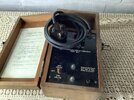 And I have never used one. The loss of metal water pipes resulted in the ELCB-v, but I tried testing a RCD with a ELCB-v further down the line, and the RCD failed, and I wondered who fitted it, as it clearly never worked.
I somewhat doubt that many people knew anything about RCD 'Types' back then. However, the performance of the one in flameport's video obviously indicates that the one he had was, in current parlance, 'at least Type A'.I remember these View attachment 405934 back on the building of Sizewell 'B' and see them in@flameport video of 2020 clearly from sticker 2013 and think these are around 30 years old.
But back then there was no sign to say what type they were, they sent a signal to the moulded breaker, and it activated the solenoid ...


If you need to find a tradesperson to get your job done, please try our local search below, or if you are doing it yourself you can find suppliers local to you.
Select the supplier or trade you require, enter your location to begin your search.
Are you a trade or supplier? You can create your listing free at DIYnot Local
