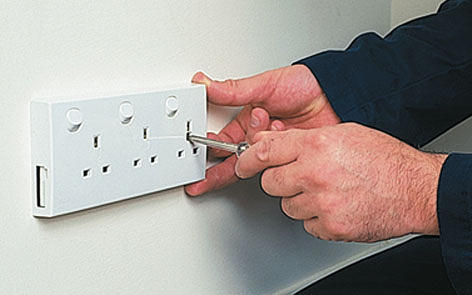
The longer answer is, you are sort of right, it is not inherently safe, if the rest of the ring was unloaded, and you plugged enough stuff into the one socket, it would indeed overload the cable but not blow the trip or fuse. This is equally true of any spur from the mid point of a ring too, but the regs will permit it, as in both cases it is assumed that the ring will be uniformly loaded along its length, and no more than one sockets worth (13A) will be drawn from any one spur at any one time.
In the days when the ring fed fixed space heaters and immersion heaters as well as one single socket per room, this was probably true, but since the 1950s, these loads have gradually been given their own circuits, and the number of double and triple sockets has risen dramatically, so arguably it is no longer a valid assumption, but there are very few accidents, not enough to justify a change of practice.
A radial, is normally wired daisy chain, so even if uniformly loaded all the current flows through the first wire to leave the CU. One could argue that it would be just about OK if an individual wire came back from each socket to the CU (star wiring) as each cable would only carry one sockets worth of loading, like the spur case. For reasons of cable economy, this is not done, and such a configuration is not an approved method
In many ways the ring main is an engineering compromise that has outlived its usefulness, and only the UK uses them, but it is so ingrained that it would be hard to stop its use now.