• Looking for a smarter way to manage your heating this winter? We’ve been testing the new Aqara Radiator Thermostat W600 to see how quiet, accurate and easy it is to use around the home. Click here read our review.

Joining 25mm MDF edges, what to use?

I once spent half an hour at B&Q in the glue section, trying to work out what the different Gorrilla glues actually were. I think there were four different types! Visit website, or just avoid the stuffs and use something known?

To be fair, I have used their PVA based glue in the past. I was happy with it. I liked the fact that it had a wide-ish (rectangular) nozzle.

I have no idea how it compares to the likes of the D3 mentioned by @GhostIntMachine. And, I do not doubt that it is 30(?)%+ more expensive. It is one of the adhesives pushed by my local store, I have have no complaints about it though. That said, I use so little that I am not able to compare it to the likes of D3
 
I've always thought PVA was a good product since I first tried some many years ago, and now I always use it whenever its practical. I recently bought a new 5L can for £14 to take away with me. From the big container I fill clean washing up liquid bottles so it's always ready for squeezing in or on somewhere
 
I have half a bottle of it left, I bought it for assembling some flatpack wardrobes last year and it is very good. No idea if it is better than other water based glues, but it dries fast and seems to be quite strong when cured. It was the only biggish bottle I could find on a Sunday, locally, without travelling
 
That said, I use so little that I am not able to compare it to the likes of D3
I use a litre of Everbuild D4 every 4 to 8 weeks, refilled from a 5 ltr container. Most guys I work with rate the Everbuild D4 more highly than the Evo D3 (better bond more waterproof, cures faster, etc), but it does cost more. With Gorilla glues, though you are paying them a lot of money for their heavy advertising, not for a better product.

At the end of the day whatever glue the OP chooses it must be a minimum of D3 (exterior grade, because it is a window board) and it must be water based if he is using biscuits so that the biscuits work in the way they are designed to
 
Last edited:
I'm not saying Gorilla glues aren't good. They're confusing, though. Some are water soluble, others expand on curing, some are quick, some 24hours... I'm looking at one now..... The list of chemicals which comprise it, isn't immediately useful.....
 
Last edited:
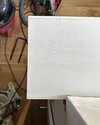
Just doing this today, mitres are cut and I'm going to attempt the biscuit jointing, but I wanted to ask how many joints would you recommend in a 350mm mitre joint in 25mm thick moisture resistant MDF window board? I'm guessing 4, but wanted to check if that's OK in this MDF. Thanks (y) IMG_9849.jpgIMG_9850.jpg
 
Just noticed this biscuit jointer's fence is about 1mm out of square, side to side and no way to adjust it, so I'm going to return it. You buy cheap, you buy twice and all that :ROFLMAO:

Edit, and the replacement is even worse. Looks ok until you tighten it up and then it's 1-2mm out at one end. Erbauer EBJ860, dog rough and not fit for purpose. The Amazon cheap tool lottery next.
 
Last edited:
Just doing this today, mitres are cut and I'm going to attempt the biscuit jointing, but I wanted to ask how many joints would you recommend in a 350mm mitre joint
A biscuit every 96mm should be enough, last biscuit centres about 48mm in from the ends (that's all based on System32, but you don't need to be that exact). So that makes 4 biscuits.

Skewed slots is an issue with low cost Chinesium biscuit jointers IMHO. You might be better off looking for a secondhand trade quality model, e.g. deWalt (DW682, which was originally the Elu MBR100), Makita (PJ7000 or the older 3901) or Trend - all models with a hinged fence as opposed to a fixed one. But a reasonable one is going to be in the £80 to £120 area, which may make you reconsider alternatives, such as dowelling. Whatever you buy if you buy, if it's secondhand make sure that it is clean - a mucky BJ has probably been abused (it's a tool absolutely needs to be kept clean). Always use a vacuum cleaner attached to the tool - helps the tool cut cleaner and faster. If offered them avoid peculiar models such as the Ryobi (weird fence), earlier Bosch (GUF4-22, ditto on the fence, oddball swing-in plunge action), Porter-Cable models (which in any case you can't get parts for any longer), Freud models (same issue re-parts) or the original Elu (DS140 - awkward fence for mitre work, this is where Bosch got their idea for a swing-in plunge action - a bit of an acquired taste? I have had one of these a loooong time ago). Other decent brands with pivoting fences include Mafell (LNF19/LNF20), Lamello (some later models), Virutex and Milkwaukee/Atlas-Copco, but they are rarer and you are a lot less likely to see a good 'un all that cheaply. All the other brands are a bit suss IMHO

Mind if I ask which model you bought?
 
Thanks again, it was the Erbauer EBJ860 from Screwfix. I was just looking at the other cheap one (Draper) I was looking at and that seems to suffer from the same thing, exactly. I totally agree about the used, decent model, but as time is of the essence, now, I am half tempted to pack out the fence with something to level it and do some test cuts as this is really going to put the job on hold and we've already been without a living room for almost a month because of other unexpected happenings (Asbestos, artex & insulation board, having to fit PIR in the ceiling, new ceiling that needed lots of levelling etc), so I am keen to get this done, but at the same time, I don't want to mess up this board that I've cut. I think some test cuts to see what it does. I reckon a couple of pieces of masking tape at one end would be in keeping with the rest of the build quality :ROFLMAO:

I will do a test cut without any packing and then one with and see how it is. Not hopeful though.
 
Looks like a couple of layers of masking tape have saved the day. Did a test cut with mitres and 3 biscuits along it and it lines up ok. Not as tight as I thought it'd be, but seems to align perfectly so far.
 
Dont knock Draper as some in here do. My Draper corded biscuit jointer has always worked well and true and the only reason I did not mention it is because of the flack it would have attracted from other members. I keep all of my tools in pristine condition so that all will serve me well as and when I need any of them.; mistreat and/or neglect tools at your peril (y)
 
Thanks again, it was the Erbauer EBJ860 from Screwfix
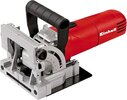
I did take a look at the Einhell TC-BJ900. Certainly seems reasonable for £65, and at least you can hoy it back if it turns out to be pants

Einhell biscuit jointer.jpg

The front end looks pretty similar to the Erbauer - and they both have front ends which remind me of the DW (Elu MBR100), so at least they've copied a known design

I totally agree about the used, decent model, but as time is of the essence, now, I am half tempted to pack out the fence with something to level it and do some test cuts...
It's a bit hit and miss I think, but you have nothing to lose. On a square edge joint I can see it working. A mitre joint might be more difficult. Long mitre joints are notoriously difficult to get right, even for pros (so be prepared to use 2-pack filler!).

Edit: written before I saw your other post :LOL:
 
Dont knock Draper as some in here do.
The Draper is pretty much the same model as the OP's Erbauer (certainly an almost identical front end) - and presumably has the same potential quality issues. I feel the problem with a lot of Chinese stuff is that there is simply no quality control to weed-out defective or inaccurate tools. Not really much of an issue for a DIY drill or impact driver where a bit of chuck wobble isn't normally be an issue, but in the cases of tools like biscuit jointers or dowel jointers which absolutely need to cut very accurate joints it really does make the difference between a tool being useable or in some cases complete junk.

I've never had a low cost biscuit jointer, having started my biscuit jointing in the period when the only choice was between an eye-wateringly expensive Swiss tool (the Lamello) and a just plain very expensive, but oddball Elu DS140 (they were patent dodging). At that time there were no alternatives. But I've never bought a cheap BJ, only heard from others of problems they have had with them.

I have, however, had a similar experience with a dowel jointer - another tool which must have a very accurate fence system (and which looks much like a BJ). I once made a "test buy" (for home use) of a Triton TBJ001 dowel jointer a number of years back to see if it could do the same job as the very expensive Mafell Duo Doweller DD40 dowel jointer. The first one I got couldn't drill two holes in line with each other, the second one had a fence which pivoted on the p*ss, the third one and we were back to the same problem as the first. At that point I was offered a refund and the excuse that "it must have been a bad batch". Others, such as Peter Millard (10 Minute Workshop on YouTube) have tried this same tool at different times and had the same sort of results, which tends to point to poor manufacturing or quality control, not just a rogue batch. The Mafell doweller is a £900/£1k machine, partly because it is made in Germany, partly because it is accurate. The Triton is £200/250 street price.

Similarly, a low cost biscuit jointer will be £80 to £120 whereas a "trade quality" model from a respected manufacturer will run you from £250 (today's Amazon price for a DW682, Makita PJ7000 very similar) up to £670 for a Lamello Classic (and a staggering £1450 for a Lamello Zeta, but they can cut a very special locking joint as well as slot for ordinary biscuits). With such enormous differences in price it isn't difficult to understand why some of these Chinese tools get a drubbing. So not to knock Draper, but there is always going to be a price point below which you can't make a product consistently to the required minimum level of accuracy, or durability, etc. That's what makes recommending Chinese tools so difficult

As a tradesman, if I could get away with buying cheaper DIY tools, then I would. Sadly, the days when DIY tools were as accurate or robust as the Black & Decker DIY electric drills were in the 1960s or 70s (where many tradesmen bought cheap and got 10 or 20 years service out of them) are now long gone. These days it's definitely a case of caveat emptor (buyer beware!)

 
Last edited:
Dont knock Draper as some in here do. My Draper corded biscuit jointer has always worked well and true and the only reason I did not mention it is because of the flack it would have attracted from other members. I keep all of my tools in pristine condition so that all will serve me well as and when I need any of them.; mistreat and/or neglect tools at your peril (y)
I'm not knocking them at all, but I really didn't want to return another Erbauer and the Draper have the same issue, as people have reported in the Amazon reviews, there are even photos of the wonky fence. For what it is worth, I've had many draper hand tools over the years and most were ok, but in recent years, the quality, like many of the big brands, just wasn't what it was, or at least it wasn't for the things I'd bought. I do look after my tools, too, clean them after each use.
 
Last edited:
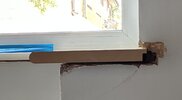
Thanks. I have managed to complete the jointing with the masking tape, taking up the slack on the Erbauer. The joints don't seem particularly tight, in fact some of the biscuits are quite loose, but the alignment seems to be ok on both joints, so that's ok for now. There's a couple of things I'm not so sure about, and I'm not sure of the name of it, so I'll try and explain it. On a window board, typically, you see the board look as if it was wider than the window return, by 3 or 4cm each side, so it's a kind of T shape? Well as this is a square bay, you see the ends of the window boards and I wanted to do that, but I couldn't work out how to do it, because I have already gone with a wider than needed board, because we have shutters and they take up most of it, so an extra couple of CM overhang is fine (5 in total). See photo.

As you can see, the side profile of this board has a lip, so that's not going to look any good, so I was thinking, could I take off the lip so it is a nice straight edge and then biscuit joint another piece onto it to create this bit that I'm missing? Or just be happy with the 1cm or so in the wall and fill it and move on?

I'd also cut the side pieces extra long, in case I messed up the cuts as I was doing it with a circular saw, so they need trimming, so thought I'd ask before I trim them if the thing I mentioned above is doable. Thanks.


IMG_9856.jpgIMG_9857.jpg
 

If you need to find a tradesperson to get your job done, please try our local search below, or if you are doing it yourself you can find suppliers local to you.

Select the supplier or trade you require, enter your location to begin your search.


Are you a trade or supplier? You can create your listing free at DIYnot Local

 
Back
Top