in the mean time you have to carry on with the vaselineI'm considering marrying Claudia Schiffer, when all the difficulties have been overcome.

You are using an out of date browser. It may not display this or other websites correctly.
You should upgrade or use an alternative browser.
You should upgrade or use an alternative browser.
Least Surprising News of The Day..
- Thread starter noseall
- Start date

Which bit do you disagree with?
None of it, even the bit affirming removal of the veto. How about you?
Please allow me to wade into this debate, if I may? (I'm gonna anyway. 
The joining the EU conditions are a Treaty requirement.
The abolishing of the veto refers to normal Parliamentry decisions. It specifically does not refer to Treaty agreements.
Therefore the adoption, or not, of the Euro, by a new member joining, nor whether that member can join, would not be subject to a normal parliament decision. Therefore the Veto existence is irrelevant.
The joining the EU conditions are a Treaty requirement.
The abolishing of the veto refers to normal Parliamentry decisions. It specifically does not refer to Treaty agreements.
Therefore the adoption, or not, of the Euro, by a new member joining, nor whether that member can join, would not be subject to a normal parliament decision. Therefore the Veto existence is irrelevant.
Please allow me to wade into this debate, if I may? (I'm gonna anyway.
The joining the EU conditions are a Treaty requirement.
The abolishing of the veto refers to normal Parliamentry decisions. It specifically does not refer to Treaty agreements.
Therefore the adoption, or not, of the Euro, by a new member joining, nor whether that member can join, would not be subject to a normal parliament decision. Therefore the Veto existence is irrelevant.
I've already found out today that things aren't as black and white as I had thought. But I'm struggling with some of the terminology, here . I thought it was the member states who had veto powers, not the Parliament. And I'm sure I've just read that member states can veto a new country joining. Are there different types of veto?
European countries can apply to join the EU but the process is complex and lengthy. Each existing EU Member State has a veto over any new country joining, as well as a veto over the pace of negotiations and the terms on which it joins.

- Joined
- 22 Aug 2006
- Messages
- 7,852
- Reaction score
- 1,485
- Country

Yes they all have a veto on new accessions.
That purely down to one member and Russian gas and oil. Maybe other eastern too. The statement must makes the article more click friendly.The EU must speak with one voice on foreign policy
LOL Our MP's say all sorts as well don't they and all happen.
Some will relate to defence spending as well. There are a number of similar areas such as the cost of supporting Ukraine and how that is spread
Anyway why do you care. We aren't in any more and also can't influence anything that they choose to agree to do. Note the word agree
As Justin says, yes each member can veto the joining of another potential member. That is a different veto than that discussed in relation to normal Parliamentary business. The possibility of any member joining is one of the real reasons why Turkey will never be accepted by Cyprus, despite Farage's et al claims.I've already found out today that things aren't as black and white as I had thought. But I'm struggling with some of the terminology, here . I thought it was the member states who had veto powers, not the Parliament. And I'm sure I've just read that member states can veto a new country joining. Are there different types of veto?
As Justin says, yes each member can veto the joining of another potential member. That is a different veto than that discussed in relation to normal Parliamentary business. The possibility of any member joining is one of the real reasons why Turkey will never be accepted by Cyprus, despite Farage's et al claims.
Thanks. And when you say normal Parliamentary business, do you mean the European Parliament has the veto power? Or is it the member states in Council of ministers?
Yes, normal Parliamentary business. Up until now a complete unison accord was required. Therefore a veto from any member could derail the business. The changes do away with the veto in this scenario only, and a majority can vote in a policy.So, the possible changes to the veto being discussed above, are they for a different sort of veto?
Therefore it's a removal of veto potential for normal Business. But the veto on a new member joining, i.e. treaty changes, will still require a unanimous accord.
It's the member states in the Council that had the veto power, but they were reliant on the Parliament forming the policy, and the Commission presenting those laws, etc. for the Council to enact.Thanks. And when you say normal Parliamentary business, do you mean the European Parliament has the veto power? Or is it the member states in Council of ministers?

The Council of the European Union
The Council is an essential EU decision maker and is also responsible for coordinating policy, developing the EU's common foreign and security policy, concluding international agreements and adopting the EU budget.
 www.consilium.europa.eu
The council can not unilaterally invent and implement policy etc.
This explains the government of the EU.
The EU - what it is and what it does
This publication is a guide to the European Union (EU) and what it does.
op.europa.eu
It's the member states in the Council that had the veto power, but they were reliant on the Parliament forming the policy, and the Commission presenting those laws, etc. for the Council to enact.
The council can not unilaterally invent and implement policy etc.
Great, thanks. It's a few years since I followed these things, and I didn't know if there had been changes. I think there used to be decisions which needed QMV, and others which needed unanimity. Is that still the same?
It might be worth quoting from a link off that page to state who the members areThe council can not unilaterally invent and implement policy etc.
Council meetings are attended by representatives from each member state at a ministerial level. Participants can therefore be ministers or state secretaries. They have the right to commit the government of their country and cast its vote.
A rather important aspect if people think it all through.
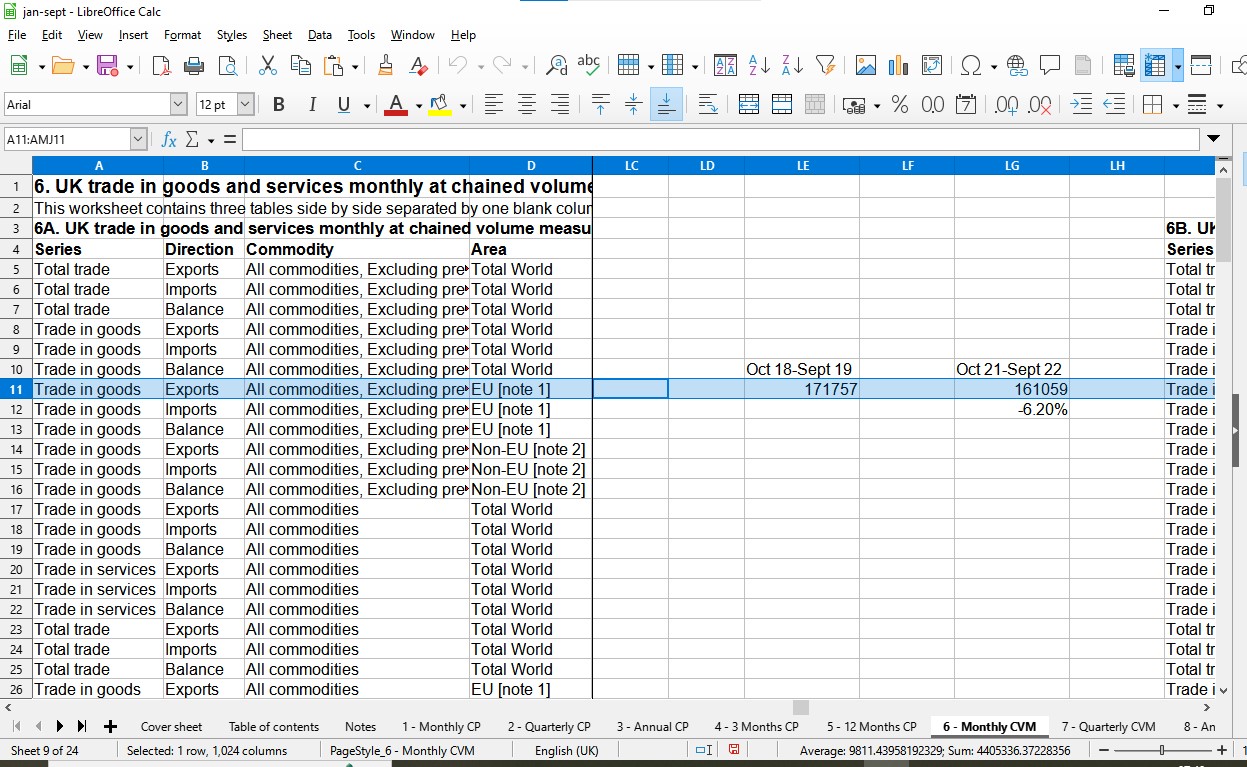
from Oct 21 to Sept 22, once the distorting effects of inflation are removed, UK goods exports to EU are DOWN -6.2% on the same period to Sept 2019 (pre-pandemic). Hardly surprising, since we've erected trade barriers.
Similar threads
J
- Replies
- 1
- Views
- 669
O


J
- Replies
- 5
- Views
- 1K
M