• Looking for a smarter way to manage your heating this winter? We’ve been testing the new Aqara Radiator Thermostat W600 to see how quiet, accurate and easy it is to use around the home. Click here read our review.

Off-peak tariff, does it really save money?

what do people do, once that system wears out, and then needs replacing - where they would have to bear the full cost?
The thinking is that by that time [a decade or more hence] the prices will have come down a lot and expertise about these products will be more widespread.
Additionally, the prices will magically come down once the grant support is withdrawn as well.
 
The thinking is that by that time [a decade or more hence] the prices will have come down a lot and expertise about these products will be more widespread. .... Additionally, the prices will magically come down once the grant support is withdrawn as well.
Maybe, but 'monopoly' ('no choice') situations are never good for customers, since (as I've just written/implied) there's no guarantee that prices will come down (much, or at all) when the time comes when there is essentially no alternative to heat pumps (or suchlike) for people to buy!
 
Why would it be a monopoly situation? There are a number of heat pump suppliers. Not that I'm thinking of getting one.
Not a monopoly of manufacturers/suppliers, but a monopoly of what type of heat sources became available to buy. If/when the day comes (as government would like) when the only option is a heat pump (or similar), then the heat pump industry as a whole could set their prices as high as they liked. Yes, there would be some competition between suppliers, but I seriously doubt whether even the cheapest will ever be remotely as cheap as a gas boiler. ....but only time will tell!
 
the heat pump industry as a whole could set their prices as high as they liked
That's not how it works. There are too many suppliers.
The "gas boiler industry" [many of the companies involved are selling gas boilers and heat pumps] could set prices as high as it likes right now given how dominant a technology it is [but they don't].
The car industry could set their prices as high as they like, given how little competition there is from horses.
Etc.
 
That's not how it works. There are too many suppliers.
The "gas boiler industry" [many of the companies involved are selling gas boilers and heat pumps] could set prices as high as it likes right now given how dominant a technology it is [but they don't].
The car industry could set their prices as high as they like, given how little competition there is from horses. ... Etc.
I think you may be underestimating the extent to which entire 'industries' (manufacturers, distributors, wholesalers and retailers of a certain type of product) are often fairly consistent in deciding what 'profit margin' (over and above the actual cost of manufacture) they want for a particular type of product. Those 'margins' can (in total) be pretty massive - but it is they which dictate what end-buyers come to regard as "the price of a boiler", "the price of a heat pump" or "the price of a car".

I've always felt, at least until pretty recently, that a truly dramatic example of this existed in relation to spectacle frames. These products consist of some small bits of 'bent wire' and/or plastic mouldings, plus a couple of mini hinges, and I suspect that they must cost at least 50p to manufacture in bulk. However, until quite recently, the 'margins' introduced by the various points in the supply chain led most people to 'accept' that "the cost of a spectacle frame" was anything from about £50 to £200+ ('Designer' ones :-) ). It's only in fairly recent times that a few on-line sources have demonstrated that it's possible to manufacture and sell them for £5 - £10 (and presumably still make some profit :-) ).
 
Heat pumps use lower temperatures as to oil or gas boilers, so often one can't use the same pipework or radiators, but assuming being fitted because of globule warming, then we will need to both heat and cool our homes, so something like the iVector radiators by Myson so it can heat and cool makes a lot of sense, only by using fan assisted radiators can they be made small enough, with the reduced temperature. But the need to store energy, means also UFH has a place too, but we are moving from a side line for the Plumber, to a very involved technical set of calculations to ensure the heating works as intended, which could mean also designing the whole home differently.

The solar panel also would be better with a home designed for them, the idea of a flat roof, with access so easy to clean, etc. But in the main we are left with near enough engineering. We know it is not perfect, but can be good enough, with gas boilers a bad one 75% efficient, a good one 95% efficient, but with heat pumps, looking at 100% or 500% efficient, so the installation has to be right. And it often seems they are not right, and the homeowner has to foot the bill to get it right.

That is a far move involved debate as to which tariff to use. I have decided to stick with a single rate tariff, and the 15p per kWh for export, yes I know not the best, but my battery as far as I am aware can't as it stands be controlled by the supplier, so some tariffs not available. And the last thing I want to do is to be chasing the best deals, but sitting behind a PC screen all day deciding when to import and when to export, I just want to sit back and enjoy life.
 
I've always felt, at least until pretty recently, that a truly dramatic example of this existed in relation to spectacle frames. These products consist of some small bits of 'bent wire' and/or plastic mouldings, plus a couple of mini hinges, and I suspect that they must cost at least 50p to manufacture in bulk. However, until quite recently, the 'margins' introduced by the various points in the supply chain led most people to 'accept' that "the cost of a spectacle frame" was anything from about £50 to £200+ ('Designer' ones :) ). It's only in fairly recent times that a few on-line sources have demonstrated that it's possible to manufacture and sell them for £5 - £10 (and presumably still make some profit :) ).

The massive margins on most things, are almost universal, so universal most of us just accept it as the norm. It's those who don't shop around for things, that encourage this norm. Today for instance - I researched buying 10Kg of bottled gas refill. The normal price around £60, though some were charging upto £80. After a few enquiries I found it on regular sale at a timber yard, for £44 - all the identical bottle gas, from the same bottled gas company.

Companies set their prices, based on what the customer would be willing to pay, not on what things cost to produce. An Iphone, costs just a few pounds to manufacture, we pay hundreds for one.
 
That is a far move involved debate as to which tariff to use. I have decided to stick with a single rate tariff, and the 15p per kWh for export, yes I know not the best, but my battery as far as I am aware can't as it stands be controlled by the supplier, so some tariffs not available. And the last thing I want to do is to be chasing the best deals, but sitting behind a PC screen all day deciding when to import and when to export, I just want to sit back and enjoy life.
Yes, it has to be a fit and forget, I have no wish to be looking for the cheap hour to charge, or changing out lifestyles to suit.

I may go for Agile + 15p Export for until end of september then do Standard rate + 15p export until next spring

Just by fluke Agile suits us, we never start cooking until after 7pm and we naturally use little between 4 & 7pm
Over the month or so we have been on Agile we have averaged 18p as opposed to 24p standard

I would, if possible like to set up a Rasp Pie to automatically look for the very low agile rates and automatically charge the batteries during that period. I think it can be don
 
The massive margins on most things, are almost universal, so universal most of us just accept it as the norm.
... and ...
Companies set their prices, based on what the customer would be willing to pay, not on what things cost to produce.
Exactly my point. The general public develop a notion of roughly what a particular type of item 'costs', and therefore become prepared to pay that amount, even if it is actually many times the cost of manufacture (the rest being added at various points in the supply chain). For many types of item (e.g. family cars, boilers, smart phones etc. etc.) those 'accepted' (end-purchaser') prices are usually all in roughly the same ball park (say ±50% or so) for most manufacturers but, again, many times the actual production cost.

That situation only changes if/when, as with the spectacle frames, someone comes along and offers products for only a small fraction of what the public have come to regard as 'the going price' for such an item, but still offering a profit in relation to the production cost. As you go on to say ...
An Iphone, costs just a few pounds to manufacture, we pay hundreds for one.
... and much the same applies (at a somewhat lower level) to all 'smart phones'. As you imply, it would probably be possible for a company to se;; such things for, say £50 or so (maybe even £100), and still make 'a reasonable profit' - but, looked at from their POV, why should they do that if the public are prepared to pay (and expect to pay) 'hundreds'?!
 
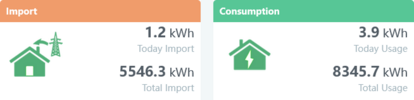
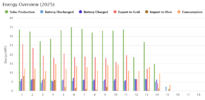
Rain yesterday, and dull and drizzle today, but still the report 1744707655679.png shows very little used from grid, and the solar has just satisfied background demand at 10:00 am. Yesterday well down on solar production 1744707931165.pngbut still enough so did not run out of battery until 05:15 am this morning. I used the online thing to register to get payment for export yesterday morning, and it seemed to work, so fingers crossed. Looking back, November to February low output from solar, so until November it can stay as it is, then review tariffs in November.
 
I may go for Agile + 15p Export for until end of september then do Standard rate + 15p export until next spring
Same here, I just switched to agile today actually. Octopus keep switching simple enough. Let’s see how it goes.
 
Octopus Energy said:
Agile prices can spike up to 100 p/kWh any time - although a typical household in Winter '22-'23 paid around 35 p/kWh average.
I have watched the youtube
My TRV heads, and my thermostat can use IFTTT, but as to washing machine, tumble drier, dishwasher, and even the solar panel battery, these don't use IFTTT, so it needs someone sitting at a display, to act as a human machine interface, (HMI) to transfer the info into starting machines.

I looked at the Flux, and the high cost, 4 pm to 7 pm, and considered if at 3 pm we seem unlikely to bridge the gap, we could force charge the battery, but likely would forget to do it.

If this charging and discharging of the battery was automated, not just a set time, but tracking the rate, then that may be a good idea. But I found the charging from the grid, even with a fixed time off-peak rate, was costing more than a fixed all day rate. Yesterday I used 1.4 kWh from the grid, in spite of bad weather, so it says "As of April 5th, 2025, Octopus Energy's Flexible Octopus tariff, for customers who pay by Direct Debit, costs 24.50 pence per kWh for electricity." so 34.3p and to charge the battery (5.76 kWh) the rate would need to be lower than 6p per kWh to break even.

And the three machines, do have timers, either ½ hour or 1 hour increments depending on how far ahead, the drier takes around 2.5 hours, so arranging to run in a 5-hour slot OK, but a 3-hour slot, not so easy. And once started must complete, you may want to have a screen showing what is going on, stuck to your wall
1744713324056.png
think I would prefer to watch TV! I note a new bit on the solar software
1744715590635.png
so at least now have an idea what we will get. Must check tomorrow to see how near.

 
Last edited:

If you need to find a tradesperson to get your job done, please try our local search below, or if you are doing it yourself you can find suppliers local to you.

Select the supplier or trade you require, enter your location to begin your search.


Are you a trade or supplier? You can create your listing free at DIYnot Local

 
Back
Top