
You are using an out of date browser. It may not display this or other websites correctly.
You should upgrade or use an alternative browser.
You should upgrade or use an alternative browser.
Over voltage
- Thread starter cully
- Start date

Indeed - so would I.If grid voltage was too high, I think I'd like to see anything generated from the solar diverted to heating water or something. ... Battery storage would be ideal.
However, I thought that grid-tied inverters shut down in the event of an 'overvoltage' of the grid supply - I would imagine primarily due to export problems?
Yes, mine does, but a few resistive loads pull down the in-house voltage a bit.Indeed - so would I.
However, I thought that grid-tied inverters shut down in the event of an 'overvoltage' of the grid supply - I would imagine primarily due to export problems?

- Joined
- 27 Jan 2008
- Messages
- 29,639
- Reaction score
- 3,665
- Location
- Llanfair Caereinion, Nr Welshpool
- Country

The iboost+ sounds a good idea, but the immersion heater is not deep enough in the tank, so it does not use as much as I would like, and if I ever do get paid for export, the figure for export is higher than the figure for buying off-peak, so not really worth doing.

In essence yes within reason but not quite correct, Kirchoffs law just about starts creeping in here...."Household" Solar Panels (EXPORTING energy) tend to push-up the voltage in the "local area".
This must be so, since the only way that such panels can "feed" into the (local) part of the "Grid" is to produce a higher voltage - to drive the current in - thus taking part of the "load" from the local "Grid" transformer...
I got one, but when I calculated the RoI, if was not worth having. Cost of HW with gas is very low, and I only get worthwhile solar generation on (some) summer days.The iboost+ sounds a good idea, but the immersion heater is not deep enough in the tank, so it does not use as much as I would like, and if I ever do get paid for export, the figure for export is higher than the figure for buying off-peak, so not really worth doing.
"Household" Solar Panels (EXPORTING energy) tend to push-up the voltage in the "local area".
This must be so, since the only way that such panels can "feed" into the (local) part of the "Grid" is to produce a higher voltage - to drive the current in - thus taking part of the "load" from the local "Grid" transformer.
Well yes, kind of & no.
Solar installations feeding into the grid do cause a local rise in voltage but not because they are delivering a higher voltage than the mains (thats not how they work. This is AC land & things behave a little different from the DC case. There are other ways to push power back into the mains than doing it at a higher voltage. Just delivering a higher voltage tends to create reactive power not real power).
This is really a "load flow" problem - it is the flow of power which determines the volt drop, not the volt-drop which determines the flow of power.
The reason that the voltage rises is more to do with 'reverse volt-drop'. The presence of the solar installs is reducing the load on the local distribution transformer, hence reducing the currents flowing & thus the volt drop along the conductors. The tapping on the distribution transformer will have been set such that the voltage at the far end of the distributor will be just above the minimum allowed whilst still being below the maximum at the close end. This is always a compromise. Introducing solar generation (or any other embedded generation, for that matter) upsets this. In extreme cases it is possible to 'flip' the transformer so that the net power flow is from the LV side to the HV side. This can happen on sunny afternoons when the solar installs are working at the maximum capacity & the load in the houses is small due to everyone being away at work.[/QUOTE]
- Joined
- 27 Jan 2008
- Messages
- 29,639
- Reaction score
- 3,665
- Location
- Llanfair Caereinion, Nr Welshpool
- Country
It depends on how much hot water is used, and length of pipe work boiler to cylinder and if lagged or not, because iboost+ records the energy used, I can say with my house immersion heater is cheaper to using oil, when the solar was fitted together with iboost+ we noticed the reduction of oil used.I got one, but when I calculated the RoI, if was not worth having. Cost of HW with gas is very low, and I only get worthwhile solar generation on (some) summer days.
Or an electric motor driving a given load. We discussed this in the earlier thread!ven if there is, say, thermostatic control of the load (e.g. electric heater, immersion heater
 and Merry Xmas
- Joined
- 27 Jan 2008
- Messages
- 29,639
- Reaction score
- 3,665
- Location
- Llanfair Caereinion, Nr Welshpool
- Country
The iboost+ showsÌn summer I use less than 50p of gas a day.
Let's suppose I could halve that
For a hundred days a year.
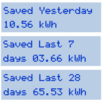 so easy to see how much used, the oil boiler does not modulate so run time = energy used, and it is a 20 kW boiler, and it would run 4 times a week on ½ hour time slots, but after 20 minutes the return water was too hot so it would turn off, and ½ hour had expired before the boiler would start heating again, therm-syphon or C Plan is slow.
I would assume due to the length of pipe work boiler to cylinder, but it was clear around 10 times the energy used to heat water using oil, to using the immersion heater, but the cost of oil vs electric is not times 10, either the electric is at export rate, what you would not be getting if you exported instead, or off-peak rate, as would heat water with no solar overnight, or for free if not getting paid of export, so electric costs at maximum 16p per kWh no way could I buy oil or gas at 1.6 p per kWh.
As said it will vary depending on distance of boiler to cylinder, that is where the losses are, but that is the bit forgotten when quoting costs, in winter the heat from those pipes goes into the house so not really lost, but in summer don't want the house heated, running a heat pump to cool the house, well living room at least, loads of free electric from solar, so why not.
But last house when the voltage dropped to 230 volts I saw no change, however when a row of OAP bungalows got solar panels fitted, we saw the volts drop from around the 247 mark to 237 mark, I assume the solar panels were tripping out on over voltage, so the tapping on the transformer were changed? Since my solar panels log over voltage, I am sure others do the same, so the DNO have to do something about over voltage.
As to going around changing the setting if no one complains, unlikely.

DIYnot Local
Staff member
If you need to find a tradesperson to get your job done, please try our local search below, or if you are doing it yourself you can find suppliers local to you.
Select the supplier or trade you require, enter your location to begin your search.
Please select a service and enter a location to continue...
Are you a trade or supplier? You can create your listing free at DIYnot Local
Similar threads

- Replies
- 5
- Views
- 2K


- Replies
- 73
- Views
- 9K
