• Looking for a smarter way to manage your heating this winter? We’ve been testing the new Aqara Radiator Thermostat W600 to see how quiet, accurate and easy it is to use around the home. Click here read our review.

Packing (or something else) between two steel lintels/RSJ?

Joined
27 Dec 2015
Messages
191
Reaction score
8
Country
United Kingdom
I'm having a new RSJ put in (blue) to remove a wall (red). To reduce the work the beam is going beneath a steel lintel (green) already in place.

The best approach seems to be up for deliberation so I thought I'd see what other opinions and ideas are out there...

1. jack the new RSJ against the existing beam. Then jack the padstones up and fill underneath with mortar. Given the padstones take the weight this seems the most risky, it assumes the mortar doesn't shrink when set etc.

2. try and pack the gap using layers of thin steel, say 0.5mm. Might still have movement when the props are removed.

3. weld the sides of the RSJ/lintel together, possibly along with (2).

4. inject the gap, possibly some sort of epoxy? This would ensure the gap is filled. Please, don't suggest expanding foam. :)

IMO (4) is the best option. I'll be asking the structural engineer later on as well

Cheers!

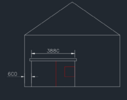
visual (copy 1).jpg
 
3:1 stiff mortar on top of beam, jack it into place, steel or slate packers between beam and padstone.
Don't jack up the padstone, mortar it in, like a brick.

But if you've got an engineer, ask him.
 
See I wouldn't have put mortar in-between two steels as it has nothing to set to.

The steel or slate packers between the beam and padstone seem a worse place then putting the same across the length of the RSJ/lintel? As those padstones are going to take all the pressure? Can pack them as close as you can but there'll still be some crushing when the props are removed?

I'll ask the engineer as well but not overloading him, he's got the RSJ calculation to do first. They're all stressed at this time of the year. :)
 
Do you really believe he'll be"overloaded" or "stressed"doing a steel beam calc?
Or is it a subtle play on words?
 
I don't know Tony, but I know I'm stressed trying to find one that can actually do the calcs in a reasonable (not 2 months) time frame. (y)

I have a larger issue now, the wall to the right he says has to come out 600mm for the lateral load on the front of the house, and I think that requires foundation work won't be enough to build on the concrete floor. And there's a boiler in the way. Rabbit hole...
 
Last edited:
The lateral load issue is concerned with wind load on the outer wall of the house.
Has he done any calcs to justify this 600 mm wall, or has he just pulled the figure out of his back passage - I suspect the latter?
If lateral stabilty is an issue - and in 9 cases out of 10 it isn't - there are neater ways of dealing with it than building an awkward chunk of masonry.
 
I couldn't say one way or the other, I suppose I'd find out once I'd committed to (aka paid for) having the full report done. It's a bit of a chicken and egg scenario because this 600mm easter egg terminates the job; apart from a boiler being in the way I confirmed earlier today there's no trench foundation under the existing lintel and so a ~900mm hole will have to be dug in the kitchen to make one. It's a step down the habbit hole too far.

I was talking to another SE and maybe they'll disagree or say there's another way but I haven't high hopes.

--

Edit: I did some googling as I thought he was referring to the front of the house. If this were external and a large window was going in where there were bricks that side of the house would be lighter so I could see how to collapse it would require less wind. But the area being widened is internal so I don't see how it makes any difference to the top half. Sideways collapse seems unchanged to my eyes, but I don't know, basically.
 

Attachments

  • Screenshot 2025-04-17 160613.png
    Screenshot 2025-04-17 160613.png
    14.9 KB · Views: 28
Last edited:
can you post a plan of the house? Eg from Rightmove, with address etc removed.
When considering wind load, the SE should consider the ground floor as a whole, rather than an isolated part.
 
I don't have a floor-plan per say but can offer up everything the SE requested and a CAD I did. The CAD is internal measurements, excludes masonry width on the left side. Masonry is 270mm brick and concrete block (70mm cavity). All walls cavity based.

There's already a lintel across the 2.8M (green in previous picture), weight unknown (but looks pretty wimpy).

The new RSJ is to go underneath (blue in previous picture) across the existing 2.8M gap, the 0.78M wall and the 0.9M window opening. Wall and window masonry will then be removed (red in previous picture).

The new RSJ will go underneath. This means it'll be seen in the ceiling but is a compromise to reduce the installation work.

Joists on the 1st floor (bedroom) are 2.9M in length. They sit in the current lintel and on the wall etc.

The roof is truss so no roof loading on the gabel ends.

Bit more detail which may be relevant...

The wall is the gabel end, and about 30cm past the window is a door and then the rest is outside (4.03M - ~30cm on the diagram).

On the ground floor, the garage was build 1M to the side. The garage roof (truss again so no load) was then extended across. At the front of the house the wall simple keeps going joining to it. It's odd, I know, a door was originally at the 0.78M point creating an area under canopy. I suspect being built mid 80's this was the place to have a smoke while not getting rained on! The door is now at the 0.9M point (can see it in the previous picture).

The current lintel sits on 100mm on the side and 210mm on the inner side. These look like concrete blocks not padstones, they've used the same elsewhere in the wall. The naughty 80's!

If you (or anyone) is a SE and can solutionise without the need to build a 600mm wall on the left side, said solution to be passable to building control, then I'll put my hand in my pocket and remunerate!

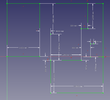
house_dimensions.png
 
Last edited:
300mm missing here and there for cavity walls but hopefully good enough to show structural walls. Doorways not included. For bearing the original lintel is going across the 2.4M section
 

Attachments

  • Screenshot_2025-04-20_10-22-00.png
    Screenshot_2025-04-20_10-22-00.png
    36.7 KB · Views: 41
The 600mm wall is a no go, I don't have a raft foundation and I'm not prepared to dig a foundation down in the kitchen it's a step too far.

What I asked the SE is whether a 100 x 660 x 220 padstone could be put length ways, so the RSJ is on the 100 x 660 side and the load distributes on the inner wall. The RSJ on 100mm is minimum but regs permit it. This is how it's done now with the existing lintel, except it's resting on a standard concrete brick (either the original builders didn't give a **** or maybe the load didn't warrant a padstone).

I suppose it needs calcs now, but not if the 600mm wall is an insistence without them, no point.

Thanks for your help, much appreciated. It's been a real learning curve of gotchas.

Edit - or even a 900mm padstone https://gilmorebuildingsupplies.co.uk/concrete-padstone-900-x-100-x-215mm/
 
Last edited:

If you need to find a tradesperson to get your job done, please try our local search below, or if you are doing it yourself you can find suppliers local to you.

Select the supplier or trade you require, enter your location to begin your search.


Are you a trade or supplier? You can create your listing free at DIYnot Local

 
Back
Top