
Plasterboarding brick walls

If you've not done it before, go with battens. The other options require you to act before stuff 'goes off', with battens you can take your time and get it right, and easily backtrack if need be.

With foam or d&d you are also relying on the adhesion of the paint to the brick to hold everything up, it will most likely be ok but paint's a funny thing.
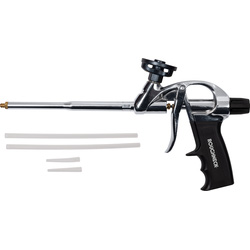
 
When I used a foam gun I only cleaned when storing for a while , otherwise I just added another can , up to around 20 without any problem .
Lighter fuel is a cheap way to clean wet foam off your hands .

I used my foam gun for the first time in about 3 months. I leave the foam canister connected until I need to replace it. This gun is only 1.5 years old, it has had about 6 canisters thus far. To date, I have only used the gun cleaner to clean the tip.

I would never want to go back to using non-gun versions of foam. The ability to control the rate of flow was worth the £30 I paid for the gun.
 
The ability to control the rate of flow was worth the £30 I paid for the gun.
Out of interest, which foam gun do you have?

Also probably worth pointing out to Johnw2, that it's a good idea to foam around the perimeter of the boards even if using battens, to restrict the movement of air.
 
If you've not done it before, go with battens.
Thanks. I've done battens and plaster-based D&D (albeit relatively small walls), but I've never used foam
The other options require you to act before stuff 'goes off', with battens you can take your time and get it right, and easily backtrack if need be.
Good point.
With foam or d&d you are also relying on the adhesion of the paint to the brick to hold everything up, it will most likely be ok but paint's a funny thing.
Yes, that was one of my concerns. As I've said there are some 130 years worth of coats of paint. The most recent ones seem to be emulsion or masonry paint, but I imagine that there is probably whitewash, or worse, under the more recent layers!
 
Also probably worth pointing out to Johnw2, that it's a good idea to foam around the perimeter of the boards even if using battens, to restrict the movement of air.
Thanks. If I use battens, including horizontally if/where there were horizonal joints between boards, there wouldn't really be any 'exposed perimeter' of boards, so where could/would I put foam?

I presume that I wouldn't need much in the way of battens - would, say, something like 25mm x 38mm be adequate?
 
No, if you close off the edges with wood then foam won't be necessary.
25x38 is spot on. Get treated battens.
 
Out of interest, which foam gun do you have?

Also probably worth pointing out to Johnw2, that it's a good idea to foam around the perimeter of the boards even if using battens, to restrict the movement of air.

It was this one


It has teflon where required, eg the pin and base.

A few months prior to buying that, I had purchased a £12 gun from Amazon. It was useable but could not be serviced. I had to bin it after about 2 months.


My current gun, as I said, I will leave it for ages. From time to time, I might need to use a knife to break the seal between the nozzle and the pin.

The gun was also supplied with two straws and two conical nozzles. The conical nozzles taper down to about 3mm.
 
All as I thought/hoped. Very many thanks!
I'm hoping to get the job done soon (have gathered most of the required materials), but just one last question ...

As I've said, I have limited experience of boarding walls. When I've done it in the past I've used 'anglebead' for the external corners, but never have been quite sure what I should do with the internal corners - so I have usually just taped them. Is that OK, or is there something else I should be doing?
 
I'm hoping to get the job done soon (have gathered most of the required materials), but just one last question ...

As I've said, I have limited experience of boarding walls. When I've done it in the past I've used 'anglebead' for the external corners, but never have been quite sure what I should do with the internal corners - so I have usually just taped them. Is that OK, or is there something else I should be doing?
That’s fine
 
A ridiculous amount of time has passed since I last posted, full of delays due to multiple distractions (mainly work-related), but I really do hope to get this job done and dusted soon! Just one more question (at least,for now!) ...

... I have been brought up with the idea (which I think is widely held) that when boarding walls it is far better to use the boards 'horizontally', rather than 'vertically'. The usual explanation is that the board is stronger when used in that fashion, because of the direction of 'the grain'. That sounds like a very credible explanation if one doesn't think too deeply - but I made the mistake of 'thinking' and ending up wondering whether plasterboard really does have 'a grain' ( I thought it was just a homogenous mass of plaster, just as if one had plastered a wall oneself)? What is the truth?

In any event, whether the board has grain or not, does it really make a lot of difference? I ask because it would quite often be much easier using boards vertically, particularly if one is working alone - so I wonder what actually might 'go wrong' if I use the boards vertically?

Kind Regards, John
 
There is no grain, it's poured between the paper as liquid plaster.
Use the boards vertically, easier to handle that way round. You might have a gap at the top depending on ceiling height. If so, fit the next board so the gap is at the bottom and so on. Batten (or foam or dab) at any joints.
 
There is no grain, it's poured between the paper as liquid plaster.
As I said, that's exactly what I thought, but if you look around the Internet, you'll find countless people saying, often quite forcefully, that one must use the boards horizontally because of the direction of some alleged 'grain'! Never trust what you read on-line :-)
Use the boards vertically, easier to handle that way round.
Indeed, very much easier, particularly for an 'amateur' - so you have reassured me!
You might have a gap at the top depending on ceiling height. If so, fit the next board so the gap is at the bottom and so on. Batten (or foam or dab) at any joints.
Fortunately, the ceiling is just fractionally over 2400 mm, so that works perfectly, with just a little gap at the bottom (behind the skirting). Since it's an ancient concrete floor, which may well get damp (if not wet!_) at times, I certainly don't want the boards to go right down to floor level, anyway.

Many thanks for your advice and reassurance!

Kind Regards, John
 
For me, the ‘ batten or dot/dab’ decision is usually decided by putting my 1800 spirit level across the wall in all directions……
 

If you need to find a tradesperson to get your job done, please try our local search below, or if you are doing it yourself you can find suppliers local to you.

Select the supplier or trade you require, enter your location to begin your search.


Are you a trade or supplier? You can create your listing free at DIYnot Local

 
Back
Top