Plug in solar

Joined
7 Nov 2010
Messages
110
Reaction score
6
Location
London
Country
United Kingdom
So you are allowed one 800 watt plug in system per socket circuit under the regs . My garage is supplied by a 6mm armoured cable from the house consumer unit to the gararage consumer unit . In the garage there is two seperate radials one running the pond equipment and another more powerful 32 amp radial for garage equipment when used.

So what is a so circuit.

As the garage is iconnected to the CU in house via 6mm armoured cable is everything in garage classed as one circuit or are the two radials in the garage classed as two circuits as they come out of the CU in garage which would therefore allow me to run two 800 watt systems from the garage.

I apologise if I’ve made that explanation confusing
 
Yes, it's a bit confusing, primarily because it's really just an argument about words, not about anything 'electrical'!

However, I think these regs talk about only one plug-in PV per each final circuit, don't they? If so, then, assuming each of the two radials has its own MCB or RCBO in the garage CU, I would have thought that it could fairly easily be argued that (per BS7671 definitions) that is TWO 'final circuits'. However, others may (and probably will!) disagree with me ;)
 
I think it's only one per household until/if other regulations change as well.
Yes, from what I've read, it sounds as if G98 still says one per household but it also sounds as if they plan to change that very soon so as to align with the new legislation. Is that also your understanding ?
 
Yes, it's a bit confusing, primarily because it's really just an argument about words, not about anything 'electrical'!

However, I think these regs talk about only one plug-in PV per each final circuit, don't they? If so, then, assuming each of the two radials has its own MCB or RCBO in the garage CU, I would have thought that it could fairly easily be argued that (per BS7671 definitions) that is TWO 'final circuits'. However, others may (and probably will!) disagree with me ;)

The circuit to the garage is a sub main and the circuits within the garage are final circuits

That’s my tuppence worth
 
The circuit to the garage is a sub main and the circuits within the garage are final circuits
Yep, indeed - provided that, as I said, the radial circuit coming from the garage each had their own OPDs in the garage CU.

On the other hand, if there were no OPDs in the garage, with the feed from an OPD in the house splittig into what the OP calls 'two radials', then I think that, in electrical terms, there would be only one (branching) 'radial final circuit' (all the way from OPD in house, and no "sub main". Do you agree?
 
A circuit is an assembly of electrical equipment supplied from the same origin and protected against overcurrent by the same protective device(s). But this produced a problem, a ring final circuit. A final circuit arranged in the form of a ring and connected to a single point of supply. If it is a final circuit, then we can't take another radial circuit from it, so another name was found Spur. A branch from a ring or radial final circuit. Which is fair enough, but really a fused spur is a radial from the ring final, but can't have a final final circuit, in the same way as saying the "very end" is wrong, the end is the end, no point in the word very.

So as @JohnW2 says, it is an English problem, not an electrical problem. But we can all work out what they are trying to say, only one plug in solar per 16 amp or greater MCB/RCBO at the consumer unit. this is the new law but it is more aimed at the manufacturer/retailer and what they need to include is in the preamble to the new law and what the instructions with the kit must say.
““plug-in microgenerator” means a source of energy which—
(a) generates electricity from the direct conversion of sunlight into electricity;
(b) has a maximum rated alternating current output not exceeding 800 watts;
(c) is intended for connection to a low voltage consumer’s installation by means of a standard plug and socket;
(d) is designed to operate in parallel with a distributor’s network; and
(e) is not designed to import electrical energy from a low voltage consumer’s installation for the purpose of storing energy for later supply, other than for control or auxiliary functions permitted by the Plug-in Solar Device Interim Product Specification;
There has been a lot of talk about batteries not included, and needs to be supplied as a whole kit.

Plug-in Solar Device Interim Product Specification Version 2.0 said:
Only one plug-in solar product shall be used per household final ring circuit to ensure the currents flowing through the electrical connection to the consumer unit remain within safe levels.
statement that a maximum of one (1) inverter of up to 800 VA may be plugged in per household circuit Note While this specification permits one device per final circuit, GB network connection requirements may restrict this until corresponding amendments to Engineering Recommendation G98 are implemented
It talks about "final circuits" many times, but final ring circuit is only talked about once.

So we are trying to use English comprehension skills, not electrical, and I would read it as saying only one unit per final ring circuit, but with radial circuits there is no such limit. But later on it misses out the "ring" and just says final circuit, and the "note" makes it clear new law allows one unit per circuit, but the G98 allows only one circuit per household.

But as yet the G98 has not been rewritten, so when that is done, it may allow more that one per household.

What we have is a temporary connection, using a 13 amp plug can never be considered permeant, even if the fridge is rarely unplugged, and the G98 is at the moment designed for a permeant connection. So saying one needs to submit it within 28 days of connection or disconnection does not really fit in with a 13 amp plug.

If I fitted one on my balcony, and used the outside double socket, each time I wanted the socket for other things, I could simply unplug it, and if not left plugged in for 28 consecutive days then it would zero the time to register each time unplugged, so clearly it needs rewriting.

What one assume is hoped, is to get the second MPAN number, and be paid for export, people will want to register their plug in solar. Since batteries not included, unless paid for export one could be loosing rather a lot.

The 4 panel and 2 kW limit for the panels, but 800 watt on the inverter does mean panels can be larger so start producing a reasonable output earlier and stop latter, I can see how a 1 kW panel with an 800 watt inverter would make sense, my 6 kW panels and 5 kW inverter, in real terms rare to see the system top out because panels producing more than the inverter can handle. But 2 kW does seem to be over kill.

However, it has to be sold as a kit, so unless the kit has grossly over sized panels, there is nothing you can do about that. So the maunfacturers have to assemble their kits, and get them approved, and all talk about what we can do, is down to the kits put on the market. And the changes to G98, or maybe they will be a special one for solar.

So the manufacturer can assemble the kit, but as it stands, he can't complete the paperwork. The pre-law releases have had copies of the G98 with half the details pre-filled in. So buyer only needs to add address and some meter details. But this will only be finalised once the new G98 is published.

It seems others are questioning batteries not included,
and point out, batteries, solar, and off-peak tariffs work in harmony with each other.

 
Thank you all . So as both radials have there own MCBs that would allow me to connect two 800 watt systems . Yes my next question was gonna be battery storage but it seem the government haven’t got that far yet, shame .

I’m not an electrician so don’t jump on me but wouldn’t the 6mm T&E 32 Amp circuit in the garage be better suited to run a 1600 watt system on its own with a different type of plug rather than having two seperate 800 systems ,one on the 32 amp circuit and another on the 13 circuit which I think has I think it has a 20 amp MCB
 
I’m not an electrician so don’t jump on me but wouldn’t the 6mm T&E 32 Amp circuit in the garage be better suited to run a 1600 watt system on its own with a different type of plug rather than having two seperate 800 systems ,one on the 32 amp circuit and another on the 13 circuit which I think has I think it has a 20 amp MCB
I don't think that the "800 £W limit" has got anything to do with the cable. Buried 6mm² SWA can carry something like 46A which, at 230 V is about 10,600 W.
 
As it stands, G98 it seems only allows one 800 watt anyway, so to which radial it is connected to makes little difference.

The law alteration has not been written by the trade bodies, so one can't expect it to make electrical sense.

As to solar fed into a battery, and the battery supplying independent sockets, not connected to the grid, verse solar with no battery being connected to grid, it will depend on how you can use the battery.

So if I was to put the battery in a box just outside the kitchen, and run my fridge/freezer and freezers from the battery, with a timed connection to charge with off-peak I could likely use more of the solar than feeding it into the grid.

Except in my case I already have a second MPAN number, so would/I paid 12p/kWh for export anyway.

So the big question is, if you have a battery with say 4 socket outlets, how easy is it to run extension leads to equipment to use that power?

The problem with a battery is ensuring it is charged for essential equipment. But a supply turned on at dusk, and off say 2 hours latter, which most smart sockets can do, would ensure always fully charged 2 hours after dusk, so if it can last to dusk the next day, any solar will mean it charges less at next dusk, and there is no limit on solar, inverter, or battery size, and it does not need fitting by an electrician.

The advantage of a pro fitted system, is the battery and inverter supplies all. Where if DIY fitted, it only supplies where you have run extension leads to.

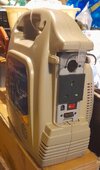
My kitchen has a void behind the units, so extension leads could be run out of sight, too much power for cooker, but depending on battery pack used, it could supply everything else, and could be fitted now, not need to wait until 27 August. And it can be configued as I want, not just what the kit allows, I had considered the idea as could use battery packs which could be used with other things, like a picnic. But in the main this old unit Back-up-power.jpg is not used that much, so likely neither would a new unit.
 
The law alteration has not been written by the trade bodies, so one can't expect it to make electrical sense.
No trade bodies ever write laws but they were widely consulted. It can't be any different, I'm sure the bodies don't agree 100% on everything anyway.
 
A Spur from a Ring Final Circuit is still a radial circuit that is merely using the Ring Final Circuit as its Distribution Circuit.
and yet the same applies to a Radial Final Circuit with Spurs etc too.

Just thought I would help to muddy the waters in case they actually need more muddying at all :unsure:
 
A Spur from a Ring Final Circuit is still a radial circuit that is merely using the Ring Final Circuit as its Distribution Circuit.
If this is a pedanticism competition :-) ....

I don't think that, per BS7671 definition of 'a circuit', an (unfused) spur could be a 'radial circuit' fed by a 'distribution circuit' - since the absence of an OPD between them means that the two bits together qualify as one single circuit!!

Ironically, a fused spur from a ring final could be described as the two circuits you mention (because n OPD separates them!)!

... but then it gets more complicated, because downstream of the FCU the spur is still 'protected' by the ring final's OPD (as well as by the FCU fuse) - so perhaps that situation is, at one and the same time , both 'one circuit' and 'two circuits' :-)

Kind Regards, John
 

If you need to find a tradesperson to get your job done, please try our local search below, or if you are doing it yourself you can find suppliers local to you.

Select the supplier or trade you require, enter your location to begin your search.


Are you a trade or supplier? You can create your listing free at DIYnot Local

 
Back
Top