Poll: Heating Concepts

Do you believe an immersion heater or radiator can appreciably heat water/air below it (see post)?


  • Total voters
    5
  • This poll will close: .
Joined
28 Jan 2011
Messages
61,850
Reaction score
4,808
Location
Buckinghamshire
Country
United Kingdom
In a lengthy ongoing thread of mine, I'm getting confused about 'who believes what'.

Considering a DHW cylinder with a horizontal immersion heater in it, or a CH radiator mounted part-way up a wall, do you believe that appreciable heating of the water/air below the heat source (immersion or rad) would occur, eventually to the point that the entire cylinder or room would be full of heated water/air?

Thanks for participating!

Kind Regards, John
 
Heat travels to cold.
Heat also risers but cools which causes it to circulate around a room. Up. Away. Down. Towards.

To your question. I don't know.
 
Heat travels to cold.
It's not really the heat which 'travels' but rather that substances (like water or air) which are less dense will rise through denser material ('float') or fall through less dense material ('sink') - that's why most woods float, whereas metals sink, when surrounded by water. Warmer water/air is less dense than cooler water/air, so will 'rise up' ('float through') any cooler (more dense) water/air above it.
Heat also risers but cools which causes it to circulate around a room. Up. Away. Down. Towards.
Rising up does not, in itself, result in cooling. However, when heated air or water rises (to top of room, cylinder or whatever) it will mix with the cooler air/water it travels through, and will also lose some some of its heat to the surroundings - so, as you say, it will cool - and, as you also say it is the heating (resulting in 'rising') and cooling (resulting in 'falling) that brings about a 'circulation'.
To your question. I don't know.
Fair enough. Can I ask you to tick the "Don't know" box?

Kind Regards, John
 
Hot water likely no, but this is the standard picture of how a radiator works.
circulation.jpg
So if we take a long tank with an immersion at one side, no reason why it should not do the same, so we are looking as the shape of the water tank. And put some dividers in the tank, or split it into two tanks and the flow could be increased.
 
Hot water likely no, but this is the standard picture of how a radiator works. <image> So if we take a long tank with an immersion at one side, no reason why it should not do the same, so we are looking as the shape of the water tank. And put some dividers in the tank, or split it into two tanks and the flow could be increased.
Sure, but that's not really the question, since the diagram shows the radiator at the bottom of the wall/room.

What if the radiator were mounted half-way up the wall (which is the sort of situation the Poll question was asking about)? Would you then expect appreciable heating of air below the radiator to happen?

[the Poll has been configured such that you can change your vote if you ever so wish]
 
Over the years many diagrams have been produced to show air flow,
circulation2.jpg
they do not take into account all items, and with double glazing and cavity wall insulation there must have been changes, but to stop the general flow as shown and leave a layer of cold air at the bottom the heater would need to be a fair way up the wall.

There are problems, like having the wall thermostat 90° wall to radiator, measuring the air just under the radiator would be best, so measuring return air, but measure just slightly to one side seems to work very well. i.e. the TRV.

There are still problems, reverse to picture we tend to put radiators under the window, which means until the flow has initiated, the TRV head is cooler than the room in general, due to being next to a cold wall, and some can be paired with a wall thermostat to get around this problem.

There is also the law problem, where they give the height of items to be viewed and items to be manually adjusted, these heights may not be the right height to sense room temperature. So I am sitting back to the window, and the sun has heated my desk thermometer showing 30°C behind me and low down the TRV is showing 20°C, and across the room the wall thermostat is showing 22°C the heating is not running, The desk thermometer can show rapid cooling when a cloud comes over, so I assume a lot of inferred heating, rather than air temperature.

But in general we want cool and hot spots in the room, to heat a cold window must waste heat when we do not sit in the window, but further into the room, and simple curtains can change the way the room is heated.

We do in the main want air movement, which is a problem with UFH as it does not circulate the air, as all the floor is heated.
 
Over the years many diagrams have been produced to show air flow, .... they do not take into account all items ...
All true, but this has really got nothing to do with the question I'm asking, not the least because all the diagrams show the normal situation of having the radiators with their bottoms more-or-less 'at floor level'.

In terms of room heating, the question I'masking related to the (hypothetical) situation in which the rad is higher up the wall - not because we're interested in that unrealistic situation, per se, but because its analogous with the heating of water with a heat source which is not at the bottom of the mass of water one wants to heat.

So, to clarify the actual question, do you believe that a rad 'half way up a wall' would heat the room right down to floor level (or do you believe that an immersion half way up a cylinder of water would heat the water right down to the bottom of the cylinder)? If your answer to that question is either 'yes' or 'no', I'd be grateful if you would change your vote accordingly!
 
We do in the main want air movement, which is a problem with UFH as it does not circulate the air, as all the floor is heated.

I would suggest the warmed air would rise in the middle of the room, and fall around the walls. With differences in temperature, you cannot not have air currents.
 
I would suggest the warmed air would rise in the middle of the room ....
Why would air at floor levelin the middle of the room (to where it had 'fallen' because it was fairly cool) be warmer than the ar above it (the necessary condition for it to 'rise') ?

Given that you have not been particularly shy about expressing your views, do you have an answer to the Poll question and, if so, is there any reason why you can't 'caste a vote'?
 
If the tank has a heater like this 1772544916823.pngthen even halfway up, it is likely to start a circulation, so we are looking at the shape of the container, and a rooms shape is not the same as a water tanks shape, we use a water tank shaped like a cylinder because we want it to not circulate, with some tea boilers we put baffles in them to stop the circulation so we get repeated cups of tea with a tap near bottom of the tank, we design the vessel so cold at the top and hot at the bottom, reverse to nature.
With the back boiler we wanted a tall tank and the water would be hottest at the top, and the water was circulated by the boiler putting hot into the top and drawing cold from the bottom, latter we used hot coils, so the water did not mix, but my childhood house, there was no hot coil, the Aga heated the actual water which came out of the taps, and the water did not suddenly go cold, but was more gradual as one ran a bath.

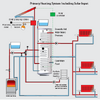
Today the digrams are more theoretical, the diagram here shows one tank, Torrent pipe example.PNG in real life there were two massive tanks upstairs so if there were a mains failure the water would still flow from back boiler to tank, and the floor was reinforced to take the weight.
It worked well, however it really has to be part of the house design, not an afterthought. The same goes for other ways to store heat, with the home built around the system, they work well, but not as an afterthought. UFH
1772546170923.png
has to be part of the design from the ground up. The Hypocaust has been around for a long time. But the early installations were not automated, that looks a nightmare to clean out!

I have talked about on another thread about having an under sink DHW heater, and as I progressed, I realised just as easy to boil a cup of hot water and add it to the cold in the bowl. Talking about it on the forum, made me realise today there is no real need for hot water from the taps. But getting a bit old in the few teeth I have left, to change.

My daughter has a shower in the evening, we would take a shower in the morning, reason she has one in the evening is in Turkey where they have their holiday home, water is heated by the sun, so more hot water in the evening.

 
Last edited:
Why would air at floor levelin the middle of the room (to where it had 'fallen' because it was fairly cool) be warmer than the ar above it (the necessary condition for it to 'rise') ?

Warm air, or water, rises. The heat source is in the floor, the floor area will be warmer the air above it, therefore it will rise. The air current will be rising in the middle, because the walls will be cooler. Basic common sense, in my view!

Given that you have not been particularly shy about expressing your views, do you have an answer to the Poll question and, if so, is there any reason why you can't 'caste a vote'?

I am not going to be drawn into it!
 
So, to clarify the actual question, do you believe that a rad 'half way up a wall' would heat the room right down to floor level (or do you believe that an immersion half way up a cylinder of water would heat the water right down to the bottom of the cylinder)? If your answer to that question is either 'yes' or 'no', I'd be grateful if you would change your vote accordingly!
I do not think your question is appropriate because, as it is written, I would say the answer (as far as the cylinder is concerned) is 'no' BUT that is because the immersion thermostat is also halfway up the cylinder and switching off the heating when the desired water temperature gets half way down the cylinder.

Were there no thermostat or there was one at the bottom of the cylinder then surely - eventually - all of the water would get hot.


So, the answer to your question as it stands is 'no' but with the proviso that it might not apply to the Willis.
 
I do not think your question is appropriate because, as it is written, I would say the answer (as far as the cylinder is concerned) is 'no' BUT that is because the immersion thermostat is also halfway up the cylinder and switching off the heating when the desired water temperature gets half way down the cylinder.
I've repeatedly said that thermostat location appears to be crucial to everything we've been discussing but, despite my having repeatedly asked the question, no-one has yet told me where the thermostat is in a Willi system, so I have been guessing/assuming that it is within the Willis heater. If so, the situation is identical to that with an internal immersion, with the stat switching off the heating when the desired water temp gets level with the Willis.
Were there no thermostat or there was one at the bottom of the cylinder then surely - eventually - all of the water would get hot.
One variant of 'common sense' would tend to agree with that. However, if that's what happens, I presume it would have to be (probably slowly) by conduction, since I can't see why ('by convection') heated water should fall through the cooler water below the heater?
So, the answer to your question as it stands is 'no' but with the proviso that it might not apply to the Willis.
As above, if the Willis has a thermostat (which I strongly suspect that it probably does), then I see no difference (in relation to the matter we're discussing) from any other immersion+stat.
 
Last edited:
Warm air, or water, rises.
Warm air, or water, rises through cooler air, or water, above it.
The heat source is in the floor...
Eh?
I am not going to be drawn into it!
The whole purpose of this Poll is an attempt to get 'straight answers' to the question of whether or not people believe that an immersion can appreciably heat the water below it, and you're not going to help that exercise by refusing to give a 'straight answer' :-)

There have so far been disappointingly few votes but, for what it's worth, no-one has yet voted 'yes' - not even the person who has been repeatedly asserting that such would be his answer :-)
 
I've repeatedly said that thermostat location appears to be crucial to everything we've been discussing but, despite my having repeatedly asked the question, no-one has yet told me where the thermostat is in a Willi system, so I have been guessing/assuming that it is within the Willis heater. If so, the situation is identical to that with an internal immersion, with the stat switching off the heating when the desired water temp gets level with the Willis.

The stat in the Willis, will be subjected to the convection flow of water, being drawn in at the base of the Willis. Only when both the Willis, and the main cylinder reach temperature, will the Willis stat open. However, the Willis system facilitates the inclusion of additional stats, on the main cylinder, so these could switch off before the Willis stat.
 

If you need to find a tradesperson to get your job done, please try our local search below, or if you are doing it yourself you can find suppliers local to you.

Select the supplier or trade you require, enter your location to begin your search.


Are you a trade or supplier? You can create your listing free at DIYnot Local

 
Back
Top