Poll: Heating Concepts

Do you believe an immersion heater or radiator can appreciably heat water/air below it (see post)?


  • Total voters
    5
  • This poll will close: .
With a Willis system, it can heat water effectively, below the element, in a none-Willis system it cannot.
That's what I don't yet understand.
The reason being, the Willis acts in some respects, as a 'pump', to enable the circulation.
That's just words. I need to understand how it is that it "acts in some respects as a pump".
 
With a Willis system, it can heat water effectively, below the element, in a none-Willis system it cannot. The reason being, the Willis acts in some respects, as a 'pump', to enable the circulation.
What do you believe would happen if (after somehow 'waterproofing' the electrics!) you installed a Willis heater in the middle of the cylinder?
 
More to the point is what do you think would happen?
Well, I find it hard to see that a 'Willis heater" in the middle of the cylinder would be materially different from a standard immersion in the same place, don't you?

If Harry believes differently from that , I would like to understand why.
 
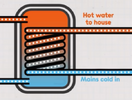
My house the DHW is in the cylinder, and the CH water is in the coil, however there is a move to reverse this 1772721327885.png and heat the DHW as required. This has the advantage that we are not coming into contact with stored water, so the legionnaires problem is no longer there, the stored water can be treated.
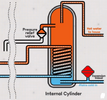
Also, the cylinder is not mains fed, so the annual tests are not required, and smaller so expansion vessels, and pressure release valves not required as with old types 1772721750399.png and we have DHW at mains pressure. Mainly due to use of heat pumps, where the water is cooler, so legionnaires was causing a real problem.
I am not sold on the heat pump, it has to me some fundamental flaws, stops working with an electric power cut, and all rooms heated 24/7 not just when needed, so it will be more expensive to run, due to heating rooms which are not required. However, some of the by-products developed are changing the whole idea of DHW.

The problem however as I see it, is that it is unlikely to be as shown, it will need a fair amount of surface area to transfer the heat, fast enough to supply a shower, so the cylinder likely already has baffles in it, being the actual heat exchanger, my hot coil in my old cylinder can't transfer the heat very well.

So fire the boiler (20 kW) and after 20 minutes the return water is too hot for the boiler to continue to run, so it moves to a mark/space ratio turning off and on again while it waits for the heat to transfer. I tried using the boiler for DHW when I first moved in, and found it was all a bit hit-and-miss, with no thermostat on the cylinder, so it was guess work on how long to run the boiler, the programmer could only be set with ½ hour slots, so it was too much ½ hour a day, and not quite enough ½ hour 4 days a week, and I was considering putting the immersion on a timer, so it turned on after the boiler had run, to top up the cylinder temperature, as no wire's cylinder to boiler location.

However, had solar fitted, and so also split tariff, so stopped using CH to heat the DHW, and all now done with the immersion heater.

I looked at the Willis system before and after moving to solar, the immersion heater is fitted upside down, and has two or more thermostats one in the immersion heater which I am not sure how well it will work when the unit is upside down? We may well be getting pulsed heating, as the immersion turns on and off, and also since using pulsed DC anyway, not sure on how this would affect how it works, and it was simply not worth the risk to fit it, when the Welsh plumbers had no idea of how it works.

So even if the best system in the world, I do not want to be a guinea pig, so not fitting it. I did fit solar panels, and did then double up on battery size, yesterday was the first day this year I got a reasonable return from them
1772724017835.png
double what I use, and their installation has resulted in a change in lifestyle to use the output from them, I do not want to further complicate things by adding Willis. Chat about it yes, but even the under sink heater when wife gets her new kitchen is not clear, a cup full of boiling water in the washing up bowl heats it enough.

 
What do you believe would happen if (after somehow 'waterproofing' the electrics!) you installed a Willis heater in the middle of the cylinder?
Do you mean a Willis with its pipes almost reaching the top and the bottom of the tank or a 'naked' Willis (oooh errr), i.e. just the immersion element like an immersion element?
 
My house the DHW is in the cylinder, and the CH water is in the coil, however there is a move to reverse this <image> and heat the DHW as required.
Would that really work? - i.e. would DHW, at a sensible flow rate, get heated to the desired temp with just one pass through the coil?
 
Do you mean a Willis with its pipes almost reaching the top and the bottom of the tank or a 'naked' Willis (oooh errr), i.e. just the immersion element like an immersion element?
Any of those, really, but what was in my mind was a 'naked' one.

From your question, do I take it that you believe that the Willis's 'pipes'are a crucial factor?
 
Would that really work? - i.e. would DHW, at a sensible flow rate, get heated to the desired temp with just one pass through the coil?
Yes it works, brothers-in-law old house had it, and it worked well. Basic idea is to bring many heating units together
Torrent pipe example.PNG
Diagram shows a single tank, in real life it was two massive tanks, and it would keep house above freezing while he was visiting his children in Germany, and one arriving back, at airport he would raise the temperature and arrive home to a warm house, all heated with solar.
 
Any of those, really, but what was in my mind was a 'naked' one.
Ok, then the same as an ordinary immersion would be.

From your question, do I take it that you believe that the Willis's 'pipes'are a crucial factor?
Of course I do; they are; do you not?

They decide where the Willis' heated water goes to and the 'to be heated' water comes from.


I really do not understand your difficulty but I am sure you would be much better helped by concentrating on the gravity fed back boiler system and substituted the back boiler with a Willis.
 
Yes it works, brothers-in-law old house had it, and it worked well.
I'm amazed! I would not have dreamed that one would be able to get an adequate flow of adequately hot water after the cold mains water had had just one pass through the coil! ...
Basic idea is to bring many heating units together
Fair enough, but that's just an added complication which dos alter what I've written above!
 
Ok, then the same as an ordinary immersion would be.
Glad you agree.
Of course I do; they are; do you not? They decide where the Willis' heated water goes to and the 'to be heated' water comes from.
Your "of course" is akin to Harry's repeated "obviously"s :-)

The heated water will 'go to' the top of the cylinder whether or not there is a pipe, so I don't really understand what difference that pipe makes.

As for "where the 'to be heated' water comes from", that takes me back to what I was saying about the basic concept of simple convection. As I illustrated with my 'test tube' scenario, when water heated at the bottom of the tube it does not 'push up' the cold water above it (which would be a way of creating 'a pump') but, rather, displaces the hot water above it. In other words, cold water which was initially above the heated water ends up being below the heated water. Since no cold water has been 'pushed up', there is no need for any 'to be heated' cold water to be 'drawn in at the bottom (not that it could be with a test tube :-) ))
I really do not understand your difficulty but I am sure you would be much better helped by concentrating on the gravity fed back boiler system and substituted the back boiler with a Willis.
I don't really understand why such 'concentration' would help me. Remembering that my one outstanding problem is in understanding how the Willis system heats water in a cylinder below its level, that's not something that a "gravity fed back boiler system" usually does, since the heat source (back boiler) is usually on the ground floor with the cylinder on a higher floor.

If you are suggesting that an unpumped back boiler system on an upper floor could successfully heat the water in a cylinder on a lower floor, then I would probably have as much difficulty in understanding that as I do in understanding how a Willis heater can heat water below its level.
 
No. You need to concentrate on the water that is being pushed/drawn into the Willis' bottom tube, where it comes from and its temperature compared to an immersion element inside the cylinder.

1772730565521.png
 
.... The Willis system works, in many thousands of applications, so how can it not work.
I've been pondering how to respond further to that comment, since it clearly deserves an answer.

If the Willis system is being used in the ('efficient') method recommended (i.e. to always heat water 'on demand', and hence wait for the desired volume to heat up) by large numbers of people in the island of Ireland, then I would image that, for the vast majority of them, it does indeed 'work' per their needs and expectations. The most heated water they are likely to need would be for a shower, and that probably only amounts to 25% or so of a DHW cylinder';s capacity - probably well above the level of the Willis heater.

If my 'theory' were correct, the only situation in which they would discover that the system did not 'work' to the extent they would like would be if they wanted a large volume of hot water (for which they would have to wait a long time!), such as for a bath - and maybe they are usually 'warned' at the time of installation (or proposed installation) of a Willis system that it is not suitable for that?
 
You've 'jumped' :-) . Since you said that I should be thinking about a gravity fed back-boiler system, before I respond to this latest message could you possibly 'respond to' ...
.... If you are suggesting that an unpumped back boiler on an upper floor could successfully heat the water in a cylinder on a lower floor, then I would probably have as much difficulty in understanding that as I do in understanding how a Willis heater can heat water below its level.
 

If you need to find a tradesperson to get your job done, please try our local search below, or if you are doing it yourself you can find suppliers local to you.

Select the supplier or trade you require, enter your location to begin your search.


Are you a trade or supplier? You can create your listing free at DIYnot Local

 
Back
Top