
You are using an out of date browser. It may not display this or other websites correctly.
You should upgrade or use an alternative browser.
You should upgrade or use an alternative browser.
Radial
- Thread starter mjtefc9
- Start date
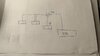

Spur or branch - same thing.
I presume there is supposed to be a gap between the two cables on the other socket.

I presume there is supposed to be a gap between the two cables on the other socket.
Spur or branch - same thing.
I presume there is supposed to be a gap between the two cables on the other socket.
View attachment 241747
Sorry yes correct
A radial is all spurs, in a way.
It could be argued in a pedantic way that the two leftmost sockets are spurred via the junction box.
But yes, to keep things nice and simple, the socket on the right could be classed as a spur.
With a radial circuit, you can branch or spur off any point as many times as you like - so every point could in fact be classed as a spur.
It could be argued in a pedantic way that the two leftmost sockets are spurred via the junction box.
But yes, to keep things nice and simple, the socket on the right could be classed as a spur.
With a radial circuit, you can branch or spur off any point as many times as you like - so every point could in fact be classed as a spur.

- Joined
- 27 Jan 2008
- Messages
- 29,636
- Reaction score
- 3,664
- Location
- Llanfair Caereinion, Nr Welshpool
- Country

I would say where BS1363 is concerned where the over load protection is the BS1362 fuse it is a spur, where the over load protection is a non BS1362 device then a radial or ring final.
The whole idea of the BS1363 plug and socket arrangement is the fuse in the plug means we can have a 30 or 32 amp supply to multi 13 amp or less devices due to the fuse in the plug. We can either double up on 2.5 mm² or we can use 4 mm² the other option is not to use a 30 or 32 amp supply but this means it is more likely that the total load is exceeded this is 20 amp radials are not a good idea, they are too easy overloaded opening the overload device.
The whole idea of the BS1363 plug and socket arrangement is the fuse in the plug means we can have a 30 or 32 amp supply to multi 13 amp or less devices due to the fuse in the plug. We can either double up on 2.5 mm² or we can use 4 mm² the other option is not to use a 30 or 32 amp supply but this means it is more likely that the total load is exceeded this is 20 amp radials are not a good idea, they are too easy overloaded opening the overload device.
It's interesting that flameport describes a branching radial as a 'mess' and says that new radial circuits should never be designed with branches.
His illustration is of a sockets radial circuit, but I wonder if he would say the same about radial lighting circuits - which, in my (limited) experience, very commonly do have (often multiple) branches?
The only specific thing he says against branching rings is that it is difficult to identify which socket is 'the end of the circuit' (by which I assume he means the one furthest from the CU/DB) - and I can only think that could be relevant to someone testing who wanted to determine the 'maximum Zs' or 'maximum VD' in the circuit.
However, unless one was prepared to guess, would it not be as 'difficult' with a non-branching radial, since, in both cases, one would still have to undertake measurements at each and every socket in order to be certain which was the (electrically) furthest from the CU/DB?
Kind Regards, John
Last edited:
Yes, if I understand your wording correctly, that's essentially correct.Thanks all.. Just for my own piece of mind... you cannot double spur from a ring unless you introduce a FCU.. but with a radial as stated you seem to be able to spur off multiple times.. is that correct ?
As you have probably gathered, the terminology is confusing and many people (including myself) do not talk about 'spurs' in relation to radials, only 'branches'. As you suggest above, provided only that the same size cable is used throughout, you can have as many branches in a radial as you like.
Technically, the point is that with a ring circuit, the cable used is not large enough to carry the 'maximum current' of the circuit (usually 32A, defined by a 32a 'breaker'), so every socket needs two cables back to the CU/DB. A spur only has a single cable, not large enough to carry that 'maximum current', and therefore could not safely supply 'a string of sockets'. However, if it is feeding just one double socket, there is no risk of the cable being asked to carry more than it's rating - which is why a spur without an FCU is limited to supplying one socket. With a radial, all of the cable is capable of carrying the circuit's 'maximum current', so it does not matter how the circuit is arranged.
I am assuming that when you talk of "double spurring", you refer to having a spur from a ring, and then connecting a further socket (another 'spur') to that 'spurred' socket - in which case the above comments apply.
However, even with a ring you can (with certain caveats) originate more than one spur, each supplying just one socket, from the same point in the ring (i.e. a socket or junction box).
Kind Regards, John
Not really. It depends on the size of the cable used whether fusing-down is required or not.Just for my own piece of mind... you cannot double spur from a ring unless you introduce a FCU.. but with a radial as stated you seem to be able to spur off multiple times.. is that correct ?
Whilst that is technically true, I don't think it alters the fact that the answer to the important/relevant part of the OP's question is 'yes' - i.e. that, provided only that one does not use smaller cable than for the rest of the circuit (which I doubt anyone would even consider) one can have as many branches one wants, arranged in any way one wants, without FCUs, in a radial circuit.Not really. It depends on the size of the cable used whether fusing-down is required or not.
In terms of ring finals, although we talk about it a lot, as a theoretical possibility, have you ever actually seen anyone install a 4mm² unfused spur (supplying multiple sockets) from a 2.5mm² ring final?
Kind Regards, John
I have not. I wonder why that would be.In terms of ring finals, although we talk about it a lot, as a theoretical possibility, have you ever actually seen anyone install a 4mm² unfused spur (supplying multiple sockets) from a 2.5mm² ring final?
Anyway, the fact that an FCU is required on a spur (with more than one socket) from a ring is because the 2.5mm² spur cable is inadequate for the 32A MCB - NOT because it is a ring circuit.
The same applies on a 32A radial.
I suspect primarily because it does not appear as an 'example' in Appendix 15, coupled with the fact that (for the same reason) people want to avoid subsequent hassle/arguments with 'inspectors'!I have not. I wonder why that would be.
Quite so.Anyway, the fact that an FCU is required on a spur (with more than one socket) from a ring is because the 2.5mm² spur cable is inadequate for the 32A MCB - NOT because it is a ring circuit.
It does, indeed, and Appendix 15 does, in this case, indicate options for a 4mm² radial corresponding to the examples given for ring finals - i.e. an 'unfused spur' in 2.5mm² cable supplying just one socket and a 'fused spur' allowing an unlimited number of sockets to be fed with 1.5mm² cable following an FCU.The same applies on a 32A radial.
Kind Regards, John
I can see a couple of reasons such a "fat spur" might be considered troublesomeI have not. I wonder why that would be.
1. It likely increases the chance of ring balance issues. Especially if an initially short "fat spur" gets extended later.
2. It increases the chance of screwups later. e.g. Electrian A installs a spur in 4mm² due to an adverse installation method and then years later Electrian B extends the spur thinking it's a "Fat Spur" (granted similar issues could occur with a 4mm² spur from a 4mm² radial where the spur wasn't actually rated to 32A due to an adverse installation method) .
That applies to anything you have done.

DIYnot Local
Staff member
If you need to find a tradesperson to get your job done, please try our local search below, or if you are doing it yourself you can find suppliers local to you.
Select the supplier or trade you require, enter your location to begin your search.
Please select a service and enter a location to continue...
Are you a trade or supplier? You can create your listing free at DIYnot Local
Similar threads

- Replies
- 12
- Views
- 2K