• Looking for a smarter way to manage your heating this winter? We’ve been testing the new Aqara Radiator Thermostat W600 to see how quiet, accurate and easy it is to use around the home. Click here read our review.

Renewing clay waste pipe

Joined
18 Jun 2011
Messages
85
Reaction score
0
Location
Yorkshire
Country
United Kingdom
Hi
My concrete path has been sinking along the side of my house, along with soil pipe underneath, for quite awhile and has dropped a full brick size now, have had a camera up it and water is pooling quite a bit from the end, so am going to replace part of the clay pipe with PVC, the concrete path is about 190mm thick ( why that thick !) so my thought is cutting a channel about 600mm wide for about 5 Mtr from the end where the drain gulley is, then hopefully break up the concrete with a jack hammer, cut the clay pipe and join with PVC , will that be the best way to do it ?.

PS: The house itself is built on a concrete slab, I think because it is built on a slight incline !
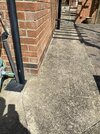
 

Attachments

  • IMG_5926.jpg
    IMG_5926.jpg
    803 KB · Views: 33
  • IMG_5928.jpg
    IMG_5928.jpg
    644.9 KB · Views: 33
I've done similar before. It's possible that the concrete isn't actually that thick but was laid on rubble, so may have a layer of rock or smashed brick stuck to its underside.

It's likely that the ground beneath will have sunk away, so if you cut the middle out the sides could tip inwards into your trench. I managed to do mine by leaving 20-30cm lengths of my pipe run intact every 1.5m or so and fed the pipe under these bridges, with a few extra cuts and couplers needed.

But my slab was about 3x wider than yours so there was more to preserve or replace. Looking at what you've got I'd save the time and effort of cutting and messing about, just take the whole lot up, get a nice clear trench to work in and replace with new.

I'm guessing that your place is 1950s-ish, the same as mine. In my case I replaced every underground pipe, they were all beyond their lifespan and leaking all over the place. Approach with an open mind, prepare for this being the start of a bigger project.
 
cut the clay pipe and join with PVC , will that be the best way to do it ?.
When Thames water replaced our pitch fibre drains a few years ago, they used clay pipes encased in pea shingle with rubber connectors. I was surprised they didn’t use plastic but they said clay was stronger.
 
That may or may not be the case, or it may be that they're on the plastic-reducing eco cause.

I found all my clay pipes had cracked due to ground movement. I doubt there would have been enough movement to crack plastic, but plastic didn't exist in the 1950s. They were the old socketed type, with a socket moulded into one end of each. I think they were mortared together so had absoutely no flexibility and probably cracked from about day two when they were buried.

Standard brown plastic pipes with pushfit fittings will probably outlive us all. If the ground moves they'll bend a bit or pivot at the joints.

I replaced an old pitch fibre (+asbestos!) drainage pipe run 50m across our field with 150mm twinwall plastic. Hopefully these are pretty indestructible, I've seen stacks of them alongside motorways waiting to go in so they're hopefully about as good as you get. It's all still working after several massive tractors have driven over them anyway.
 
I've done similar before. It's possible that the concrete isn't actually that thick but was laid on rubble, so may have a layer of rock or smashed brick stuck to its underside.

It's likely that the ground beneath will have sunk away, so if you cut the middle out the sides could tip inwards into your trench. I managed to do mine by leaving 20-30cm lengths of my pipe run intact every 1.5m or so and fed the pipe under these bridges, with a few extra cuts and couplers needed.

But my slab was about 3x wider than yours so there was more to preserve or replace. Looking at what you've got I'd save the time and effort of cutting and messing about, just take the whole lot up, get a nice clear trench to work in and replace with new.

I'm guessing that your place is 1950s-ish, the same as mine. In my case I replaced every underground pipe, they were all beyond their lifespan and leaking all over the place. Approach with an open mind, prepare for this being the start of a bigger project.
Yeh, built 1964, yes, you are right , best to remove part of the path in question , which is around 6 Mtr and 3 Mtr round the corner , I did a cut into it awhile back with my Stihl saw and it cut down full cut of new blade , still solid concrete !.
So I think I will do some cuts along the path with the floor saw ( will cut around 185mm) then hopefully jack hammer then !.
 
110mm plastic underground pipe, bed on peagravel, get the fall where it needs to be then surround with more peagravel. Backfill needs to be selective for the first few inches, no stones or big lumps, that could damage the pipe.


Clayware is nowhere near as widely used now for House Drains, it's heavier, brittle, awkward to cut and chamfer, and take longer to lay. Not the stuff for DIY.
 

If you need to find a tradesperson to get your job done, please try our local search below, or if you are doing it yourself you can find suppliers local to you.

Select the supplier or trade you require, enter your location to begin your search.


Are you a trade or supplier? You can create your listing free at DIYnot Local

 
Back
Top