Replacing a socket

Joined
3 Aug 2009
Messages
277
Reaction score
7
Location
Somerset
Country
United Kingdom
Hello
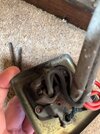
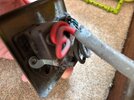
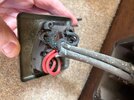
I thought this would be straightforward but after taking the socket apart I just want to clarify before anything goes wrong.
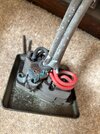
See attached images showing the rear of the socket. Is the red live (there’s 2 cables) neutral black (again 2) and earth the twisted one?
Is quite an old house..
Cheers
 

Attachments

  • IMG_2985.jpeg
    IMG_2985.jpeg
    741.7 KB · Views: 60
  • IMG_2986.jpeg
    IMG_2986.jpeg
    720.9 KB · Views: 65
  • IMG_2987.jpeg
    IMG_2987.jpeg
    569.8 KB · Views: 55
  • IMG_2988.jpeg
    IMG_2988.jpeg
    636.3 KB · Views: 56
  • IMG_2989.jpeg
    IMG_2989.jpeg
    1.1 MB · Views: 61
I thought this would be straightforward but after taking the socket apart I just want to clarify before anything goes wrong.
Why have you changed your mind?

Is the red live (there’s 2 cables) neutral black (again 2)
Well, yes they should be unless someone has done something stupid.


and earth the twisted one?
Yes.


Cables are very corroded. Strip them back until the wires are shiny copper.
 
Already have it a go and it’s working ok.
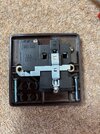
The old one has just rusted inside which is why the top pin wouldn’t allow me to plug anything in.
I’ve since put some silicone spray in and it’s released it. Presumably doing this when disconnected is ok and could reuse it in the future (it’s much more substantial than these plastic ones!)?
 
The old one has just rusted inside which is why the top pin wouldn’t allow me to plug anything in.
I’ve since put some silicone spray in and it’s released it.
Ok.

Presumably doing this when disconnected is ok and could reuse it in the future (it’s much more substantial than these plastic ones!)?
A poor contact might cause overheating so - as long as it doesn't get hot it should be alright.
 
Hmm the cable is a bit past its best.

(Line and Neutral are BOTH considered as "Live" conductors = conductors that normally carry current as part of their intended function ).
We should expect the Reds to be Line and the Blacks to be N if done correctly and the twisted stuff to be E.

E should not normall carry current (or not much in reality) as part of its intended function but during a fault could do so.

Obviously we would verify with a glance at everything else it is what it looks like before anything else by use of test equipment really.

One question to bear in mind with the cable in the state shown is are there other parts that could do with some attention.
( Do you have an RCD protecting all circuits is one such question - there are more questions too!).
 

If you need to find a tradesperson to get your job done, please try our local search below, or if you are doing it yourself you can find suppliers local to you.

Select the supplier or trade you require, enter your location to begin your search.


Are you a trade or supplier? You can create your listing free at DIYnot Local

 
Back
Top