Replacing fluorescent tubes

Joined
15 Aug 2009
Messages
39
Reaction score
0
Country
United Kingdom
Hello
I have 6ft fluorescent light fittings in my garage but as tubes are no longer available (other than eBay), can LED tubes be used as direct replacements?
Also, I've read that dummy LED starter is required, is that correct and what specifically is this?
Thank you
 
Its realy easy just to replace the whole fitting,

most people with a bit of know how can do it?
 
Yes, with a wire wound ballast type you can replace the starter for a special fuse, and simply fit a LED tube. The old ballast absorbs some energy, so you get around 95 lumen per watt and the tube has around half the output of the fluorescent it replaced.

Rewiring the fitting will increase the lumen per watt, from this LED before converter.png to this LED tube wiring.jpgso the ballast is completely removed. As to if this or complete new fitting is best, is down to if bright enough, and if you want a fitting where you can change the tube or one which needs a whole new lamp fitting when it hits end of life.

Whole new fitting in general gives more lumen per watt.
 
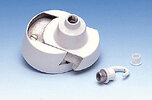
The dummy starter is only used if your old fitting is old enough to have a normal starter.
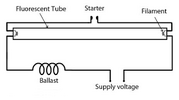
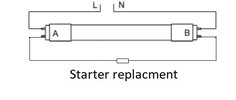
If you look at the drawing above on a old style starter fitting Live and Neutral are at opposite ends of the tube, the dummy starter simply brings one end connection to the other end connection.
L and N become at one end now to feed the new led tube.
With more recent tube fittings the dummy starters not required as the tube runs on a High Freguency ballast
 
With more recent tube fittings the dummy starters not required as the tube runs on a High Freguency ballast
I have noted, there are tubes now designed to work with an electronic ballast, but the early tubes were not to be used with electronic ballasts.

I have seen diagrams where only one end is fed, the other end of the tube is a dead short between the pins, so putting the tube in wrong way around will mean a dead short, to wire up, so this can be done, seems wrong, I have seen labels to show which way around to fit tube, but as said to wire, so the error can be made seems just wrong.
 
I would suggest that buying new complete units is the better way forward
The question is maintenance, even with units which plug into some fixed outlet, will they still be available in 3 years time when the unit fails? I went for plug in unit Ceiling rose.jpg now withdrawn, OK I can reuse this with another chandelier, so
in my garage
they may be on jack chains, so can arrange so it hooks up and plugs in. In which case great. But then why not simple pendent bulbs? The main reason for the fluorescent was spread of light and better lumen per watt. Today the simple LED bulb has good lumen per watt, so for use batten lamp holders
1773580847991.png
allow one to aim the light better to where required to a LED batten. I looked, around £20 and 50 watt. Compared with this
1773581114663.png
it is a garage, is not 28 watt enough? OK the new batten is 6000 lumens and the tube 2520 lumens but do you need the 6000 lumens, or was the 6 foot simply to stop shadows?
 
I know this is an old thread, but I’ve just replaced a fluorescent tube and a couple of things puzzle me.

No problem getting the right length, 1.2m, and it works OK. Jacobsen, made in China naturally, from B&Q.

The 2 leaflets that came with it refer to fluorescent and LED types. Says “battens” which I assume means the ceiling unit it goes into, but I’ve not heard it called that before.

Says
1A (pic shows tube and starter)
Installation in fluo battens only.
Only compatible with ferromagnetic battens used with LED starter and LED replaceable patterns. Not compatible with battens operating with electronic ballasts.

And
1B (pic shows tube only)
Installation in LED battens only. No starter required.
IMPORTANT: LED tubes must be installed with the arrow close to mains supply connection. (AC input)
If installation way is not correct, tube would be damaged.

Does this mean the tube can function as fluorescent or LED, determined by the “batten” it goes in to?

Just to see what would happen, I tried it with no starter and it didn’t light. I tried it with the old starter and it didn’t work properly, can’t remember whether it flickered.
With the supplied starter it works fine, lights instantly without the traditional initial flickering.

Interested in any comments.
 
t's a LED tube. It functions the same way in either type of fitting (batten), the difference is how the power is gets to it. The supplied "starter" is not a starter, just a link/fuse that completes the circuit. Similarly, between the pins at the end of the tube that does not have the arrow is also a link (possibly a fuse link) which could/would/should blow if you connect the tube the wrong way round. Battens with HF ballasts can quite easily be modified to work too - see post #3 above.
 
Last edited:
t's a LED tube. It functions the same way in either type of fitting (batten), the difference is how the power is gets to it. The supplied "starter" is not a starter, just a link/fuse that completes the circuit. Similarly, between the pins at the end of the tube that does not have the arrow is also a link (possibly a fuse link) which could/would/should blow if you connect the tube the wrong way round. Battens with HF ballasts can quite easily be modified to work too - see post #3 above.
Thanks. My fitting will be fluo type, over 30 years old, so I assume there isn't a wrong way round. The "starter" being just a link accounts for no light when I left it out!
Could I remove (or bypass) the ballast in #3? Not that I'd want to, it gives OK light.
 
The old "ferromagnetic battens" ballast is in essence just a coil of wire, as shown here
1793723159526.png
and fitting a LED tube means the coil of wire reduces the voltage a bit and heats up a bit making the light less efficient but it will still work once the started is renewed.

The electronic ballast is far more complex, it is in essence a switch mode power supply, which regulates the output to old fluorescent tube, making it far more efficient, they were first used to allow fluorescents to work with 12 and 24 volt supplies, but latter were used with mains supplies, as to how they will work with LED units is a bit hit and miss.

But magnetic ballast has two connections, and electronic likely six connections, so removing the cover easy to see, and magnetic in the main uses a starter, and electronic don't. There were some magnetic without a starter but you would be very unlucky to find one of them today.
 
The old "ferromagnetic battens" ballast is in essence just a coil of wire, as shown here View attachment 425752and fitting a LED tube means the coil of wire reduces the voltage a bit and heats up a bit making the light less efficient but it will still work once the started is renewed.

The electronic ballast is far more complex, it is in essence a switch mode power supply, which regulates the output to old fluorescent tube, making it far more efficient, they were first used to allow fluorescents to work with 12 and 24 volt supplies, but latter were used with mains supplies, as to how they will work with LED units is a bit hit and miss.

But magnetic ballast has two connections, and electronic likely six connections, so removing the cover easy to see, and magnetic in the main uses a starter, and electronic don't. There were some magnetic without a starter but you would be very unlucky to find one of them today.
Thanks. Am I right thinking they're all LED type nowadays, so don't need a ballast (but ballast left in is OK)?
 
Last edited:
Yes - unless you have a really pressing reason once all things are considered in depth.
The easiest, most prudent, answer is almost always just to replace the whole thing.

An absolute brilliant (no pun intended) idea in its day and for many years, in many places the best option was the beloved fluoro.
However, fluorescent has just about had its day.
LED is here and now and is the sensible way to go.

From Filament lamp to Fluorescent then likewise from Fluorescent to LED the changes in the combination of light output versus colour rendition versus spread evolved into no simple direct corelation between technologies.
The largest driving force was running costs then came the "tweaks" and the "Suck it and see" again and again ad infinitum.

A lot of modern ways have evolved with similar benefits and similar problems.
 
Fluorescent with electronic ballast was around 95 lumens per watt, and LED around 110 lumen per watt, longevity about the same, but tubes with LED far more expensive, so really only advantage is LED uses arsenic, where fluorescent used mercury, so not that much between the two.

Compare a magnetic ballast fluorescent at around 80 lumens per watt and shorter life, then yes, LED better, however since can't get fluorescent any more, does not really matter.
 

If you need to find a tradesperson to get your job done, please try our local search below, or if you are doing it yourself you can find suppliers local to you.

Select the supplier or trade you require, enter your location to begin your search.


Are you a trade or supplier? You can create your listing free at DIYnot Local

 
Back
Top