There are two 1mm² CPCs in the ring?

Yes, I thought about that. However, if a fault occurs very close to one end of the ring, almost all the fault current will flow through the CPC of the 'short route', so I suppose one has to design on the basis of that 'worst case' scenario?There are two 1mm² CPCs in the ring?
Good question. If the assumptions underlying my recent calculation (hence the answer!) are roughly correct, they should have realised that it was inadequate for a 30A BS3036 fuse.If the 1mm² CPC in 2.5mm² T&E had to be increased, why was it there in the first place?
True, but if all that is required is actually 1.18mm² then...Yes, I thought about that. However, if a fault occurs very close to one end of the ring, almost all the fault current will flow through the CPC of the 'short route', so I suppose one has to design on the basis of that 'worst case' scenario?
... "then" (if that calculated figure is actually correct), given that the fault could be 'infinitely close' to one end of the ring, then the CSA of the CPC would have to be at least 1.18mm² - which, as I said, is clearly more than 1.0mm² - which, as I said, begs your question as to why 1.0mm² was ever used (in the days when 30A 3036s were probably 'the norm').True, but if all that is required is actually 1.18mm² then...

Reluctant to change from what? Given that they were producing an 'equivalent' to 7/0.029", they surely must have known/noted/discovered that the CSA of its 3/0.029" CPC was about 1.28 mm² - and one would therefore have thought that they would have done some calculations to check 'adequacy' before 'rounding that down' to to the substantially smaller 1.0 mm², wouldn't one?My guess is that nobody noticed. Or if they did they were reluctant to change ...
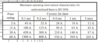
As I said last night, the problem I had was in trying to ascertain the appropriate value of I²t for a 30A BS3036 fuse to use for an adiabatic calculation. The best I can currently do is to look at the 'bottom end' of the characteristic curve for a 30A BS3036 in the Appendix of BS7671. That indicates a disconnection time of 0.1 sec at a current of about 430A.
That equates to an I²t of 18,490 A²sec.
What if a 3036 never gets any faster as the current increases?....'worst case' scenario?
Yes, I saw that table which suggested 450A for 0.1sec disconnection time with a 30A BS 3036, but I decided to go with the graph instead - not easy with the log scale, but clearly a bit lower than 450A, which is why I estimated ~430A.<paste from Fig 3A2(a) of BS7671>
 ).
).That's why, as I said, one needs to know the I²t at the actual PFC of the circuit - and neither the graphs nor the table in BS7671 go below 0.1 sec (hence above a PFC of 430/450 A, as above). If, as you have postulated, disconnection time remains as 0.1 sec when PFC rises above 430A (or 450A!), there's not actually any need to consider the actual value of I²t in the way you have done, since the calculation then simply reduces to:What if a 3036 never gets any faster as the current increases?
View attachment 224667
One can apply the Mk.1 eyeball curve extrapolator.neither the graphs nor the table in BS7671 go below 0.1 sec (hence above a PFC of 430/450 A, as above).
Sure, but one doesn't have to rely on eyeballs to do the extrapolation - once one has managed to read a few points reasonably accurately off the curve, it can easily be mathematically modelled (in fact, the log-log curve is almost straight from about 150A onwards). However, what we obviously don't know whether the actual behaviour of the fuse beyond what is shown on the curve (i.e. above about 450A) is anything like what we would expect by extrapolation (whether 'by eyeball' or by mathematically modelling) ...One can apply the Mk.1 eyeball curve extrapolator. Might work better on a piece of paper without the fuse rating legend, but on a screen one can get some kind of idea.
What if a 3036 never gets any faster as the current increases?
Oh that's scary, can I ask your age please?Is that a graph of logarithmic values? Is this something that a qualified electrician should be expected to understand because I can barely remember them and this type of calculations is Advanced and I don't think you'd cover that at GCSE mathematics level. It's used in A level sciences but not below that I don't believe
The actual 'values' (seconds and amps) are the actual values but, yes (as can be seen from the spacing of the values and of the dashed gridlines) both the vertical and horizontal axes of that graph are logarithmic. The range of values is such that, if that weren't the case, the graph would be impossible to use.Is that a graph of logarithmic values?
The blue curve in my graph is nothing more than a magnified version of part of one of the graphs for all types of fuses and MCBs which appear in the Wiring Regulations (BS7671) and are the standard source of reference for such information used by all electricians.Is this something that a qualified electrician should be expected to understand ...
No mathematics or calculations, advanced or otherwise, is needed to use the graphs. For 'practical use', all that anyone (e.g. an electrician) needs to be able to do is to 'read figures' from the graph - and I'm sure that I was not alone is being able to do that before I left primary school.... because I can barely remember them and this type of calculations is Advanced and I don't think you'd cover that at GCSE mathematics level. It's used in A level sciences but not below that I don't believe

If you need to find a tradesperson to get your job done, please try our local search below, or if you are doing it yourself you can find suppliers local to you.
Select the supplier or trade you require, enter your location to begin your search.
Are you a trade or supplier? You can create your listing free at DIYnot Local