• Looking for a smarter way to manage your heating this winter? We’ve been testing the new Aqara Radiator Thermostat W600 to see how quiet, accurate and easy it is to use around the home. Click here read our review.

RTS turn off

I would expect the electrical distribution industry to have reasonably accurate records of how many dual-rate meters there are
Those records presumably must be virtually 'totally accurate' since, if they were not, they would not be able to billsome of their customers?
, but I could well see records being poor as to which installations had radio teleswitches vs which had traditional time clocks.
That's undoubtedly true. As I've said, I've has E7 (hence dual rate meters) for about 40 years, initially with an external electromechanical time switch and for the last couple of decades or so 'dumb' electronic meters with some sort of internal clock - but never a radio teleswitch.
 
Those records presumably must be virtually 'totally accurate' since, if they were not, they would not be able to billsome of their customers?
I could well imagine there being cases where a dual-rate meter was installed, but only one of the two registers was being read/billed.
 
I had E7 but never had a radio teleswitch actually I had never heard of it until my electric supplier sent me warning letters that if I did not have a smart meter then my heating wouldn’t work ( I have been on a single rate with them for about 15 years )which was after I realised that it was costing me MORE on E7 due to the extra standing charge and the extra cost of the day rate compared to a single rate.
I give the low and normal readings and they are juts added up as one.
I still now put the dishwasher and washer on overnight from when I was trying to benefit from E7 but as I did not have storage heating then I never used enough electricity to compensate for the extra cost of the day and standing charge. -- Felt scammed.
 
Those records presumably must be virtually 'totally accurate' since, if they were not, they would not be able to billsome of their customers?

Suppliers, have gone through several iterations, so I would not expect many/any of the present suppliers have much, or anything in the way of records as to what might trigger the switching. They will, of course, know which customers have E7.
 
I have rung the DNO to ask what supply type, and they had to send someone out, and the head was modified to give me TN-C-S, I also had the guy come to fit my smart meter, and he was unaware the CT coil had to be fitted the correct way around. He does now, but it does seem records are poor, and training maybe a little lacking.

So yes, it does seem they may not be good records as to who has RTS.

If it were turned off in summer, there would likely be some complaints of no domestic hot water, then while still in Autumn the reports of heating not working, so taking two weeks to sort would not be too bad, one has a bit of time to correct errors, however by November it will be too late, if heating fails, then it needs to be corrected fast.

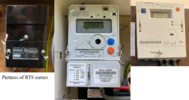
What they look like is important 1750720193279.png the three I found pictures of, look very different from each other, and what would seem a good start is to show pictures of what the meters look like.

It would seem the suppliers have sent letters out to people who have Economy 7, clearly some will have other systems, as @JohnW2 has pointed out he has Economy 7, but does not have a RTS meter. And the government report says "As of 30 May, there were 314,935 RTS meters requiring replacement in Great Britain, according to supplier data collected by Ofgem." It does not say more than 300,000 it gives a very precise figure, so it would seem they do know who has them fitted.
 
Is the change in load correlated across these meters? If so, one could estimate how many are in service by looking at how the load changes when the on peak/off peak signal is sent.
 
Is the change in load correlated across these meters? If so, one could estimate how many are in service by looking at how the load changes when the on peak/off peak signal is sent.

Common sense would suggest, that they should each receiver have some means to delay the switching for a random period. The worst possible way to switch, would be for all to switch on, or off, at exactly the same instant.
 
Is the change in load correlated across these meters? If so, one could estimate how many are in service by looking at how the load changes when the on peak/off peak signal is sent.

Well variation again. Some/most only change the cost per KWh.
As its summer, some people will have them turned off at the wall, or the thermostat may hold the element off.
 
I was rather surprised when it said how many have Economy 7. I had never realised it was used so much.
Wonder if the PO has been receiving letters designed to scare people into having a smart meter fitted. I have had plenty - and phone calls warning me that my heating wont work.
Years ago I was on economy 7 but it turned out that the day rate part was higher than a normal all day rate and it meant that I was actually paying more on E7 than a normal rate.
I never had any devices using the radio signal. I changed the tariff to normal so when I give a reading the low and normal are just added up
This does make me wonder how many will realise they no longer need Economy 7? Needing to use 70% off-peak to break even is rather a lot, and when it first came out, the off-peak was so much cheaper, and people simply don't realise how the tariffs have changed over the years.

I had an EV tariff from British Gas, which I was locked into for a year, and when it ended I realised the flat rate for the day was actually working out cheaper, and if people do by default move to a flat rate, many may realise it is not saving anything having Economy 7, and the question is can the grid take the extra peak load?

OK, retired now, but when working, we would roll out of bed in the morning, and for the ½ hour getting ready for work, not worth putting the heating on, so at 4:30 pm the heating would come on, so warm at my return at 6 pm, and it would run until 11 pm, and there was enough heat in the fabric of the building to do the night and morning.

Now flux have peak rate 4 pm to 7 pm and once people stop using Economy 7 this is going to get worse. Trying to get people back to the storage heating idea is going to be hard, once they realise it was not as cheap as they thought. So the replacement must be up and running before RTS switch off. Not for the users, but for the suppliers.
 
I was rather surprised when it said how many have Economy 7. I had never realised it was used so much.

This does make me wonder how many will realise they no longer need Economy 7? Needing to use 70% off-peak to break even is rather a lot, and when it first came out, the off-peak was so much cheaper, and people simply don't realise how the tariffs have changed over the years.

I had an EV tariff from British Gas, which I was locked into for a year, and when it ended I realised the flat rate for the day was actually working out cheaper, and if people do by default move to a flat rate, many may realise it is not saving anything having Economy 7, and the question is can the grid take the extra peak load?

OK, retired now, but when working, we would roll out of bed in the morning, and for the ½ hour getting ready for work, not worth putting the heating on, so at 4:30 pm the heating would come on, so warm at my return at 6 pm, and it would run until 11 pm, and there was enough heat in the fabric of the building to do the night and morning.

Now flux have peak rate 4 pm to 7 pm and once people stop using Economy 7 this is going to get worse. Trying to get people back to the storage heating idea is going to be hard, once they realise it was not as cheap as they thought. So the replacement must be up and running before RTS switch off. Not for the users, but for the suppliers.
Good points there.
Without storage heaters I just could not make E7 pay for the higher day rates and higher standing charge. Never understood the need to pre warm the house before you came home - you are heating an empty house. Where is the eco sense in that.
 
Common sense would suggest, that they should each receiver have some means to delay the switching for a random period. The worst possible way to switch, would be for all to switch on, or off, at exactly the same instant.
Indeed. In the days of electromechanical meters, I was told that the people 'setting' the meters' time clocks were told to do so only 'approximately', so as to introduce some random variation.

I don't know whether in the case of meters with internal clocks or RTS control the electronics adds some random variation, but that would certainly make sense.

Having said that, I imagine that there are a good few people with E7 (etc.) who, like me,have never used the meter to switch, or control the switching of, my loads - so my own switching arrangements will introduce variation.
 
Good points there. ... Without storage heaters I just could not make E7 pay for the higher day rates and higher standing charge.
For the past few decades I have managed to make savings by having E7, but without storage heaters, by adjusting my pattern of energy usage and, in particular, by heating my water with an immersion during off-peak times. At least in the past, the 'break-even' point (beyond which E7 worked out cheaper) required about 35% of one's total consumption to be off-peak ('night') and I have generally managed around 50%.
Never understood the need to pre warm the house before you came home - you are heating an empty house. Where is the eco sense in that.
There may not be much/any "eco sense" in it, but I suppose it depends on how happy one is for the house to be cold for the first hour or two after one got home.
 
This does make me wonder how many will realise they no longer need Economy 7? Needing to use 70% off-peak to break even is rather a lot ...
It's never been that high, at least in 'real-time'. Traditionally one had to use 35% off-peak to 'break even', and I don't think it's a lot different from that even now.

Of course, that 35% or whatever relates to an entire year. If the majority of one's off-peak usage is storage heaters, then one would have to have a lot more than 35% during Winter to compensate for the very low off-peak usage during the Summer - but that's not really difficult, since storage heaters use so much more than everything else in a house.

In my case, in which the lion's share of off-peak usage is water heating (and most of the rest tumble drying), I have always managed to achieve around 50% during both Summer and Winter.
 
Good points there.
Without storage heaters I just could not make E7 pay for the higher day rates and higher standing charge. Never understood the need to pre warm the house before you came home - you are heating an empty house. Where is the eco sense in that.
Today we have Drayton Wiser, which works out how far ahead of time, we need to start heating a room, so it is up to temperature at the required time. Back then, I had to guess how long it would take.

We left our house to look after mother, the heating was left on a low heat setting to stop any pipes freezing, but lifting the house from near enough ambient temperature of around 12ºC to 20ºC is not that fast, main room had a Myson fan assisted radiator 3 kW, a standard radiator 4 kW and a gas fire 4.5 kW but still nearly ½ hour to reheat the room. Normally, the room would have only cooled to around 16ºC by 4 pm, so reheated much faster.

This house is much slower to reheat, but also slower to cool, and I have needed to alter how the heating is controlled, due to hall cooling slower than the living room, so found we needed three units which could turn on the central heating, to allow for changes mainly down to internal doors left open or closed.

But both with gas and oil, we heat rooms only when required, and only just warm enough, with 14 electronic programmable TRV heads, and this is where the storage radiator fails, you can't decide, Oh, the family have just said they are coming around, we will need dinning room, and spare bedroom heating, let's switch it on now, you need to plan at least a day ahead, and so end up heating rooms at times when not required.

The larger the radiators (in output) and the larger the boiler (in output) the faster one can heat rooms and home, but in the main the boiler does not need to be that big, as one can heat rooms in the sequence in what they will be used.

But all of this goes out of the window with storage radiators, Although off-peak central heating does not need to use storage radiators, I saw a set of council houses in North Wales where there was a hot room and blown air fed other rooms from it, and told they could turn off the input and the heat would remain for a week, but this is unusual. And the house was designed to use this system from the word go, central heating was not an afterthought.

But once anyone realises using heaters as and when required, rather than just in case needed latter, works out cheaper, they will not return to Economy 7.

 

If you need to find a tradesperson to get your job done, please try our local search below, or if you are doing it yourself you can find suppliers local to you.

Select the supplier or trade you require, enter your location to begin your search.


Are you a trade or supplier? You can create your listing free at DIYnot Local

 
Back
Top