- Joined
- 31 May 2016
- Messages
- 29,242
- Reaction score
- 7,977
- Country

When you cross the channel, certainly the wider stretches (say Portsmouth to Cherbourg) in a boat doing 7-10kts your path is like an S-Shape. Lets say its going to take you 12 hours to make the maths easy and you Leave at high tide. The Tide will head West for the next 6 hours peaking at HW+3 and then gradually weakening until it turns and goes back the other way. You typically calculate the net effect based on the impact of tide at each hour (you might want to calculate 2 or 3 in one go). You then set your course to steer accordingly. If there was no tide you might choose a heading of around 200° But the net effect of the tide as you cross might have you say a couple of miles further west. So you might calculate a heading of 190° to compensate. You don't fight the tide, you are sitting on top of the water and moving with it at exactly the same speed it moves. if you adjusted for the tide to make a straight line over ground, you'd end up a lot slower.
Here is an example of a tidal stream chart, the first number is the speed at Neep tide and the second is the speed at spring tide. So for example 20,35 arrow east is 2.0kts east in Neap and 3.5kts in a spring. 3 hours before high water at Dover. It doesn't matter that you aren't in Dover, its the reference point. if you are faster and do the crossing in 6 hours then you'll only have one tide to calculate, so in this case you will be putting a fairly significant adjustment to your course to steer to take account of the probably 10 miles of tidal effect.
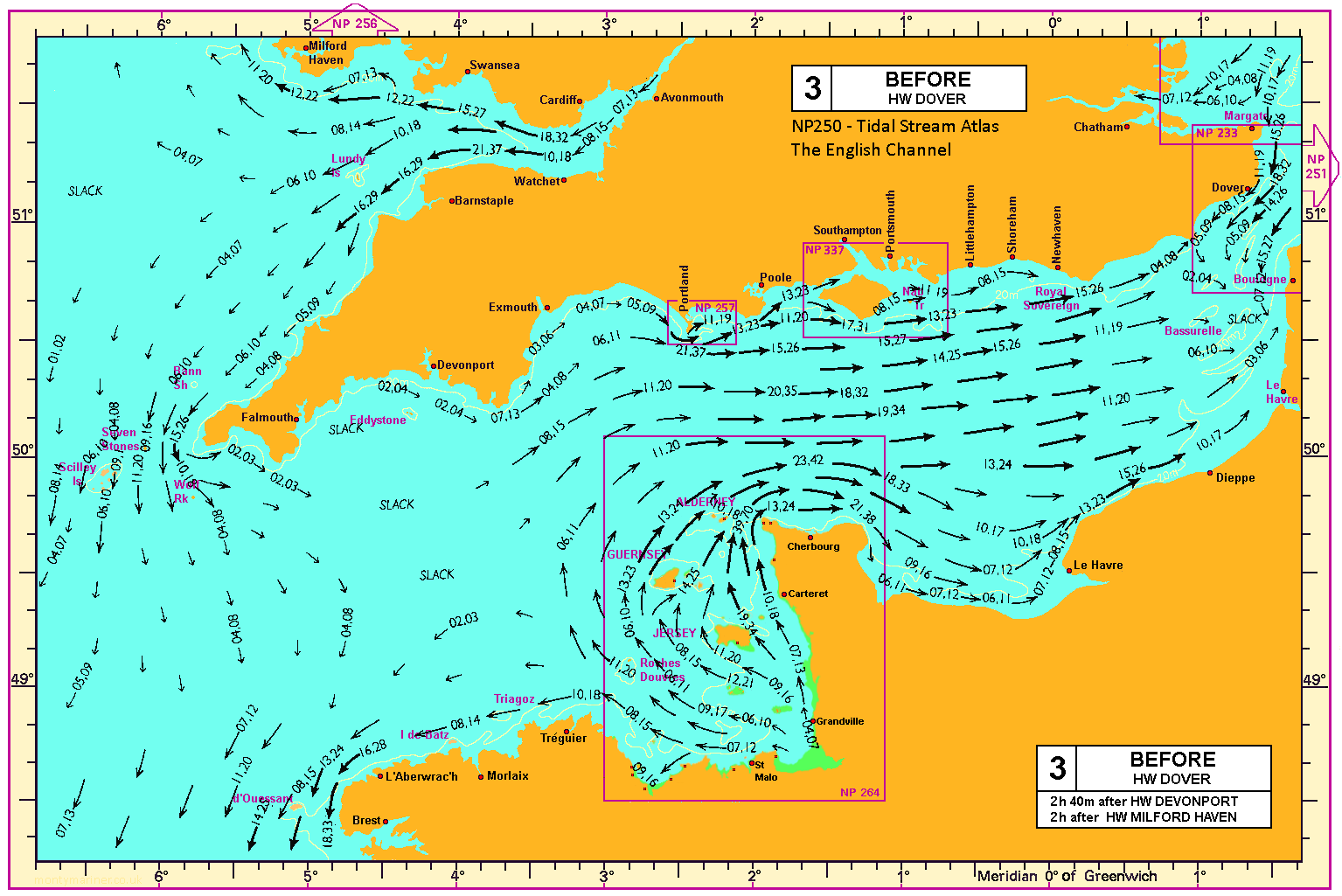
Here is an example of a tidal stream chart, the first number is the speed at Neep tide and the second is the speed at spring tide. So for example 20,35 arrow east is 2.0kts east in Neap and 3.5kts in a spring. 3 hours before high water at Dover. It doesn't matter that you aren't in Dover, its the reference point. if you are faster and do the crossing in 6 hours then you'll only have one tide to calculate, so in this case you will be putting a fairly significant adjustment to your course to steer to take account of the probably 10 miles of tidal effect.