
Sander motor hardly moves

Joined
16 Jun 2006
Messages
12,804
Reaction score
3,099
Location
London
Country
United Kingdom
Hi all

One of my Festool sanders isn't working properly. Turn it on and it just buzzes and the sanding plate barely moves.

Initially, I thought it might he the speed control module, so I removed/bypassed it. Made no difference.

Today I stripped the whole thing down.

I see continuity on the commutator and the corresponding pairs of field windings.

Is it likely that the capacitor has failed. The replacement PCB and capacitor is only £14, a replacement sander will be about £300.


Additionally, I have a floor standing fan that recently stopped working. Unlike the sander it is an induction motor. The following is a photo of the capacitor.
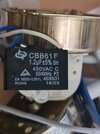
capacitor.jpg

I have seen a number of them that say CBB61, what does the F mean? The one in the photo has a right angle bracket to screw it down, but many of the of the CBB61 capacitors seem to have that bracket even they don't have a F at the end.

I can get a cheap one from China for £2.75 inc postage. Is there any reason why the one in my link would not be suitable?
 
It might be a variation of the manufacturers reference rather than a technically different product, maybe worth getting one in if you prepared to wait a few weeks or longer.

Blup
 
Not meant to be offensive but have you checked the carbon brushes are making GOOD contact with the commutator and are free moving in the brush boxes?
When you say you have tested the comm and fields did you split the two fields and get the same resistance across each coil?

Testing the commutator you have to remove the armature and 'step' around the individual segs, again noting the readings of each one. With this test, depending where you start, the readings will vary up then down, (or down then up, it doesn't really matter). It may rise at the start, then fall then rise again until you reach your starting point. What it shouldn't do is rise, then fall, then rise, then fall again etc. This is only a static continuity/resistance test. To test it correctly you need to measure the volt drop across each pair of segs but this involves applying a small DC current to a section at a time and recording the readings
 
Not meant to be offensive but have you checked the carbon brushes are making GOOD contact with the commutator and are free moving in the brush boxes?
When you say you have tested the comm and fields did you split the two fields and get the same resistance across each coil?

Testing the commutator you have to remove the armature and 'step' around the individual segs, again noting the readings of each one. With this test, depending where you start, the readings will vary up then down, (or down then up, it doesn't really matter). It may rise at the start, then fall then rise again until you reach your starting point. What it shouldn't do is rise, then fall, then rise, then fall again etc. This is only a static continuity/resistance test. To test it correctly you need to measure the volt drop across each pair of segs but this involves applying a small DC current to a section at a time and recording the readings

The brushes are fine. I have completely dismantled the sander. I removed the armature and cleaned the commutator.

I didn't test every segment on the commutator. On a scale of 1 for no continuity and 0 for continuity, my meter displayed 0.29 for each of the segments that I did test. I shall test all of them when I get a chance.

I have had 2 of these sanders. The first one developed the same problem. I damaged it trying to take it apart and binned it. This one developed the fault whilst under warranty and was repaired for free. Three years later and the same fault has re-occurred. I have never burnt out a motor on any of my tools (as far as I am aware).
 
Motor capacitors are a common failure item.
Buy a new one for a few quid. Fairly likely the motor will work again. If not, you are down the cost of a cheap capacitor.

New one needs to be the same type, same capacitance, and have a voltage equal or higher than the original.
Minor variations in the code on it are generally irrelevant.
 

If you need to find a tradesperson to get your job done, please try our local search below, or if you are doing it yourself you can find suppliers local to you.

Select the supplier or trade you require, enter your location to begin your search.


Are you a trade or supplier? You can create your listing free at DIYnot Local

 
Back
Top