Shower High Pressured Initially Then Slows Down

Joined
15 Dec 2023
Messages
13
Reaction score
0
Country
United Kingdom
I have a water tank and boiler linked to 3 showers.

When turning on the shower the pressure is great for roughly 10 seconds then it slows down, it's not terrible but I'd like to keep that initial pressure if possible?

Is this set somewhere on the system or perhaps just a limitation?
 
I had this on an unvented cylinder and the pressure regulator had to be replaced
What sort of hot water tank do you have? Do you have a tank in your loft?

Brian
 
That’s the type
I got a plumber in to check it out and he confirmed it was likely the pressure regulator. He changed it and all good. I don’t think it’s a DIY job, so better to get someone in. I’m not a qualified plumber, so hopefully someone who is can advise better

Brian
 
If your hot water cylinder is mains pressure (unvented), there will be a filter inside the pressure reducing valve - would be worth getting that checked. Also the expansion vessel connected to it may need checking - it can give you an initial surge of water at a greater pressure and flow, but then the flow will reduce a little to what the incoming mains is giving you.
Unvented cylinders should have a yearly service where these things would be checked.
 
valid point about the filter in above post.

My money would be undersized pipe feeding the cylinder. The flow that you get initially is due to pressure buildup in the expansion vessel prior to tap run. When tap is run, water flow to cylinder cannot be maintained at the same rate so hot water flow reduces to the rate cold water getting to the cylinder.

You might find running other hot taps at the same time reduces the hot water delivery further

Theory is you have high pressure cold coming to the cylinder that is reduced by the combination valve to around 3.5 bar.
When you run hot or a cold tap ( if cold tap connected correctly), you get 3.5 bar delivered pressure.
Run another tap, same 3.5 bar as you have good mains connection.
 
valid point about the filter in above post.

My money would be undersized pipe feeding the cylinder. The flow that you get initially is due to pressure buildup in the expansion vessel prior to tap run. When tap is run, water flow to cylinder cannot be maintained at the same rate so hot water flow reduces to the rate cold water getting to the cylinder.

You might find running other hot taps at the same time reduces the hot water delivery further

Theory is you have high pressure cold coming to the cylinder that is reduced by the combination valve to around 3.5 bar.
When you run hot or a cold tap ( if cold tap connected correctly), you get 3.5 bar delivered pressure.
Run another tap, same 3.5 bar as you have good mains connection.
Sorry for the late response on this.

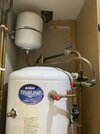
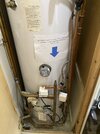
I've attached an image of the tank.

Could the undersized pipe feeding the cylinder be replaced if required?
 

Attachments

  • IMG_8391.JPG
    IMG_8391.JPG
    278 KB · Views: 59
  • IMG_8392.JPG
    IMG_8392.JPG
    316.3 KB · Views: 63
22mm to that cylinder so you wouldn't usually need anything larger than that.

AS suggested, the issue you will have is when the cylinder fully heats up, the Expansion Vessel (EV) becomes pressurised. If the pre-charge pressure on the EV isn't set correctly then that pressure can end up being a bit higher than the mains supply pressure. When you open the tap the EV gives the pressure a little boost until it balances out.

The trouble is the EV pre-charge isn't set correctly and you have been misled into thinking that you have more pressure than the cold mains could supply.
You need an experienced qualified engineer in to service and check/setup the system properly.
Unfortunately though, if there's nothing wrong with the combination valve and the reducing valve (PRV) and EV is set correctly, then you won't be able to increase the pressure, that's dictated by the max available mains pressure and the PRV setting @3bar (if the dynamic mains pressure is above that)
 
Looking at those pics, the tundish is marked. Probably due to discharging.
I think expansion vessel for the unvented cylinder is full of water. It needs pumping out and pressurising correctly.
 

If you need to find a tradesperson to get your job done, please try our local search below, or if you are doing it yourself you can find suppliers local to you.

Select the supplier or trade you require, enter your location to begin your search.


Are you a trade or supplier? You can create your listing free at DIYnot Local

 
Back
Top