
• Looking for a smarter way to manage your heating this winter? We’ve been testing the new Aqara Radiator Thermostat W600 to see how quiet, accurate and easy it is to use around the home. Click here read our review.

Sig Energy Solar Installation

15p Export + standard tariff - but then there is no value in charging batteries from the grid
It seems that is the best option for me. But it all changed when I went from 2.88 kWh of useable battery, to 5.76 kWh of useable battery. I say useable as 10% held back in case of a power failure.

To charge a battery at 15.45p per kWh, which results in latter exporting at 13.9p per kWh, does not save money. So have to look at the morning droop in state of charge. Even the 2nd of January 1745143912456.pnglet me look at state of charge, 67% with a 6.4 kWh battery, but would have been 34% with only one battery 3.2 kWh, I exported 4.6 kWh that day, it would have been a lot lower with the old 3.2 kWh battery, I had failed to realised how the extra battery changed how much power exported. It reduced the import in the evening, but caused a larger export around midday.
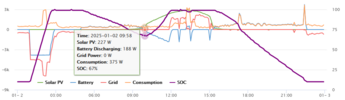

 
To charge a battery at 15.45p per kWh, which results in latter exporting at 13.9p per kWh, does not save money.
Obviously - but where do you get the 13.9p from, my reading of the 15p export tariff is you sell all your surplus at 15p per kWh
 
To charge a battery at 15.45p per kWh, which results in latter exporting at 13.9p per kWh, does not save money.
Obviously - but where do you get the 13.9p from, my reading of the 15p export tariff is you sell all your surplus at 15p per kWh
True, but 15p is still (fractionally) less than 15.45p - so, even if he could export at 15p/kWh, eric would still be correct in saying that the exercise would not "save money", wouldn't he?
 
I think the point I was trying to make earlier was either badly explained or was missed entirely

the point I was trying to make is that there is a tangible cost that can be attributed to the use of the battery, (the more you use it the quicker it will wear out) And due to the vast cost of these batteries, each kWh used could be as high as 6.7p per unit

So if you were charging a battery at 15.45p per kWh, you would need to export it at (15.45+6.7 ) 22.15p just to break even
 
..... the point I was trying to make is that there is a tangible cost that can be attributed to the use of the battery, (the more you use it the quicker it will wear out) And due to the vast cost of these batteries, each kWh used could be as high as 6.7p per unit .... So if you were charging a battery at 15.45p per kWh, you would need to export it at (15.45+6.7 ) 22.15p just to break even
Indeed. We've discussed that before and I totally agree with you.

As you are presumably aware, more generally I'm pretty doubtful (in monetary, not environmental, terms) about the whole concept of domestic PV installations, by the time one has taken into account the capital cost and maintenance/replacement costs of the PV+batteries. At the very least, it means that there will be (initially, and repeatedly if one gets to the 'replacement point') many years during which one will be financially worse off than one would have been without PV - something which makes increasingly little sense as one moves into/through the latter years of one's life.
 
Oct tariff.jpg
Sorry, I was using Flux rates, as looking at import and export, yes with other tariffs the export is 15p and with some like Octopus SEG (Smart Export Guarantee) non Octopus customers is 4.1p per kWh.

The problem is working out what goes with what, and what tariff one can actually have. My installation document is 1745155639507.pngand I had problems with suppliers wanting certificates from another organisation.
 
Indeed. We've discussed that before and I totally agree with you.

As you are presumably aware, more generally I'm pretty doubtful (in monetary, not environmental, terms) about the whole concept of domestic PV installations, by the time one has taken into account the capital cost and maintenance/replacement costs of the PV+batteries. At the very least, it means that there will be (initially, and repeatedly if one gets to the 'replacement point') many years during which one will be financially worse off than one would have been without PV - something which makes increasingly little sense as one moves into/through the latter years of one's life.
I meant to get back to you on this but forgot

I think it is worth while now, but just. So many unknowns it is difficult to be certain of anything.

I am about to have a 20 panel system fitted at a cost of £10,700, and here are my considerations into 'is it worthwhile'


£3,700 One off costs, Wiring it all up, Accessories Rails etc, and £550 registration!
£4,000 Stuff with a lifespan of 10 to 15 years (Depreciation) this includes inverter & panels (including re fitting costs of replacements)
£3,000 Batteries (10 kWh)

One Off £3,700, + Depreciation of £320 per year, + use of Batteries at 6.7p per kWh

It is predicted from my Latitude, Angle of of panels , location etc, that I should generate 6150 kWh per year, of which I should be able to use 4100 kWh (3000 kWh through the batteries and 1100 kWh directly) - then I can export the remaining 2050 kwh

If we consider a standard Tariff of 24p per kWh

that would be a gross saving of £984 (4100 x 24p)
minus battery use £200 (1100 x 6.7p)
minus depreciation of £320

Nett saving of £464
If we pencil in an Export tariff of 15p
+ Export of £307 (2050 x 15p)

Giving a total annual income / worth of £771

This would give a pay back on the one off costs of 4 years 9 months
 
I was I think wrong when I costed the solar panel v electric costs. I considered 7 years to repay, the lack of export payment has moved the goal posts, so this is now unlikely.

The battery however is another story, not such a large outlay, and the use of off-peak can vastly reduce costs.

But combine them together, and in some ways they compliment each other, but in other ways, they don't. I looked at my total bill, and solar and battery reduced cost by half, but when I got a smart meter, and so able to use off-peak, plus increased battery size, the goal posts moved, and I failed to realise that the tariff was not suited to the new set-up.

So looking at what I am paying rather than working it out, £500 per year maybe a little more, with no payment for export. Over 20 months, exported an average of 180 kWh per month or at 15p per kWh £30 per month, so total £825 per year. So looking at more like 15 years, not 7 years.

By adjusting lifestyle, this can be improved, I was used around £60 per month, and was paying well over £100 a month, using 29.57p per kWh and 62.21p per day standing charge and the 8412.3 kWh used since the solar panels were installed, I get an average cost using 30 days a month of £143 per month, so minus £60 that's £83 per month saving, or just under £1000 per year, So £1325 per year, but since I had solar, I have been less careful in how much I have used. So some where between the £825 and £1325 per year, but that means 10 to 15 years to pay back. Assuming nothing to pay out on repairs.
 
I meant to get back to you on this but forgot I think it is worth while now, but just. So many unknowns it is difficult to be certain of anything.
Quite so.
I am about to have a 20 panel system fitted at a cost of £10,700, and here are my considerations into 'is it worthwhile'
Fair enough [do you really only use about 11 kWh per day?]
Nett saving of £464
If we pencil in an Export tariff of 15p
+ Export of £307 (2050 x 15p)
Giving a total annual income / worth of £771
This would give a pay back on the one off costs of 4 years 9 months
I don't dispute your figures, but isn't that pretty misleading because, as you say, that 'pay back' period on;y relates to the 'one-off costs', whereas what surely matters to an individual is the 'total costs' ?

The day after you have it all installed,you will be £10,700 'worse off' than if you hadn't had any of it installed. After 4.75 years, the 'annual savings' (of £771 per year) will have recouped all of the 'one-off costs', but you will still be £7,000 worse off than you would have been at that point in time had you not had the PV installation. If, thereafter, you continued to make 'annual savings' of £771 per year, it would take you roughly another 9 years before you had 'recouped' all of the initial capital outlay.

In other words, you will be financially 'worse off' (than if you'd never had any PV) for a total of about 13.75 years and only after that will you move into 'profit' (actually better off than you would have been without the PV). However, that 'profit period' may be pretty short-lived, since that 13.75 years is in the same ballpark as the expected life of the kit - so that you may well then have to embark on further capital investment, hence another few years of being 'worse off' than you would have been without ever having had PV ;)

I am 75, so it would make no sense for me to consider an 'investment' that would leave me financially worse off for the next 13.75 years, no matter what benefit there might be beyond that (if I were then still around!). However, more to the point (for 'my readers'), I very probably would feel the same if I were 60 or 65. Indeed, if I think back to younger ages than that, I'm not sure there was any age at which I would have been particularly comfortable with the idea of 'being worse off' for the next 13+ years.

... or am I missing something?

Kind Regards, John
 
Quite so.

Fair enough [do you really only use about 11 kWh per day?]

I don't dispute your figures, but isn't that pretty misleading because, as you say, that 'pay back' period on;y relates to the 'one-off costs', whereas what surely matters to an individual is the 'total costs' ?

The day after you have it all installed,you will be £10,700 'worse off' than if you hadn't had any of it installed. After 4.75 years, the 'annual savings' (of £771 per year) will have recouped all of the 'one-off costs', but you will still be £7,000 worse off than you would have been at that point in time had you not had the PV installation. If, thereafter, you continued to make 'annual savings' of £771 per year, it would take you roughly another 9 years before you had 'recouped' all of the initial capital outlay.

In other words, you will be financially 'worse off' (than if you'd never had any PV) for a total of about 13.75 years and only after that will you move into 'profit' (actually better off than you would have been without the PV). However, that 'profit period' may be pretty short-lived, since that 13.75 years is in the same ballpark as the expected life of the kit - so that you may well then have to embark on further capital investment, hence another few years of being 'worse off' than you would have been without ever having had PV ;)

I am 75, so it would make no sense for me to consider an 'investment' that would leave me financially worse off for the next 13.75 years, no matter what benefit there might be beyond that (if I were then still around!). However, more to the point (for 'my readers'), I very probably would feel the same if I were 60 or 65. Indeed, if I think back to younger ages than that, I'm not sure there was any age at which I would have been particularly comfortable with the idea of 'being worse off' for the next 13+ years.

... or am I missing something?

Kind Regards, John
gosh where do I start with all that

No - we use about 13kWh per day, I said earlier; out of the 6150 kWh we will generate we will use about 4100 either directly or through the batteries - the remainder of what we generate will be exported and we will still have to buy some electric from the grid at full price.
---------------------------------------------

I have no idea where you get the 13.75 years from (may be you forgot the depreciation or costs in using the battery)
----------------------------------------


Initial cost £10,700
Annual predicted savings of £1,291 (984 free electricity + 307 exported)
10700 / 1291 = 8.3 years
--------------------------------

Indeed inflation does complicate the matter, lets assume electricity increases by 2% er year and you could achieve 3% on your savings
Inflation just makes another argument to get it done

1745186895861.png


to explain; year 1 = (10700 x 1.03 ) - 1291
and in year 2 electricity has increased by 2% to £1317

-------------------------------------------------------------------------

So many ways to work this out and which ever way I do, it does have value

If it wasn't for the environmental argument then I probably wouldn't bother, the savings are small and no profit for many years, however solar + batteries is a viable option now (capable of washing its own face, so to speak). I have the spare cash so I can do a bit towards slowing down climate change without it costing me.

I am very environmental conscious and generating a very clean energy will make the wife and I feel we are doing something
 
True, but 15p is still (fractionally) less than 15.45p - so, even if he could export at 15p/kWh, eric would still be correct in saying that the exercise would not "save money", wouldn't he?
What about people who are not doing it as a profit making operation, but are seeking to ameliorate the costs of a provision which makes them not totally reliant on a grid supply?

With a non-electric way to cook, and only LED lighting, a gas CH pump, and a fridge/freezer to run, 10kWh of capacity could allow a household to ride out quite an extended grid outage.
 
No - we use about 13kWh per day, I said earlier; out of the 6150 kWh we will generate we will use about 4100 either directly or through the batteries - the remainder of what we generate will be exported and we will still have to buy some electric from the grid at full price.
That's how I got "about £11/day", since 4,100 / 365 = 11.23. How did you get £13/day?
I have no idea where you get the 13.75 years from (may be you forgot the depreciation or costs in using the battery)
....
Initial cost £10,700 .... Annual predicted savings of £1,291 (984 free electricity + 307 exported) .... 10700 / 1291 = 8.3 years
Where I 'got it from' was by taking at face value what I understood your statement ...
Giving a total annual income / worth of £771
to be saying .... given that 10,700 / 771 = 13.88 (my 13.75 was 'roughly rounded' :-) )

It therefore looks as if I need to look more carefully into where your £771 (rather than £1,291) came from, since I previously just assumed it was the correct 'total annual gain'.

However, that doesn't really matter much - since even if the figures you're now quoting are correct, I don't think that even 8.3 years of 'being worse off' (before one 'moves into profit') makes any real sense for a person of my age, or anywhere near it.

Indeed inflation does complicate the matter, lets assume electricity increases by 2% er year and you could achieve 3% on your savings
Inflation just makes another argument to get it done
In what I previously wrote, I didn't even bother to consider inflation, because they are far too many unknowns. Even in terms of the things you mention, I don't think it's by any means a foregone conclusion that there will be continuing inflation of electricity prices over coming years. We currently are 'enjoying' some of the highest energy prices in the world, and it's far from impossible that that will eventually be addressed - in which case electricity price inflation could reduce, or even reverse.

The is also the total unknown about the prices of replacement kit (hence for how many 'new years' one will be 'worse off') if/when one gets to the point of needing replacements. That price could be more, or less, than it is today - so I can't sensibly model it.

If it wasn't for the environmental argument then I probably wouldn't bother, the savings are small and no profit for many years, however solar + batteries is a viable option now (capable of washing its own face, so to speak). I have the spare cash so I can do a bit towards slowing down climate change without it costing me. ... I am very environmental conscious and generating a very clean energy will make the wife and I feel we are doing something
As I wrote, I was talking only about monetary benefits, but acknowledge that there are also environmental ones which some/many people might want to consider.

Mind you, for those who are environmentally conscious and 'would not miss' £10k (or whatever) for the next several years, there are obviously other ways in which they could spend that money - e.g. in optimising the insulation of their home and/or their heating systems. Indeed, there are plenty of environmentally-beneficial measures that would cost them nothing (probably the converse), such as taking shorter showers, wearing more jumpers and reducing room temps, eating less imported food, minimising overseas travel etc. etc. ;)

Kind Regards, John
 
What about people who are not doing it as a profit making operation, but are seeking to ameliorate the costs of a provision which makes them not totally reliant on a grid supply? ... With a non-electric way to cook, and only LED lighting, a gas CH pump, and a fridge/freezer to run, 10kWh of capacity could allow a household to ride out quite an extended grid outage.
Fair question, but I like to think that I have achieved that ability "to ride out quite an extended grid outage." (albeit not something I expect to be faced with) by purchasing a £150 genny from Lidl.
 
Fair question, but I like to think that I have achieved that ability "to ride out quite an extended grid outage." (albeit not something I expect to be faced with) by purchasing a £150 genny from Lidl.
How does the genny from Lidi know when it needs to unplug the freezers from the grid supply, and supply them from the generator?

I am sure I could have an automatic start up and change over for less than cost of solar, I would still need a generator to power lights, etc. But the freezers need automatic supply, I also have the central heating on the solar and battery. I lost the freezers in the last house while away from the house, and I now live 8 miles from town, so we tend to have a lot of food in store.

I have not looked at the price of an inverter and battery without solar panels. I have looked at the savings by using a battery charged with off-peak. I would say 12 kWh is around the normal use per day, so batteries would only last ½ the day as they stand, but if I was to get an electric car, then the car batteries would mean I could run the house on off-peak only. At the moment the shower is the one item which is larger than the inverter.

So I can see with an EV would need to be a new one, to be able to use its battery, one could run on off-peak only. This would clearly mess up all the calculations as to solar pay-back times, as the cost of electric is so much lower.

But I have looked at the tariffs, and one can work out what you can in theory do, but the question is in practice can you get the tariff? And how long will it last? I watched a YouTube video about a guy who had installed an insane amount of solar panels on his tennis court, and could not export the energy they produced. Clearly the installer had not done his homework, but I can see this becoming a big problem in the future, our infrastructure was never designed for microgeneration, and I can see in the future solar loosing its advantage.
 
Mind you, for those who are environmentally conscious and 'would not miss' £10k (or whatever) for the next several years, there are obviously other ways in which they could spend that money - e.g. in optimising the insulation of their home and/or their heating systems. Indeed, there are plenty of environmentally-beneficial measures that would cost them nothing (probably the converse), such as taking shorter showers, wearing more jumpers and reducing room temps, eating less imported food, minimising overseas travel etc. etc. ;)
It would be very interesting to know how much of such measures would be required to result in as much environmental benefit as one would achieve by 'investing' £10k or so in PV+batteries etc. (and hence probably being 'worse off' for at least 8 years). Indeed, most such measures would actually result in a reduction in outgoings - so, far from "probably being 'worse off' for at least 8 years", one would probably be financially 'better off' from the very start, and for evermore!

Another part of the environmental equation which should be (but rarely is) taken into account is the environmental cost of the acquisition (mining etc., followed by processing and transport) of necessary materials followed by the manufacture, installation and ultimate disposal of the panels+batteries etc. I have absolutely no idea about the magnitude of those environmental costs - does anyone here have any idea?
 

If you need to find a tradesperson to get your job done, please try our local search below, or if you are doing it yourself you can find suppliers local to you.

Select the supplier or trade you require, enter your location to begin your search.


Are you a trade or supplier? You can create your listing free at DIYnot Local

 
Back
Top