Small concrete pier foundations – how do you normally form and level them?

Joined
26 Sep 2026
Messages
8
Reaction score
1
Country
Viet Nam
I'm looking at different ways of making small cast-in-place concrete piers for things like small buildings, decks and similar structures.

I'm interested in the practical side rather than structural calculations: how do you normally form the pier, keep the form in position and get the top to the correct level before and during the pour?

What part of the process tends to be the most awkward or time-consuming?

I'm working on an idea around this problem, but before showing it I'd like to understand how people actually deal with it on site.
 
Use easypads.....https://easypads.co.uk/ It's not a problem that needs another solution... but then again I see you are in vietnam, so perhaps the shipping cost for easypads would be a bit too high :)
 
Make the shutter, level the top edge.

Really really simple, people have been doing it for centuries.
 
Use easypads.....https://easypads.co.uk/ It's not a problem that needs another solution... but then again I see you are in vietnam, so perhaps the shipping cost for easypads would be a bit too high :)
Thanks, that’s an interesting system. I’ve actually used a similar approach before. It works well where ground conditions allow a surface foundation, but it isn’t universal — in many regions and soil conditions, foundations still need to go below ground.
It’s definitely a neat solution, though quite expensive per support.
 
Make the shutter, level the top edge.

Really really simple, people have been doing it for centuries.
I’ve done it that way too. It works, but setting and leveling each form can take a lot of time. I’m more interested in fast pier foundations where cost, speed and consistent quality all matter.
 
It's a truism that it's awfully difficult to get fast cheap quality. You generally have to sacrifice one.

Easypads will work quite happily at the bottom of a hole.

I think you're trying to reinvent the wheel
 
Last edited:
It's a truism that it's awfully difficult to get ast cheap quality. You generally have to sacrifice one.

Easypads will work quite happily at the bottom of a hole.

I think you're trying to reinvent the wheel
Agreed — fast, cheap and high-quality rarely come together; usually you get two. I’m not trying to reinvent the wheel. I’m trying to see where other people lose time or make the same mistakes I’ve seen, and whether those pain points can be simplified.
 
How is building the formwork to the correct level difficult?

You set your datum, you measure the board, cut it, fit it. These are standard operations and so cutting to the correct level is not extra or onerous. If you are creating formwork you would do all this anyway.
 
All sounds a lot like a spam thread to me. Are you about to say that you've just discovered the WhizzBang 3000 easy pier support system?
No, no WhizzBang 3000 yet.
I’ve worked with poured foundations and piers for quite a while, and over time I’ve built up my own list of little pain points — things that aren’t difficult by themselves, but on a large number of piers eat a surprising amount of time.
I’m mainly trying to see whether other people run into the same issues, or completely different ones. I’ve already picked up some useful feedback on other forums, and I’ll probably share a few of my own ideas here in a follow-up post.
 
How is building the formwork to the correct level difficult?

You set your datum, you measure the board, cut it, fit it. These are standard operations and so cutting to the correct level is not extra or onerous. If you are creating formwork you would do all this anyway.
I agree — for someone experienced, none of those individual steps are particularly difficult. I’ve done the same myself. The interesting part for me is how much time all those simple operations add up to when you have a lot of piers. And what feels routine to an experienced builder can be a much bigger problem for someone doing it for the first time. That’s really what I’m trying to understand — which “simple” steps actually consume the most time overall.
 
I've never built or had a need for a pier support. Isn't this a bit of a niche thing? You're solving a problem that almost nobody has.

Most building is just a case of dig a hole, pour concrete in it, build stuff on top of it. If you want it taller then build some courses of bricks or blocks. Job done, no need for any complications.
 
I've never built or had a need for a pier support. Isn't this a bit of a niche thing? You're solving a problem that almost nobody has.

Most building is just a case of dig a hole, pour concrete in it, build stuff on top of it. If you want it taller then build some courses of bricks or blocks. Job done, no need for any complications.
Sure, if accuracy and the foundation detail aren’t particularly important, digging a hole and filling it with concrete is obviously simpler and cheaper. But the foundation sets the geometry for everything that follows — walls, posts, beams and ultimately the roof — so sometimes height, position and repeatability do matter.
I agree this is a niche product, but I don’t think it’s a tiny niche. I’ve personally poured concrete piers for houses, decks and fences, and there are plenty of applications where you need a series of piers positioned accurately and at a consistent level.
 
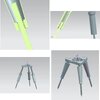
Following the discussion here, I’ve taken the idea a little further and made the first CAD model.

One important point that wasn’t clear in my original post: this is not intended to support Sonotube or another rigid form.

The concept is a system of two parts: a cheap flexible stay-in-place sleeve and a simple adjustable support that positions the top of the sleeve at the required height and location during the pour.

The sleeve carries the concrete itself; the tripod mainly controls its position and level. The idea originally came from watching someone with no construction experience spend a surprising amount of time cutting, bracing, adjusting and correcting conventional forms.

This is still an early prototype. I’m planning to print the support and actually pour a few test piers before deciding whether the idea is worth taking further.

The feedback I’m most interested in now is practical: what part of this would fail or annoy you on a real job?
 

Attachments

  • SAVE_20260929_193221.jpg
    SAVE_20260929_193221.jpg
    158 KB · Views: 2

If you need to find a tradesperson to get your job done, please try our local search below, or if you are doing it yourself you can find suppliers local to you.

Select the supplier or trade you require, enter your location to begin your search.


Are you a trade or supplier? You can create your listing free at DIYnot Local

 
Back
Top