• Looking for a smarter way to manage your heating this winter? We’ve been testing the new Aqara Radiator Thermostat W600 to see how quiet, accurate and easy it is to use around the home. Click here read our review.

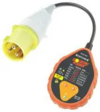
Socket testers, false sense of safety, or actually useful?

That assumes no paralell paths.

Though I question whether there is any need to care about L-N disconnection times, L-N faults are not a shock risk (at least not directly), so as long as the fuse blows/breaker trips before the cable melts we should be ok right? even if it takes some time for that to happen.
You also need to know that the device we are installing can withstand the maximum fault current that the loop impedance will allow to flow in a fault condition.

You don’t want the device blowing up when it trips.
 
You also need to know that the device we are installing can withstand the maximum fault current that the loop impedance will allow to flow in a fault condition.

You don’t want the device blowing up when it trips.
Good point, the socket tester does not do that.
basis of the 'minimum possible supply voltage'
under over voltage <195V or >270V
So if the tester is set to not alarm until below 195 volts, should that be considered as minium voltage? So minium voltage is 230 - 6% - 3% or 5% depending on if for power or lighting. Since only interested in power here, that's 205.39 volts, so at 5 x 32 amp = 160 amp that's 1.28Ω.

I do see the point that RCD protection is secondary, when the type AC was dropped, I did consider changing mine. That's over £150 for 14 of them, and I decided only secondary protection, so not going to change. I was mislead when buying them, it said clearly type B on the box, not until they were fitted did I realised they were type AC.

But if the RCD's or RCBO's are tested with something plugged into the socket, one would hope if desensitised due to DC one would see it has failed to trip when tested within required time.

What do we have today which can't cause DC? The cooker is induction, the immersion heater has an iboost, the washing machine, and freezers use inverter drives, odd the biggest inverter I have, 5 kW for the solar panels, states in the instructions type AC can be used.

Big thing for me, is the consumer unit is in the flat, so to test socket RCD's means a walk outside and down a set of steps, to reset, so not tested that often.

But I am aware of the failing in any of my test procedures, but the socket tester declares OK, when really it is no fault found, which is not the same as no fault.
 
That assumes no paralell paths.
It does. However, I already 'write too much' and if I tried to include every caveat and exception that would get worse :-) In any event, getting an 'upper bound' for L-N impedance would be of limited value, anyway.
Though I question whether there is any need to care about L-N disconnection times, L-N faults are not a shock risk (at least not directly), so as long as the fuse blows/breaker trips before the cable melts we should be ok right? even if it takes some time for that to happen.
Exactly - that's why I asked eric why he felt that PSCC was 'more important than EFLI. I suppose that if disconnection times got 'very long' that would represent an increase in fire risk but, in practice, I don't really see an issue.
 
You also need to know that the device we are installing can withstand the maximum fault current that the loop impedance will allow to flow in a fault condition. ... You don’t want the device blowing up when it trips.
True, but I really don't think that is an issue in domestic installations. The devices will have breaking capacity of at least 6 kA, and I have personally never seen a domestic installation with a PSCC, even at the CU, much greater than 1 kA. Given the sizes of cables the DNOs seem to use, I think one would have to literally have a substation in one's garden to get a PSCC a lot higher than that.

As for the suggestion that one should consider (as DNOs would say) that PFC should be regarded as 16 kA, that really makes no practical sense to me in relation to domestic installations!
 
So if the tester is set to not alarm until below 195 volts, should that be considered as minium voltage?
The tester is irrelevant. I was talking about the minimum 'permitted' ('contracted') supply voltage - which in the UK is 216.2 V (230 V - 5%).
I do see the point that RCD protection is secondary, ....
I suppose that it is probably in some senses 'historical'. If RCDs had been in use before OPDs, we probably would have accepted them as being the primary protection against (L-E) faults. However, we've always needed OPDs to protect agains L-N faults or overloads, so it couldn't, and didn't, happen that way around.

However, whichever way around one looks at it, it's clearly good to have the 'belt and braces' of both OPDs and RCDs.
But if the RCD's or RCBO's are tested with something plugged into the socket, one would hope if desensitised due to DC one would see it has failed to trip when tested within required time.
Despite any amount of trying, I still don't really understand 'the truth' about the behaviour of these various 'types' of RCD. If I recall correctly, flameport's video demo seemed to indicate that one needs quite a substantialDC current to appreciably affect the performance of a Type A RCD.

Testing an RCD with loads connected is fraught with problems. If what you suggest above were to occur, it would have rendered the test useless as a 'test of the RCD', since it could resuklt in the RCD 'failing' the gtest despite performing 'within spec'. Similarly, if there are appreciable pre-existing (AC) 'earth leaks', an RCD could fail (because it tripped at too low a residual test current), even though there was nothing wrong with it.

In any event, loads (particularly on sockets circuits) are not fixed - so, no matter what test results one gets when testing 'with loads connected', 10 minutes later a totally different set of loads may be plugged in, with consequently different test results!
What do we have today which can't cause DC? The cooker is induction, the immersion heater has an iboost, the washing machine, and freezers use inverter drives, odd the biggest inverter I have, 5 kW for the solar panels, states in the instructions type AC can be used.
As above, I have yet to really gain an understanding of how sensive Type AC RCDs are to DC components in the (normal and/or residual) current.
But I am aware of the failing in any of my test procedures, but the socket tester declares OK, when really it is no fault found, which is not the same as no fault.
It may be a reason for concern in relation to the general public, but you, I and many of those reading this, hopefully have more sense than to take the results produced by these 'testers' very seriously, don't we? They can be useful for giving 'quick approximate information' (particularly as regards presence of supply, reverse polarity, totally absent earth etc.), but that's about all.
 
The tester is irrelevant. I was talking about the minimum 'permitted' ('contracted') supply voltage - which in the UK is 216.2 V (230 V - 5%).
The voltage of 216.2V is correct but that is 230 - 6% which, of course, is not the same as using the (for some reason stated) Cmin of 0.95.
 
The voltage of 216.2V is correct but that is 230 - 6% which, of course, is not the same as using the (for some reason stated) Cmin of 0.95.
Yes, as said, Cmin should have been 0.94 in UK - and I (and some others) made this point in our comments on the DPC of the last amendment of BS 7671. However, as I've said, it seems that 0.95 was 'forced' upon us by some 'international' considerations :-)
 
At this point in my life (and having lost my NHS dentist as a result of their 'handling' of Covid rules and now almost exclusively private) I don't know if you are lucky or me with half of mine left and most are bad as a result of excessive repairs 60+ years ago (unchecked early NHS exhuberance)
Unlawful totalitarian diktats should never be characterised as "rules". This gives these crimes a legitimacy that is wholly undeserved.
 
As a rule, that may be correct, but the problem with rules and laws, is one needs to comprehend what is being written or said. And it seemed with Covid the requirements did not always make sense, with a local man fined for fishing in a private pond for example, where there was only any chance of catching Covid if someone was poaching.

Plus of course people looking at those in authority as an example of what was permitted.

But with the plug in tester, I simply have no need to use one. Can't see why an electrician would buy one, when they have a proper RCD and loop impedance tester, so we are looking at the DIY man in the main, who is unlikely to understand the limitations, so he plugs in the tester, the lights say OK, and he assumes that's all right then.

"Pobody's nerfect" we all make mistakes, I remember fitting three boxes of sockets on a second fix, and had not noticed the line and neutral was reversed on the last box. It happens, and I found my error when doing the inspection and testing, and that error would show up with a socket tester.

But when I did my C&G 2391, I looked at the loop impedance, not just pass or fail, but was the reading to be expected, and 0.955Ω and 1.055Ω for sockets less than 6" apart did not make sense, (only guessing on readings it was a long time ago) so I looked at the cable between the sockets, and found a resistor soldered into the cable, which would clearly overheat with a 13 amp load, so failed it.

It seems this was not a fault we were intended to find, it was to emulate what we would find in a house, left the examiner with a problem, could he pass those who had not found the fault? But that aside, the fault could not have been found with a plug in tester. I would have expected on the instructions something like this
1746097851912.png
since designed for the DIY guy, so he is aware of the limitations. Or at least a note, this device is designed for testing circuits of no more than 20 amp.
 
But with the plug in tester, I simply have no need to use one. Can't see why an electrician would buy one, when they have a proper RCD and loop impedance tester ...
They represent a very easy and quick way of getting some basic information, particularly as regards polarity.

When I recently watched a 'smart' meter being fitted, the first and last things the young lady (I suspect probably not 'an electrician', but rather someone trained just to install meters) did was to plug a tester into a socket and photographed it - to produce evidence of correct polarity 'before and after'.

Electrician or not, she was prepared to do more than just change the meter - rather strangely, she asked me if I would like to remove the isolator which was between meter and CU and wire the new meter directly into the CU. I declined her offer :)

I must say that had she not appeared driving a large van, I would probably have doubted that she was old enough to have a driving licence, but she certainly appeared to know and understand what she was doing :)
 
My main reason for using one is to save walking a 100m and up and down a ladder when isolating a socket
 
I made my own for 110 volts, two LEDs and a neon, plus some resistors and diodes, main idea was to test there was an earth, so LEDs reversed to each other, showed 55/64 volts to earth, and neon showed 110 volts line 1 to line 2.

When propriety ones came out, stopped making them. These do the same 1746104221364.png and yes, since my RCD/Loop impedance tester not designed for a centre tapped earth, these still have a place, main reason for not making my own tester any more is insurance, today my tester would be silly, as can buy one ready-made.

I have wondered about loop impedance, the meter may say 1.38Ω or less, but would it trip even a 16 amp MCB? The inverter is 5 kW so unless the MCB was less than 4 amp, not sure that it would trip. The inverter would shut down, but not to the BS standard required. Same with RCD protection, built into inverter, but not to BS standard required.
 
Noted a new Martindale EZ664 and EZ668, they also do CP501, BZ101, CP520, BZ701, EZ165, and EZ365. Some with and some without loop impedance test, and some with and some without RCD test. There are also of course different makes, and some will show line - neutral reversal, and claim "Detect presence of earth" and under and over voltage.

However, earth loop impedance pass level is typically 1.7Ω and under over voltage <195V or >270V and if the neutral to earth voltage is >30V. And the RCD test is for 300 mS, where we would normally look for 40 mS.

I used to have one in a caravan to test line - neutral reversal, was easy on continental caravan sites in the 80s, but when we got the last batch of caravans, we had proper testers, and did not take it abroad, and line - neutral reversal is unlikely in the UK. And one caravan, it was built into the consumer unit, and could be swapped at the consumer unit by pressing one button.

My loop impedance tester will take a lead with 13 amp plug, so does the same as the plug in testers, but actually shows mS, tripping currents, tripping time, and voltage, and leaves it to me to decide if within range.

I have seen the plug in tester in tool kits, but have no idea why carried, but the question is, do the users think if correct lights have lit, all is OK, as I have said many times, a ring final was 1.44Ω, now 1.38Ω, with a B32 MCB, so why pass at 1.7Ω?

Basically they’re good servants but poor masters
 
Three neons and two resistors in a crabtree plugtop back in the 70s was the thing electricians and electronics folk made themselves a a quick test for polarity indication.
could indicate as power or no power and correct polarity or incorrect polarity of L & N, and if you had a N or E fault but not distinguish btween the two.
pretty much what you gat today really but LEDs are easier to see and less blinded by the sun.

I suppose it was very slightly better than wetting a finger then touching a terminal with that finger and seeing if your hair stands on ends or not.

Supplement that by leaving a capacitor charge up to 5ooV in easy reach and lessons are soon learned.
Those old car radio suppressors of can type construction and one lead were ideal for that.
 

If you need to find a tradesperson to get your job done, please try our local search below, or if you are doing it yourself you can find suppliers local to you.

Select the supplier or trade you require, enter your location to begin your search.


Are you a trade or supplier? You can create your listing free at DIYnot Local

 
Back
Top