Suitable Junction Box

Joined
20 Feb 2010
Messages
64
Reaction score
1
Location
Norfolk
Country
United Kingdom
Evening all,

I'm in the process of fitting new lights in my newish flat (downlights - dirty word on here it seems) and i have positioned one of the spots where the old ceiling light was.

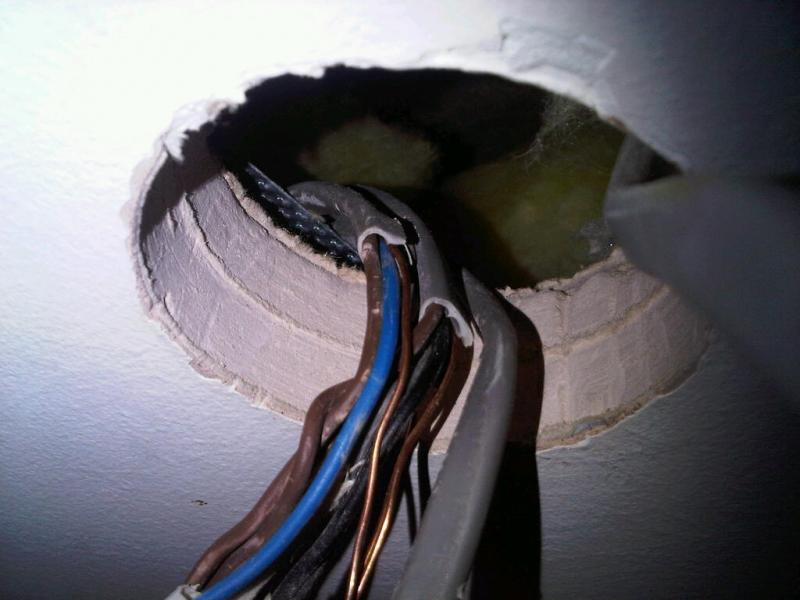
I'm now left with the following -


The cables i have to terminate are 2 x 3 core & earth (1mm) and 3 x twin & earth (1.5m).

As you can see the cables were previously terminated in the old light fitting so i would like to know what people suggest i use now? If i use a junction box i can at least make it accessible however the outer insulation is trimmed right back to the ceiling so I'm not sure how this stands under the regs.

I have tried a gentle tug on the cables but this is all i have :lol:

Any sensible suggestions please on how i can sort this out.
 
Ashley make a downlighter 4 way junction box. Each terminal has enough holes to get plenty of wires in.

However, you may struggle getting those shorter cables into it, mainly as the outer sheath has been cut back short, as you have mentioned.

So it may pay to extend each or some of the cables in separate, smaller junction boxes. The small, enclosed, so-called choc-boxes may allow you to do a neat job.

With the cables extended, you should hopefully be able to use the larger junction box.

You will have to neatly arrange this lot in the void.
Keep the fibre-glass insulation away from the downlighter and transformer, if you're having one.
Keep the cables and junction box away from the downlighter.

If you have a thin enough wrist, you may be able to gain some slack on those cables.

I take it you do not have access from above?
 
That ceiling is double plasterboard so it is probably providing the firebreak into the flat or room above.

I sure hope that you are using fire-rated downlights and that they also comply with the necessary (and legal requirements) particularly Building Regulations Parts B and E?
 
Ashley make a downlighter 4 way junction box. Each terminal has enough holes to get plenty of wires in.

However, you may struggle getting those shorter cables into it, mainly as the outer sheath has been cut back short, as you have mentioned.

So it may pay to extend each or some of the cables in separate, smaller junction boxes. The small, enclosed, so-called choc-boxes may allow you to do a neat job.

With the cables extended, you should hopefully be able to use the larger junction box.

You will have to neatly arrange this lot in the void.
Keep the fibre-glass insulation away from the downlighter and transformer, if you're having one.
Keep the cables and junction box away from the downlighter.

If you have a thin enough wrist, you may be able to gain some slack on those cables.

I take it you do not have access from above?

Cheers for your suggestions.

Unfortunately no access from above - its a tiled floor.

This is all the slack i have as i have managed to get my hand in the hole and have given the cables a reasonable pull.

So are you suggesting i can use small enclosed choc blocks (with cable clamps) to extend the cables (cutting back the cores) and then use a larger junction box like this -

http://www.tlc-direct.co.uk/Product...andard&OVADID=19811964531&OVKWID=152181537531

Have you ever used one of these -

http://www.l-in-e.co.uk/product/Line_Junction_Box_(_1_Pack)_K97.1

My only worry is that the original cables will then be even shorter and no room for error/repairs later down the line.
 
That ceiling is double plasterboard so it is probably providing the firebreak into the flat or room above.

I sure hope that you are using fire-rated downlights and that they also comply with the necessary (and legal requirements) particularly Building Regulations Parts B and E?

It's a flat and you will have breached the carefully designed and installed and tested sound insulation too! :oops:
 
Yo - read this: http://www.diynot.com/forums/viewtopic.php?t=242146

Mind you, when asked about access from above he said "tiled floor", not "someone else's flat", so I guess it's his room, and he won't complain about the noise.

But if it makes it worse then that is a contravention of the Building Regs, and the fire issue is a very real concern whoever is above.
 
Yo - read this: http://www.diynot.com/forums/viewtopic.php?t=242146

Mind you, when asked about access from above he said "tiled floor", not "someone else's flat", so I guess it's his room, and he won't complain about the noise.

But if it makes it worse then that is a contravention of the Building Regs, and the fire issue is a very real concern whoever is above.

I don't want to get into a deep discussion regarding the pitfalls of downlights as this is not a concern of mine. Safety and correct installation is my concern and my local BC has approved my initial plans.

I can confirm the following -

Floor above is not mine
Fire rated (90 mins)
The downlights are IP65, Acoustic rated to BS (Part E)
Seals to block Moisture/Air leakage (Part C&L)

I counted the wrong amount of cables up there so the Ashley downlight junction box will do the job :D
 
I don't want to get into a deep discussion regarding the pitfalls of downlights as this is not a concern of mine.
the_nightshade_travel_blindfold_large.jpg

disposableearplugs.jpg


Acoustic rated to BS (Part E)
I don't know what the makers claim, but anything more than a 1dB increase in the sound going through will be audible to the occupants above and they will have grounds to make you remove them, BCO approval or not.
 
I don't know what those in-line junction boxes are like, but they look fiddly, and, as you say, will probably involve shortening the wires even more.

You need something simple LIKE an Ashley J201, but ideally with cable clamps. The cheap looking enclosed choc boxes should be ideal, and should accomodate the wiring without shortening it.

The J501 can be used, but you will need to fit a piece of connector strip inside to provide the fifth connection.
 

If you need to find a tradesperson to get your job done, please try our local search below, or if you are doing it yourself you can find suppliers local to you.

Select the supplier or trade you require, enter your location to begin your search.


Are you a trade or supplier? You can create your listing free at DIYnot Local

 
Back
Top