OP,
You are working on barge board tails & you: "removed most of the rotten timber" - but you left in areas that were "quite punky" why? why did you leave the rot in the barge boards? - and claim to have used "timber splicing" for the repair.
"splicing" is the wrong carpentry term for you to use. I very much doubt that you used any kind of splice.
If the tail is rotten (quite punky) then you cut out beyond any signs of rot, & use a simple butt joint for fixing the tail piece.
Why fool around with the wet rot when it would be easier to eliminate it entirely?
Jesus wept, you really can be hard work.
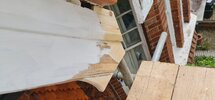
Is the above not spliced? Square edge cuts glued with a dedicated
"1" hour epoxy resin. No screws used.
Along the length of both barge boards there where numerous 0.2 to 0.5mm shallow cracks. I enlarged the cracks, used the super glue (as a wood hardener) and then used the semi- flexible "1" hour epoxy resin.
I could have used the 2 part wood hardener recommended by the manufacturer, but I have found that it is great on unpainted timber but stays sticky where it meets painted finishes for ages. The timber above and below was "punky" (read: fiberous). It wasn't rotted.
Here you go, there is a link for the manufacturer, tell them that you are a polymath and know everything and that they are stoopid. I am sure that they would love your feedback.
[email protected]
Frankly, I don't understand why you seem to need to be so combative. I have previously agreed with
some of your posts. Often, you, on occasion, come across as the scary bag lady with a beard that shouts at pigeons.
Set up a go fund me page so that you can seek professional help- I will donate the minimal permissible amount. At a guess, you will be able to purchase a button, or half a button. I don't care. Oh, maybe you can buy some bread crumbs to entice the pigeons to increase the volume of pigeons to shout at.
I would say that I pity you, but, to be honest, I can find few redeeming factors that allow me to empathise, or sympathise with you.
I would add that I am not a pigeon. Feel free to malign me and shout at me- I really do not care. I love this site because because I value feedback from knowledgeable people.
Sometimes you are one of those people. In this case you are not.
I have never claimed to be an expert in all areas on which I comment. Can you honestly say the same thing?
Interacting with you is awfully tedious. I have never blocked comments from fellow members, but, seriously, you are hard work.