Surges or "High" voltage possibly killing stuff?

Joined
28 Jul 2012
Messages
1,454
Reaction score
64
Location
Surrey
Country
United Kingdom
So i've been living in my new house full time for about 6 months now with all my stuff moved in, after previously spending around 10 months renovating my house.

Earthing system is split concentric TN-S according to DNO when I had them out last December to check the rating of my incoming fuse and also look at a old disused supply around the side of my house.


I come to notice recently a number of electrical items have failed in recent times, including:

1) A 110V tape cassette deck from Japan that runs on a small step down transformer that I have had for a number of years. Fixed by replacing a failed 1A glass fuse on the secondary side of the transformer inside the tape deck it's self.

2) A fancy colourful Glass LED mood bulb from B&Q, that has failed after 10 months from new when I bought it in Jan 2026.

3) A Philips Hue GU10 colour spot. I have a bunch of these, but now one won't turn on or reset.


Also I don't think so, but have my Hager SPD's in my consumer unit failed after only a year of use? I understand the window on them says "Defect" when failed, so I think they are ok, but not 100% sure. (I took them out to just to film the video and get a better look, since reinstalled them.)


My measured line voltage also often is pretty high-ish on the nominal 230v +10%/-6% range, with it peaking at 252 volts a few days ago according to my APC UPS data log. Right now and according to a separate plug in power meter, my voltage is 247V.

So my questions are:

1) Have my SPD's failed and need replacing? I don't think so, as I think the windows says "Defect" on them when failed afaik.
2) Is my high-ish line voltage causing things to fail and die, or is it just a coincidence?
3) If my line voltage is responsible for causing stuff to die, what can I do about it? I'm not that far away from a major large sub station, so I suspect that's why my line voltage is on the higher end.


Regards: Elliott.
 
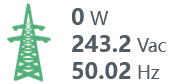
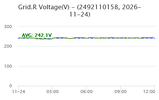
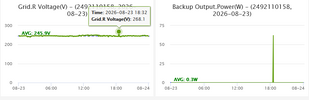
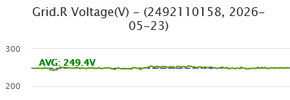
My software reports voltage 1795521299160.pngand it also logs when over voltage happens, as the solar shuts down, and logs the voltage 1795521468901.png I have looked back to see if high voltage I seem to remember it being higher, and I found a spike. 1795521784477.pngbut then noted the back-up also activated at the same time, so likely due to a power cut. How one would check without solar software I don't know. I seem to remember seeing voltage just under the upper limit in the past, but it looks as if the transformer tapping have been changed, back in May it was higher 1795522440170.pngso I will guess when the panels were fitted up the road, the tapping was dropped.

Back in my old house I had the same, load of OAP homes had solar fitted, and the voltage dropped, and my old kitchen fluorescent fitting stopped working. To be far designed for fat tubes 65 watt and running on thin tubes 58 watt which did not help.

But the SPD comes in at well over standard voltage, they will show a short with an insulation tester, but that's 500 volts, I don't have same make as you, so could only do an internet hunt, and you can do the same. My smart meter app does not show voltage, but think it does show direct on the meter?
 
Yeah, i'm not suggesting my SPD would kick in at 252 ish volts, I know it's much higher than that; was just wondering if I was getting the odd surge as well has the higher end of the nominal voltage range, but I doubt so.

Also my GU10 Philips hue bulb has now come back to life...for now at least!
 
1) Have my SPD's failed and need replacing?
No, the window is solid red when they fail.

2) Is my high-ish line voltage causing things to fail and die, or is it just a coincidence?
Possibly, but there is no way to prove anything.

3) If my line voltage is responsible for causing stuff to die, what can I do about it?
Complain to the network operator until they reduce it to compliant levels.

A 110V tape cassette deck from Japan
Japan is 100V, not 110.
If you are using a 110V TX, then it's overvolting it by at least 10%, and probably more if the supply to that transformer is in the 250V range.
 
My measured line voltage also often is pretty high-ish on the nominal 230v +10%/-6% range, with it peaking at 252 volts a few days ago according to my APC UPS data log. Right now and according to a separate plug in power meter, my voltage is 247V.
.

Current statutory low-voltage limits in the UK are 216.2 V to 253.0 V (a nominal 230 V with -6% to +10% tolerance) under the Electricity Safety, Quality and Continuity Regulations (ESQCR).

Key Details & Proposed Changes
    • Current Single-Phase Limits: 230 V nominal, ranging from 216.2 V (-6%) to 253.0 V (+10%), as outlined by UK Power Networks. [1]
    • Proposed Reform (207 V Lower Limit): The Energy Networks Association (ENA) proposed lowering the minimum limit to 207 V (-10%) while keeping the 230 V nominal and 253 V upper limit.
    • Why Change Is Proposed: Lowering the floor gives Distribution Network Operators (DNOs) more headroom to manage voltage rises from solar generation and prevent over-voltage trips on devices like EV chargers. [1, 2]
    • Current Status: Following consultation in early 2026, the ENA has been reviewing responses and developing an evidence case for the Department for Energy Security and Net Zero; existing limits remain in force until any rule change is enacted.
 
Japan is 100V, not 110.
If you are using a 110V TX, then it's overvolting it by at least 10%, and probably more if the supply to that transformer is in the 250V range.
So it is, my step down transformer is putting out 121-122V on average, and the back of my imported tape deck is marked 100V, so I'm over volting it by at least 21%!
 
Worth checking when those 252V peaks happen. If they line up with sunny middle-of-the-day periods, it's very likely neighbours' solar on the same street. When a lot of houses on one cable export at once, the voltage at the end of the run creeps up. Peaks overnight, when demand is low, point more at the transformer tap setting.

Either way, ring your DNO and ask for a voltage logger. They'll fit one free for a week or two. If it shows you're regularly brushing 253V, they're obliged to sort it, usually by adjusting the transformer tap.

On the failures, I'd be cautious linking them. 252V is still inside the limit, and cheap LED bulbs mostly die from heat, not voltage. GU10s in enclosed fittings are the worst for it. The cassette deck is the only one I'd blame on the supply, and that's the transformer as flameport says.

If you ever fit solar yourself, high supply voltage matters more. The inverter has to shut down once voltage goes past the G98 trip limit. On a street already running hot, you can lose generation on the best days. Getting the DNO to sort it now saves that headache later.
 
Last house, I did note the volts drop, as the old 65 watt florescent fitting with 58 watt tubes started to fail to strike, went to LED as a result. And this coincided with a whole load of solar panels being fitted on local OAP homes.

I did not here, I was near the upper limits, and it was not until I came to copy and paste to show how close I was, did I realise the voltage had dropped around 10 volts, and now sitting at 240 volt.
 
Why not measure it?
What do you mean? According to my auto ranging multimeter, the no load output voltage from my step down transformer when I measured it the other day was hovering around 121.5 volts, with it swinging between 121 and 122 volts in the minute or so I was measuring the output voltage of the transformer.
 
Worth checking when those 252V peaks happen.
Peaks often happen between 18:00 and 00:00, the 252V one the other week was around 22:17 at night.

GU10s in enclosed fittings are the worst for it.

The GU10 bulb came good, being it was a Philips Hue smart bulb, think it was a tech issue. For some reason back then, would not turn on or reset then.
 

If you need to find a tradesperson to get your job done, please try our local search below, or if you are doing it yourself you can find suppliers local to you.

Select the supplier or trade you require, enter your location to begin your search.


Are you a trade or supplier? You can create your listing free at DIYnot Local

 
Back
Top