- Joined
- 22 Jan 2026
- Messages
- 6
- Reaction score
- 0
- Country

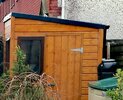
I have a timber potting shed built approx. 19 months ago. Construction is horizontal shiplap cladding fixed to a timber frame. Internally it is lined with OSB, except on the wall with the large window, where the lower part is OSB and the upper part is internal shiplap. There is rigid Unilin insulation in the cavity between the external cladding and internal lining. The shed sits on large paving blocks with gravel around it.
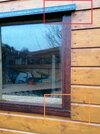
Since the first autumn/winter, during heavy wind-driven rain, water has been getting inside around/through the timber frame built for a fixed plastic window (non-opening, no weep holes). I initially applied TEC-7 generously around the window perimeter (all joints), which reduced the initial severity but did not resolve the issue.
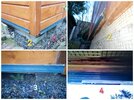
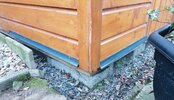
I suspect the same is happening with the other, smaller window on the front side, but splashback was an early suspicion, and I’m still not fully convinced whether it is contributing to the issue. The areas where the floor gets wet are the sides with windows; however, these are also the most exposed sides of the shed, while the other two sides are sheltered by a fence/wall.
Internally, moisture can be seen:
I plan to remove some internal OSB panels to trace the exact water path, but would appreciate advice on correct external detailing first. I also fitted a few rain deflectors externally as a test. If splashback is contributing, my next idea was to add DPC hanging down over the rain deflectors.
Specific question:
Any thoughts or advice would be very welcome.
Photos attached:
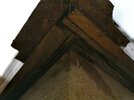
01–04: affected sides and corners
05–07: window where the issue is confirmed
08: impact on the shed floor
Since the first autumn/winter, during heavy wind-driven rain, water has been getting inside around/through the timber frame built for a fixed plastic window (non-opening, no weep holes). I initially applied TEC-7 generously around the window perimeter (all joints), which reduced the initial severity but did not resolve the issue.
I suspect the same is happening with the other, smaller window on the front side, but splashback was an early suspicion, and I’m still not fully convinced whether it is contributing to the issue. The areas where the floor gets wet are the sides with windows; however, these are also the most exposed sides of the shed, while the other two sides are sheltered by a fence/wall.
Internally, moisture can be seen:
- appearing near an upper window corner
- then either tracking down internally to the bottom corner and/or appearing there directly
- in heavy rain the bottom corner can be wet to the touch
- that water has been strongly suspected to go down behind the OSB, and on a few occasions as small drops or trails on the front face of the OSB
- this ultimately wets the floor edge, leaving visible staining and dampness
I plan to remove some internal OSB panels to trace the exact water path, but would appreciate advice on correct external detailing first. I also fitted a few rain deflectors externally as a test. If splashback is contributing, my next idea was to add DPC hanging down over the rain deflectors.
Specific question:
- In a timber shed of this type, should the bottom of the window frame be left open to allow drainage?
I originally sealed the bottom with TEC-7 as well. More recently I’ve read that the bottom should not be fully sealed, to allow any water that gets in to escape. I’ve since removed some sealant at the bottom corners, just in case this can act as a drainage path — though I remain unsure whether this is correct.
Any thoughts or advice would be very welcome.
Photos attached:
01–04: affected sides and corners
05–07: window where the issue is confirmed
08: impact on the shed floor
Attachments
-
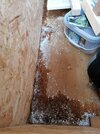 08-wet floor.jpg316.7 KB · Views: 20
 -
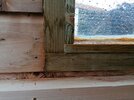 07-bottom corner of the same window.jpg343.4 KB · Views: 15
 -
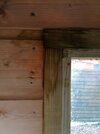 06-Top corner of this window, from the inside.jpg151.6 KB · Views: 15
 -
 05-window where the water is getting through.jpg310.9 KB · Views: 16
 -
 04-collage.jpg333.8 KB · Views: 18
 -
 03-structure of the affected corner.jpg154.7 KB · Views: 18
 -
 02-affected corner.jpg338.7 KB · Views: 15
 -
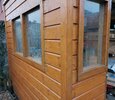 01-affected sides.jpg405.8 KB · Views: 18