
You are using an out of date browser. It may not display this or other websites correctly.
You should upgrade or use an alternative browser.
You should upgrade or use an alternative browser.
Washer/dryer tripping consumer unit
- Thread starter Keitai
- Start date
Yeah. Senior moment!We would know with an RCCB. It's an RCBO

- Joined
- 27 Jan 2008
- Messages
- 29,786
- Reaction score
- 3,694
- Location
- Llanfair Caereinion, Nr Welshpool
- Country

Washing machines use mineral insulated heaters, which if the seal is damaged can absorb water and this results in an earth fault, to confirm this is the case you need an insulation tester
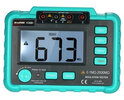 not a standard multi-meter, so to repair it likely better to get a washing machine repairer to trying to DIY as the test gear costs so much.
- Joined
- 5 Nov 2024
- Messages
- 6,139
- Reaction score
- 2,924
- Country
That could be a result of poor wiring and or connectionsIs this RCB or MCB. I changed the plug's fuse and it sizzled so pulled plug straight away
View attachment 426056

- Joined
- 18 Apr 2022
- Messages
- 7,598
- Reaction score
- 1,165
- Country
Washing machines use mineral insulated heaters, which if the seal is damaged can absorb water and this results in an earth fault,
Faults with those are highly indicated by everything being OK until the heating part of the cycle kicks in.
Ditto with pumps or internal drain hoses when draining starts.
- Joined
- 27 Jan 2008
- Messages
- 29,786
- Reaction score
- 3,694
- Location
- Llanfair Caereinion, Nr Welshpool
- Country
Oh no, that's rather dangerous.As Eric says the heating element is the most likely cause. Disconnect and insulate the wires going to it and see if it still trips.
Several years ago a neighbour in a caravan on a holiday site washer kept tripping his electrics when switched on and he was on about getting a new one. On inspection just under the top cove was a small device just after the incoming feed which I noted had a slight browning stain around one of the terminals, The device turned out to be an electrical interference suppressor, on by passing it (and eventually replacing it) the problem was resolved.
Following output from Google AI :-
An electrical suppressor (also known as a mains interference filter or noise filter) is typically the first internal component connected to your washing machine's power cord. Its primary job is to smooth out electrical current and stop electromagnetic interference generated by the machine's motor from disrupting other appliances or your home's electronics. [1, 2, 3]
Because it deals with the direct entry of power, a failing suppressor will cause distinct electrical faults. [1]
Symptoms of a Faulty Suppressor
If your washing machine's suppressor is failing or has blown, you will usually notice one of the following issues:
How to Choose a Replacement Part
Suppressors are highly specific to the manufacturer and model. You cannot safely use a generic suppressor unless it is explicitly cross-compatible with your brand's specifications (voltage, amperage, and pin configurations). [1, 2]
To get the right part, you must look up your washing machine's Model Number or Product Number Code (PNC), usually found on a sticker behind the door rim or on the kick plate. Here are standard examples of genuine replacements depending on your brand: [1, 2]
Following output from Google AI :-
An electrical suppressor (also known as a mains interference filter or noise filter) is typically the first internal component connected to your washing machine's power cord. Its primary job is to smooth out electrical current and stop electromagnetic interference generated by the machine's motor from disrupting other appliances or your home's electronics. [1, 2, 3]
Because it deals with the direct entry of power, a failing suppressor will cause distinct electrical faults. [1]
Symptoms of a Faulty Suppressor
If your washing machine's suppressor is failing or has blown, you will usually notice one of the following issues:
- Tripping the Electrics: The most common symptom. It will immediately trip your household RCD, circuit breaker, or blow the plug fuse the moment you turn the machine on or plug it in. [1]
- Completely Dead Appliance: If the internal circuit or fuse inside the suppressor fails, no power can pass past it. The machine will appear completely dead with no lights on the control panel.
[1, 2] - Physical Damage: A failed suppressor often bulges, cracks, shows visible black scorch marks, or gives off a strong burnt plastic smell. [1, 2]
How to Choose a Replacement Part
Suppressors are highly specific to the manufacturer and model. You cannot safely use a generic suppressor unless it is explicitly cross-compatible with your brand's specifications (voltage, amperage, and pin configurations). [1, 2]
To get the right part, you must look up your washing machine's Model Number or Product Number Code (PNC), usually found on a sticker behind the door rim or on the kick plate. Here are standard examples of genuine replacements depending on your brand: [1, 2]
Why, quite common practice.Oh no, that's rather dangerous.
- Joined
- 27 Jan 2008
- Messages
- 29,786
- Reaction score
- 3,694
- Location
- Llanfair Caereinion, Nr Welshpool
- Country
I have in the past insulated a heating element from the earth and allowed it to heat up and drive the moisture out, but this means the machine can be live, which is clearly dangerous and the process does not last so rather pointless.
Using an insulation tester one can work out what is faulty, but the problem is any neutral to earth fault even in some other device, can seem to be due to the washing machine as the high load increases the potential difference between neutral and earth, so without an insulation tester best it to try running it from a different RCD, and also try to make sure everything else is unplugged.
Yes capacitors on the supply can go faulty, and can also blow clear, I had a problem myself, and unplugged as much as I could find until able to reset the RCBO and then one by one plugged back in, convinced the dish washer was at fault, used the insulation tester on it before renewing, could find no fault, plugged back in and no trip. Put the clamp meter on the supply, and whole house only leaking 8 mA, tested the RCBO and it was well within range, so I assume some capacitor has blown its self clear, but never did find the fault.
All we can do is split the RCD protection into circuits using RCBOs so as the regulations say since 2008
I have never worked out how using two RCDs has ever complied with that? But it says "in normal operation" which is the get out clause.Every installation shall be divided into circuits, as necessary, to:
(iv) reduce the possibility of unwanted tripping of RCDs due to excessive protective conductor currents produced
by equipment in normal operation


I'll stick my neck out and make the suggestion these symptoms are classic of a faulty interference suppressor

 usually immediately adjacent to the mains flex entry to the WM.
I'm not ruling out a water leak by any means, but experience of the symptoms etc.
I'm not ruling out a water leak by any means, but experience of the symptoms etc.

The expense of fitting a number of 16/20A 2.5mm² or 32A 4 or 6mm² radials (other than for a specific purpose) is in my opinion crazy.who said anything about thicker cables ?
more circuits is the most sensible split in a home to minimise inconvenience (314.1.2 iirc)
Like john my failures here since 1994 are minimal, the biggest outage being rodent damage to a lighting circuit in the loft which required replacing 2 pieces of cable. Actually they were only twin so I took the opportunity to upgrade to T&E and the whole job including fault finding, doing away with a borrowed neutral...
I'll stick my neck out and make the suggestion these symptoms are classic of a faulty interference suppressor
usually immediately adjacent to the mains flex entry to the WM.
I'm not ruling out a water leak by any means, but experience of the symptoms etc.
I'm not ruling out a water leak by any means, but experience of the symptoms etc.
The expense of fitting a number of 16/20A 2.5mm² or 32A 4 or 6mm² radials (other than for a specific purpose) is in my opinion crazy.who said anything about thicker cables ?
more circuits is the most sensible split in a home to minimise inconvenience (314.1.2 iirc)
Like john my failures here since 1994 are minimal, the biggest outage being rodent damage to a lighting circuit in the loft which required replacing 2 pieces of cable. Actually they were only twin so I took the opportunity to upgrade to T&E and the whole job including fault finding, doing away with a borrowed neutral...
Probably so post nr 23 gets the messageI don't know why it does that!

DIYnot Local
Staff member
If you need to find a tradesperson to get your job done, please try our local search below, or if you are doing it yourself you can find suppliers local to you.
Select the supplier or trade you require, enter your location to begin your search.
Please select a service and enter a location to continue...
Are you a trade or supplier? You can create your listing free at DIYnot Local
Similar threads

- Replies
- 13
- Views
- 2K