

During periods of wind driven rain I experience water ingress at the corner of a large window, which has a steel lintel above. The previous house owners' carried out major modifications including the enlarged window replacement. From the outside I can't tell whether the steel lintel is simple angle bar or catnic.
Given the water ingress, I do wonder whether a cavity tray was fitted above the lintel and if so, whether stop ends were fitted. Could stop ends be retro fitted or would it require the whole lot to be opened up and start again with a cavity tray?
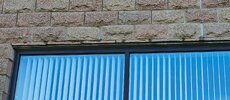
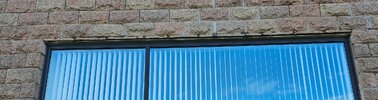
In the photograph (taken some eight hours after driven rain) you will see that the weep vents are set into the blocks some 2 to 3 inches above the steel lintel, and above a fillet of Fyfestone block. Are these weep vents in the right place or should they be directly on top of the lintel base plate to work effectively? Will it be possible to fit new weep vents lower down without damaging any cavity tray that may be fitted? If so, I'm hoping that the new weep vents will do their job and possibly prevent the need for cavity tray intervention.
Any advice would be greatly appreciated.
Given the water ingress, I do wonder whether a cavity tray was fitted above the lintel and if so, whether stop ends were fitted. Could stop ends be retro fitted or would it require the whole lot to be opened up and start again with a cavity tray?
In the photograph (taken some eight hours after driven rain) you will see that the weep vents are set into the blocks some 2 to 3 inches above the steel lintel, and above a fillet of Fyfestone block. Are these weep vents in the right place or should they be directly on top of the lintel base plate to work effectively? Will it be possible to fit new weep vents lower down without damaging any cavity tray that may be fitted? If so, I'm hoping that the new weep vents will do their job and possibly prevent the need for cavity tray intervention.
Any advice would be greatly appreciated.


