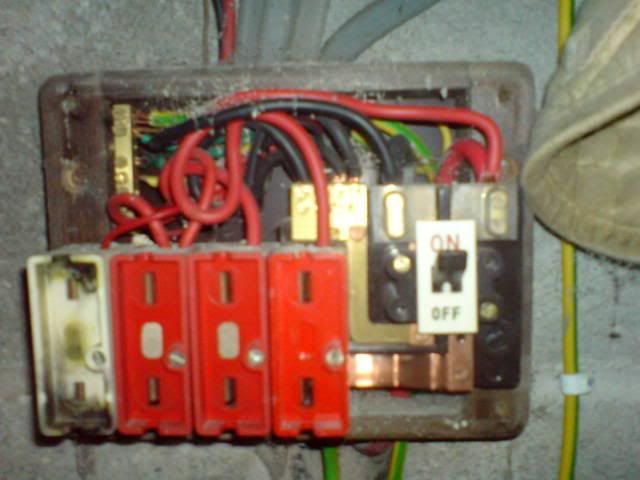
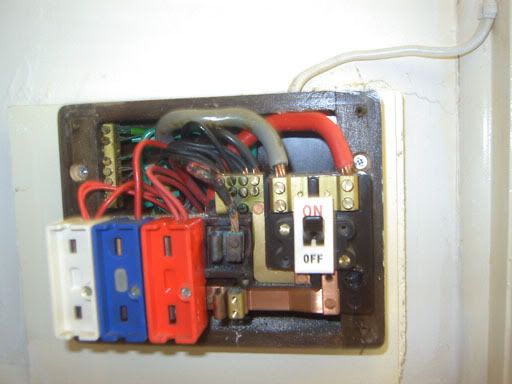
Another thought, would it be possible to take tails from the input supply to a seperate small correctly rated single fuse box just for the cooker to take the load off the main fuse box
Rather than do that, have a full-sized CU put in, then it can be used to transfer existing and new circuits to, rather than install a mini-unit which can't be used for anything else. The cost difference would be marginal.
Thanks for the quick replies but you have lost me a bit as you are all obviously experts in the subject
Sorry - it was a chat about diversity.
If you look at your CU, you'll probably see more than one lighting circuit, more than one socket circuit etc. If you were to add up the ratings on all the MCBs it would come to far more than the rating of your supply fuse, which will be 60 - 100A.
The reason it doesn't blow is that you don't run all your circuits flat out - you don't have 1.4kW of lighting burning on each circuit, you don't have several fan heaters plugged into each socket circuit etc. The allowance for the fact that you don't do these things is called diversity, and there are guidelines on how this is worked out to come up with a reasonable estimate for your overall load.
A cooker is one appliance where diversity is applied - if you think about it, once the oven or grill or ring has reached the right temperature it switches off, and only clicks back in now and then for a short time to keep the temperature level. Electric cookers are not like gas, you can't run an element at a lower level, it is either on or it is off - no in-between.
So your 9.8kW - 10.7kW cooker doesn't use that continuously - it'll be rare to have every part in use at once, and even when you do it'll only consume all that power for a short while from cold.
The guideline for working out how much to allow for a cooker is the first 10A + 30% of the remainder, then +5A if the cooker control unit has a socket. So for a "45A" appliance that would be 10A + 10.5A + possibly 5A, i.e. 21-26A.
I have a lot of sympathy with Col's view that you shouldn't do that on a per-circuit basis, i.e. it's for working out the demand of your whole house, and that if you have a 45A appliance you should have it on a 45A circuit, but when I've expressed that view in the past I've often been shouted down and called some unpleasant names, and been accused of ripping people off etc.
As long as the relationship between cable capacity and MCB rating is OK, no harm can be done by connecting too large a load - all that would happen would be that the MCB would do its job and trip. If you were putting in a new circuit I'd say use 10mm² on a 45A breaker, but as you already have a 40A circuit I'd say give it a go first and see what happens in practice.
But....
I'm still not sure that is an OK 40A circuit. What is the rating of the main switch - does it say? Does it
not say 100A?
Any chance of a photo?
ban-all-sheds, If you mean do the circuit breakers look wonky, not really they seem to sit snugly
The 40A one has a plastic tab on it to prevent it being used in boards which are not rated highly enough. I guess it could have been broken off..
You are right the box does need replacing, the previous owner had the house rewired and it has a digital meter beside the box, how long ago this was i dont know off hand but it was in the last few years, why they didnt change the box I dont know
It's not unknown for sellers to pretend to have rewired by just replacing the cables you can see.
I gather from what you are saying 40amp is the biggest breaker to be used in this box anyway
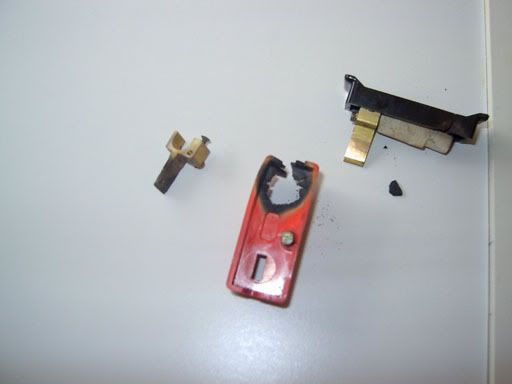
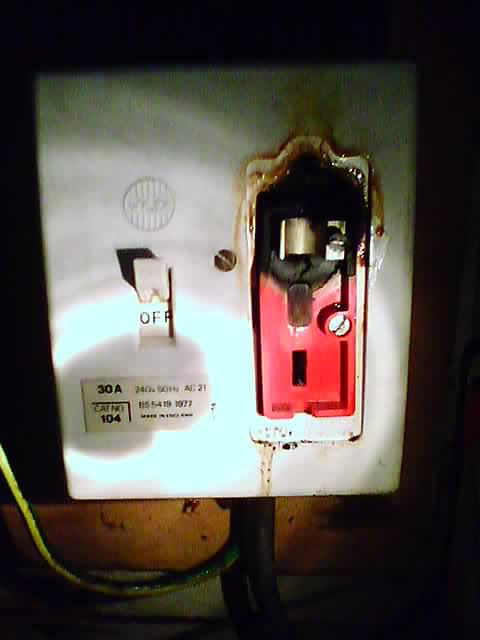
Or maybe less. Someone here once posted a photo of an old Wylex which had gone bad - not a pretty sight....
But meanwhile would it be safe to use if I changed the cable for 10mm, it will be just clipped to the wall, not buried and there will not be a socket on the cooker unit,
It's not the relationship of the 40A breaker to the 6mm² cable which is in doubt, it's the presence of that breaker in the CU. Changing to a 10mm² cable won't affect that.