What should I use to cap wires?

Joined
22 Aug 2014
Messages
7
Reaction score
0
Location
London
Country
United Kingdom
Hi,
I have an old wall mounted light fitting (with a pull cord attached to the fitting) which was pulled loose from the wall. When I looked more closely at the wiring it was obvious that the cable had previously been damaged by the rawl plug, to such a degree that there was bare copper showing.

I decided to disconnect the light fitting, and I then removed some plaster to expose more of the cable, and then cut the cable back to remove the damaged section. I have now stripped the main cable to expose a couple of inches of the blue, brown and yellow/green cables.

I had planned to cap the wires and rebury them (adding a blank plate to cover and mark the spot).

Initial advice that I found online discussed using "wire nuts" on each individual wire, but I now understand that this is not standard practice in the UK.

Could anybody please advise what I should use to cap the wires, and whether I need to further shield the capped wires, before reburying them behind the blank plate.

Any advice would be much appreciated.
 
If the cable terminals are to be left accessible behind a blank plate, then any standardised connectors will be suitable, correctly rated terminal strip will be appropriate as will wagos. If the cable repair is not to be left accessible, I would suggest removing the cable and installing a complete new length.
 
If the cable terminals are to be left accessible behind a blank plate, then any standardised connectors will be suitable, correctly rated terminal strip will be appropriate as will wagos. If the cable repair is not to be left accessible, I would suggest removing the cable and installing a complete new length.

Thanks. Would this be appropriate? (lighting circuit is on a 5 amp fuse, so I assume the rating is high enough)

www.screwfix.com/p/5a-terminal-strips-pack-of-10/60804

Do I simply need to put the three separate wires into three different holes on the strip, or do I need to separate the terminals?
 
Thanks for all the advice.

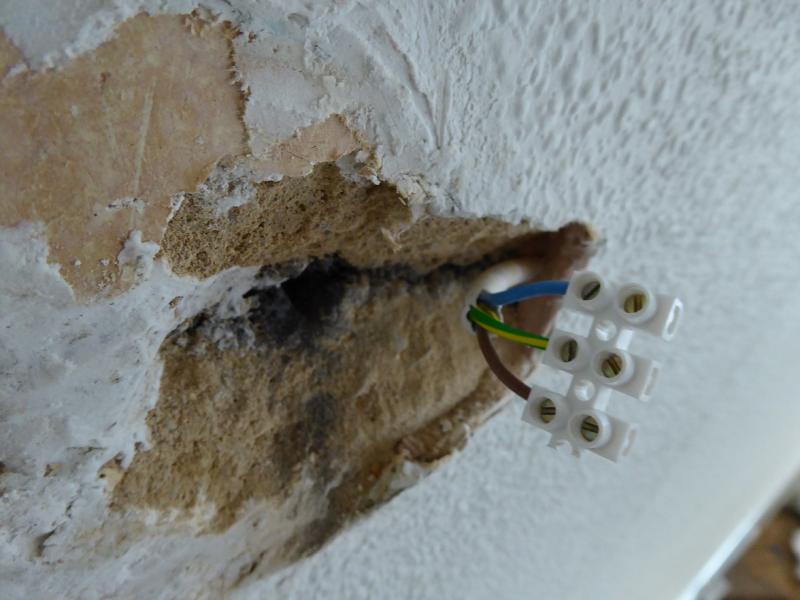
I bought a terminal strip today, cut it down to just three terminals and then screwed the wires in. This is what it looks like now. Obviously I have a bit more more to do before I can re-bury the cable and put the blank plate up.


You can't see from the image, but the three wires still have all of their insulation intact (except maybe a millimetre or so at the end). I only loosened the first screws before feeding the wires in, so the wires stop at the second screws.

Does that look OK? Is it worth removing the second screws to further isolate the wire?
 
Thanks for all the advice.

I bought a terminal strip today, cut it down to just three terminals and then screwed the wires in. This is what it looks like now. Obviously I have a bit more more to do before I can re-bury the cable and put the blank plate up.


You can't see from the image, but the three wires still have all of their insulation intact (except maybe a millimetre or so at the end). I only loosened the first screws before feeding the wires in, so the wires stop at the second screws.

Does that look OK? Is it worth removing the second screws to further isolate the wire?

That terminal strip and the unsheathed wires should really be in an enclosure, not just buried in the wall. You should sink a standard back box, connect the CPC to the earth terminal of the box and just the live and neutral to that connector block, then fit the blanking plate onto the back box.
 
That terminal strip and the unsheathed wires should really be in an enclosure, not just buried in the wall. You should sink a standard back box, connect the CPC to the earth terminal of the box and just the live and neutral to that connector block, then fit the blanking plate onto the back box.
Agreed - except that "should really be" is, IMO, a serious understatement. To just bury the connector block in plaster (if that is what the OP was planning to do) would obviously be totally unacceptable, and potentially dangerous - it must be done in the manner you have described.

Kind Regards, John
 
OK, thanks.

What I had planned to do was just to cut a cavity in the wall, large enough to accommodate the unsheathed wires and terminal strip, and then place a blanking plate over that (rather than putting the unsheathed section into new plaster).

If I need a back box, can I use a non-metallic one like this, and then avoid the need to attach to an earth terminal?

http://www.screwfix.com/p/appleby-sfsb619-1-gang-dry-lining-box/44827

I'm sure attaching to the earth terminal would be straightforward, but I'd like to simplify things as much as possible.
 
OK, thanks. What I had planned to do was just to cut a cavity in the wall, large enough to accommodate the unsheathed wires and terminal strip, and then place a blanking plate over that (rather than putting the unsheathed section into new plaster).
Fair enough. That's not as bad as I was fearing (actually burying it in plaster), but still not very nice.
If I need a back box, can I use a non-metallic one like this, and then avoid the need to attach to an earth terminal?
http://www.screwfix.com/p/appleby-sfsb619-1-gang-dry-lining-box/44827[/QUOTE]
In theory, yes. However, plastic back boxes are usually (like the one you mention) designed to 'clip onto' hollow plasterboard walls, and you might have difficulties fixing it to a solid wall. You could, I suppose, bury a plastic 'surface box' ('pattress') in the wall.
I'm sure attaching to the earth terminal would be straightforward, but I'd like to simplify things as much as possible.
It's only a matter of attaching one wire to one screw terminal on the box (and putting green/yellow sleeving on the bare wire) - not anything complicated.

Kind Regards, John
 
Looks like flex to me - wonder why that was used for a buried cable.

Can you not find the other end, disconnect and remove it?
I think that the wiring in this house (and many of my neighbours) is a very questionable hodge-podge.

I'd hoped to not have to dig out and disconnect the whole cable. There is a second light, which this cable runs towards, and (given the hodge-podge) I'd hate to think what I would find at the junction

What I really want to do for now is make it safe, until such time that I can get a whole house re-wire sorted arranged.

Looks like flex to me - ...
So it does! - cancel my comments about G/Y sleeving over the 'bare earth wire'!

Uh-oh...why are we cancelling your comments? :(

Does the fact that it is a flex change my ability to connect this to a earth on a metal back box, or put it in a non-metallic back box?

Given that I am looking for a short-term (but safe) fix, what is the best way for me to proceed?

Thanks again for all the help so far.
 
Looks like flex to me - ...
So it does! - cancel my comments about G/Y sleeving over the 'bare earth wire'!
Uh-oh...why are we cancelling your comments? :( Does the fact that it is a flex change my ability to connect this to a earth on a metal back box, or put it in a non-metallic back box?
Not at all - it actually makes it easier. I hadn't looked properly at the pic, and was assuming (since that's what one would normally expect) that it was standard ('twin and earth') house wiring cable, which has a bare earth wire - hence my comment about putting sleeving over it. Flex has an earth which is already insulated (with green/yellow), so you don' have that 'problem'.
Given that I am looking for a short-term (but safe) fix, what is the best way for me to proceed?
Probably to put some sort of back box (ideally metal, possibly plastic) into the wall with a blank plate on it (connecting the earth wire to the back box terminal if the box is metal). If, despite that, you did decide to go with your original plan, be very careful not to drill into the cable when establishing fixings for the blank plate screws.

Kind Regards, John
 
Agreed - except that "should really be" is, IMO, a serious understatement. To just bury the connector block in plaster (if that is what the OP was planning to do) would obviously be totally unacceptable, and potentially dangerous - it must be done in the manner you have described.

Kind Regards, John

Agreed, I was trying to be gentle :)
 
Probably to put some sort of back box (ideally metal, possibly plastic) into the wall with a blank plate on it (connecting the earth wire to the back box terminal if the box is metal). If, despite that, you did decide to go with your original plan, be very careful not to drill into the cable when establishing fixings for the blank plate screws.

Thanks. I very much appreciate the very detailed advice that you, and everyone else, have taken the time to provide.

I shall go with a back box as you folks have advised, and will report back on progress! :)

Thanks again.
 

If you need to find a tradesperson to get your job done, please try our local search below, or if you are doing it yourself you can find suppliers local to you.

Select the supplier or trade you require, enter your location to begin your search.


Are you a trade or supplier? You can create your listing free at DIYnot Local

 
Back
Top