
lack of smogYeah - just going over why the speed appears to have changed.



lack of smogYeah - just going over why the speed appears to have changed.
Indeed, once one has been exposed to that 'explanation' (or has thought it up for oneself).Well....... But no - what I meant was that you don't have to be an expert in probability, or do any complicated maths, to see how that explanation makes sense. ...
I suppose it's fairly reassuring to know that, like the rest of us, you are also humanFWIW, my initial thought, when I first encountered the problem, was that swapping to the other door made no difference.

Quite - but it depends upon what you mean by "that view". The fact that probabilities cannot change due to subsequent events is drummed into students very strongly from Day 1, but seemingly without the necessary qualification that it ceases to be the the case if someone/something 'moves the goalposts' (which can 'move probabilities around') - and that will usually (always?) require at least partial knowledge about 'the answer'.I don't see how anyone can not take that view.
Indeed, as above.If one of the unchosen doors is opened that too cannot change the probability of the contestant having picked the right one originally, but it does change how the ⅔ probability in the unchosen set is distributed amongst the doors.
True, but the problem here is that probably most people, particularly 'the general public', do not think about probabilities 'that way around' - e.g. they think about the probability that their chosen number will win the Lottery, not the probability that one of the numbers they have not chosen will win.Remember the "that" are the probabilities after the contestant has chosen, which are that there's a 1 in 3 chance the prize is behind his door and a 2 in 3 chance it's behind one of the other two doors.
Again true - but, of course, the 'problem' arises because many people will (incorrectly) think/say exactly the same about each of the other two doors (i.e. forgetting that the host has revealed the (zero) probability of the prize being behind one of the doors).Opening a door does not sometimes cause the prize to move, and therefore does not alter the probability of the prize having been behind the contestants door at the start.
Quite so - but, as I said, many people will (incorrectly, and probably subconsciously) assume that, if the prize was allocated to a door 'at random', that in the 2-door scenario, there will be an equal (1/2) probability of it being behind either of the doors.That's a different scenario - the contestant is choosing between 2 doors, not 3, so the probabilities become ½ & ½.
The numbers which ebee and yourself are talking about are, of course, the speed of light in a vacuum. The speed of light in air is very similar but it is much slower in media such as water and glass (I think generally about 70% of the speed in a vacuum).Yeah - just going over why the speed appears to have changed.

When you say that's how you 'initially' saw it, are you saying that you are one of those exceptional (but seemingly rare) people who 'immediately saw' the correct (and 'simple') answer?Yup that is the way I initially saw it. Changing from a choice of 1 in 3 to a choice of 1 in 2 (providing that the host - monty hall - always reveals a goat not a car - therefore from .333 to .500 is a 50% increase. ... Simple when you see it but not so simple if you do not.
I'm not sure what you mean by "90% probability of a positive result or a negative result" (the result must be either positive or negativeAnother test/survey thingy apparently and goes something along the lines of (others might correct me) :- a disease is reckoned to be 10% prevelant in the community and a test is developed that gives with a 90% probability of a positive result or a negative result.
A patient with no other observations goes to see his GP , he has had that one test and it was positive. What are the chances he has the disease? A/ 90%, B/50%, C/10% , D/5%. Apparently the correct answer is 50% or thereabouts. All thanks to a Reverend Bayes and his Theorem.
) but, yep, as you say, it's all down to Mr Bayes' Theorem, and some people regard it as counter-intuitive. However, I think it's a bit different from Monty Hall.

However, it's perhaps worth remembering that the speed of light is a most extraordinary animal. It may have made sense to Mr Einstein, but I would say that it is next-to-impossible for us mere mortals to get our head around it!
Everything that we (virtually all of us) understand about 'speed' is relative - indeed, the concept of speed has no meaning in the absence of a reference point or observer (i.e. speeds are relative to that point or observer). However,given that we seem to believe Mr Einstein, the speed of light is absolute - i.e. the same 'relative to anything', including 'relative to the speed of an observer who is travelling at high speed (relative to something else).
I don't really know how us 'mere mortals' are meant to conceptualise this, particularly if we think of light as the movement of particles (photons), rather than as 'a wave'. If it were almost any object other than a photon, if it moved X kM away from (or towards) an observer in Y seconds, then its speed relative to that observer would be X/Y kM/sec - so if the observer were moving in the same (or opposite) direction as the object, it's speed relative to the observer, then the speed of the object relative to the observer would be less (or more) than X/Y. How/why on earth that can be different for a photon certainly escapes me!
But hey, maths is not a perfect science,
But hey, maths is not a perfect science, as is evidenced by paradoxes such as Gabriel's Horn. An infinitely large cone which, if filled with paint, would not contain enough paint to cover the outside of the cone.
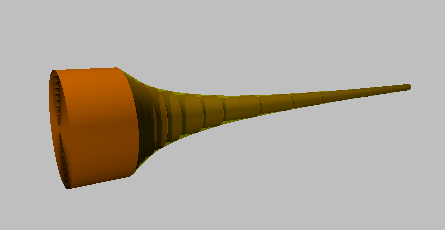
If you're interested in 'counter-intuitive' matters of probability, are you familiar with "The Birthday Paradox"?
Doesn't the takaway make a profit on sales?No downside for him/upside for the takeaway if he was wrong?
Why would the takeaway go for that? Who would ever take a bet where if they lose they pay and if they win they get nothing?

I once worked it out with a computer program.I was chatting to a guy a couple of weeks ago. He recounted how a maths student friend walked into a takeaway and said to the guy behind the counter "I predict that of the next 30 people to walk in, two will have been born on the same day, same month. If I am correct can I have my food for free?". He got his food for free. He knew that he would only have a 50% chance of winning if he said 23 people, so he went for 30.
When you say that's how you 'initially' saw it, are you saying that you are one of those exceptional (but seemingly rare) people who 'immediately saw' the correct (and 'simple') answer?
I'm not sure what you mean by "90% probability of a positive result or a negative result" (the result must be either positive or negative
The important point about diagnostic tests is that the "Positive Predictive Value" (the probability of a person having the disease if the test result is positive) is what matters, and that depends on the prevalence of the disease in the community being tested . If you think about it, that makes some sense, since if, say, the prevalence of the disease is very low, then nearly all positive results (for any test) will be 'false positives'. Ultimately, if the prevalence of disease were zero, then any positive results would be false positives'.
Bayes' Theorem reminds us that, other than for a 'perfect' test, diagnostic tests are not 'absolutes' but, rather arepart of the overall 'melting plot' that helps to refine what we knew before undertaking the test. If the prevalence of a disease is 10%, then the 'pre-test probability' of a random individual having the disease is 10% but the test result then enables us to 'refine' that to a figure closer to the truth!
If you're interested in 'counter-intuitive' matters of probability, are you familiar with "The Birthday Paradox"?
I once worked it out with a computer program.
OK a Spectrum and I used Spectrum basic.
I used the Random button (OK Pseudo Random, but you get the drift).
I ran it thousands of times and came to the conclusion that 28 days was almost always the number needed to match a birthday with the first entrants birthday at least once.
So I would be inclined to agree that around 29 or 30 people total might be a reasonable figure for a very high expectation of say better than 90 odd percent of the time.
I've read dozens, if not hundreds, of explanations' in my time, as have many statisticians, but that doesn't alter the fact that most of us still have grave 'intuition problems'!
sorry John, I missed that one!When you say that's how you 'initially' saw it, are you saying that you are one of those exceptional (but seemingly rare) people who 'immediately saw' the correct (and 'simple') answer?

If you need to find a tradesperson to get your job done, please try our local search below, or if you are doing it yourself you can find suppliers local to you.
Select the supplier or trade you require, enter your location to begin your search.
Are you a trade or supplier? You can create your listing free at DIYnot Local


