NIC PIR Certs

Status
Not open for further replies.
I suppose the point is design and installation are separate and although as an electrician we are trained to install should we also be doing the design?
If you're self employed, unless you're paying someone to do the design for you, yes you should be doing the design as well as the installation.

Test results should only be verification of the design calculations so without a design you can't really install.

I agree that for the average domestic installation you can base the design on previous installations and experience. But throw in a shed or workshop at the end of a garden and out comes the calculator.

Because for various reasons we often cannot fully live test our installations we have to attach our design calculations to the EIC to show compliance. The NIC have never had a problem with this, in fact they are more than happy to see the design. But I had to invest in software otherwise the designs would take far too long. (for me anyway)
 
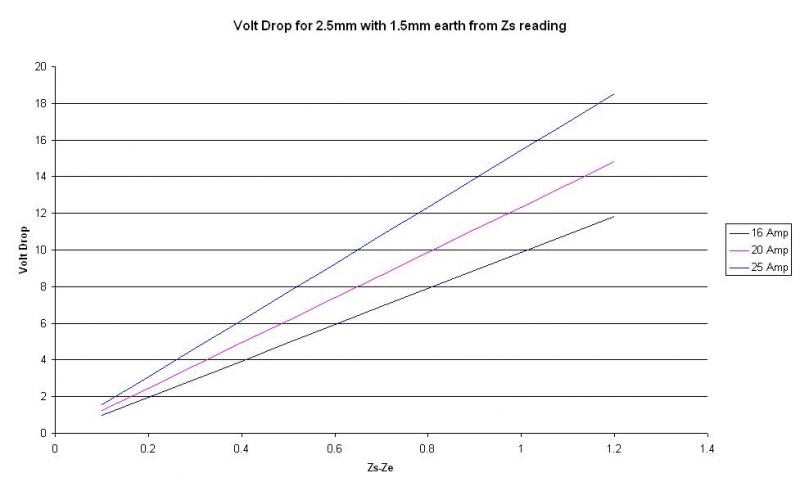
OK we can compare volt drop to Zs - Ze reading for 2.5mm T&E as shown here but how is that going to help other than look nice. We could use it to give us the value but would it not be much easier to use Excel to directly work it out?
All the information is in BS 7671 but it does not tell you how to use it. In the example I have allowed for Zs being measured between R1 + R2 but volt drop is required between R1 + Rn.
Although some one leaving school in the last 10 years may have been trained how to use Excel how many electricians of my age (57) will be able to work this out. I have come across some who can't even remember ohms law!
Which is why I ask as an electrician how far should we go. OK I can do it but I only got my degree a couple of years ago so is all fresh ask me when I am 80 and you may get a different answer! i.e. 25 years after I have left full time education.
Eric
 
For any in-service installation, Voltage Drop can only be verified at best as a rough rule of thumb, whether by measurement or calculation based on measured values.

I wonder how many are now installing Standard Circuits in accordance with the new specifications found in the new OSG?
 
Checking volt drop on unloaded circuit is meaningless.

Also from appendix 12, the percentages given there are based on nominal :lol: voltage. So for lighting, 3% of 230v = 6.9v, therefore if you measure a vd of 7v on a (actual) 240v circuit thats a failure eventhough 3% of 240 = 7.2v.

I really feel sorry for you guys who have to somehow comply with sort of nonsense to maintain your registrations.

And also you must take harmonics into account as well. :lol: :lol:

And while your at it should'nt there be some type of temperature factor introduced. I'm thinking, testing a bungalow in the middle of winter with most of the wiring in the freezing cold roof void, surely you have to heat the void to summer temperatures, a dozen of those gas blower heaters should do the trick.
 
Also from appendix 12, the percentages given there are based on nominal :lol: voltage. So for lighting, 3% of 230v = 6.9v, therefore if you measure a vd of 7v on a (actual) 240v circuit thats a failure eventhough 3% of 240 = 7.2v.
How does that work?

Surely a %ge is a %ge,and if you are allowed 3% of a nominal 230V you're allowed 3% of an actual 240V?

[aside]What is the symbol for actual or measured P-N voltage, not nominal?[/aside]
 
Seems to me that it depends whether the load is resistive, or draws a fixed current regardless of voltage.

Though it gets more complicated if the current draw is only for part of the cycle of course.
 
Holmslaw no where does it say we measure volt drop. It says circuit impedance or calculations i.e. R1 + Rn or Z1n between Line and Neutral where the supply is to a fixed current using equipment then the amps actual draw would be used but where the current may vary then of course the current of the protective device would be used.
So to work through an example:-
Ring main R1 + R2 = 0.5 ohms feed from 32 amp MCB with twin and earth.
R1 + Rn = 0.5 /((18+29)/2)*18 = 0.382979 ohms since the cable is doubled up to mid-way point this is halved so 0.191489 also since current will go through both cables that also is halved so 16 amp and 16 x 0.191489 = 3.06383 volt drop well within the 11.5 volt permitted.
What to me is more interesting is the reverse taking a 11.5 volt drop what will the R1 + R2 be? I will not bore with calculations but R1 + R2 of 1.9 ohm is the limit on a 32 amp ring main using twin and earth so long as it is better than 1.9 it will pass since we know that figure what is the problem. Why would we ever need graphs and the like?
If we do the same for 1.5mm with 1mm earth and 6 amp MCB (3%) we get a max of 1.45 ohms R1 + R2 using the same cable to feed an emersion heater (5%) at 13 amp we get 1.11 ohm for R1 + R2 so what is the problem we already measure R1 + R2 and we have a set of maximums is it not just a case of pass or fail as to if the R1 + R2 is under or over maximum or are you saying each one needs calculating if so why if it passes why does anyone need to know by how much it passes?
As to BS3036 on type of load do you expect us to carry an oscilloscope with us?
Am I missing something what is all the fuss about we have always had to work out volt drop what has changed?
Eric
 
As to BS3036 on type of load do you expect us to carry an oscilloscope with us?
No. of course not, I was commenting on BAS' statement that:
Surely a %ge is a %ge,and if you are allowed 3% of a nominal 230V you're allowed 3% of an actual 240V?
It would depend on the type of load which BS7671 was assuming.
 
Surely a %ge is a %ge,and if you are allowed 3% of a nominal 230V you're allowed 3% of an actual 240V?

Yes, it's a percentage between the origin of the installation and any load point.
So the 3% would include the total drop of any sub mains and final circuits supplying lighting which is supplied from a low voltage distribution system.
 
As to BS3036 on type of load do you expect us to carry an oscilloscope with us?
No. of course not, I was commenting on BAS' statement that:
Surely a %ge is a %ge,and if you are allowed 3% of a nominal 230V you're allowed 3% of an actual 240V?
It would depend on the type of load which BS7671 was assuming.
I'm confused now.

It's 3% for lighting, 5% for other, so in that sense it depends, but you actually said "Seems to me that it depends whether the load is resistive, or draws a fixed current regardless of voltage.".

And it doesn't.

A good SMPSU will provide immunity from voltage drop, but that doesn't change the limits of what voltage drop is allowed in BS 7671:2008...
 
From appendix 12, " The voltage drop between the origin of an installation and any load point should not be greater that the values in table 12A expressed with respect to the value of the nominal voltage of the installation."

That translates to me as % of 230V.
 
You could well be right.

:oops: I didn't read the opening sentence properly :oops:

Somebody should tell the guy who wrote TLC's VD calculator.... :wink:
 
So for lighting:

Nominal voltage 230v, maximum VD of 3% or 6.9v so bottom line of 223.1v
Measured voltage of 240v would then give a maximum VD of 16.9v.
 
Why not take it further and factor in the permitted tolerance of the nominal voltage?
 

If you need to find a tradesperson to get your job done, please try our local search below, or if you are doing it yourself you can find suppliers local to you.

Select the supplier or trade you require, enter your location to begin your search.


Are you a trade or supplier? You can create your listing free at DIYnot Local

 
Status
Not open for further replies.
Back
Top