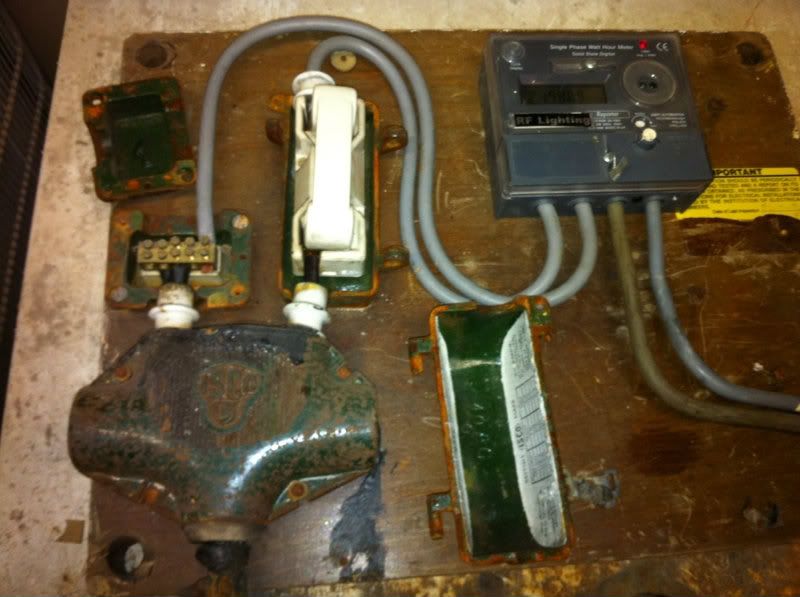
Cutout

Was just going to say that! Maybe he has glued the covers to the board to save losing them :lol:
 
looks very fishy to me

And unless gravity has turned horizontal, the backboard is lying on a workbench, not fixed to a wall

269bec61.jpg
 
:lol:

It was an extention to a house. Supply was moved to an external cabinet. The DNO cut the cable outside and jointed a new split con to the meter cabinet.

I got the old cutout with about a meter of PILC still attatched. Hooked it up to my isolating transformer and popped a meter on the end.

Thought it would be interesting to open it all up before it went to the scrappers :D
 
The only bit that would have been done is the fitting of heat shrink to the individual cores before putting it in the crutch cover of a new cut-out. Though some DNOs heat shrink the lot and use a separate fuse and neutral.

In a paper cable the individual insulation on a core is insufficient to insulate to earth, think of the design with core & belting papers.
 
It's cracking cable. It's been around for maybe 60 odd years and still meggers over 1000MΩ
 
It is good stuff I've only seen one where it was in poor condition under the lead which was due to the passage of fault current.
I'm not sure any of the modern cables will last that long
 
Why did they enclose the wires in black goo and then put it in a metal cover?
 
Metal cover to comply with the "earthed metallic sheath/cover" requirement, now relaxed at cut-outs so that plastic can be used (though plastic cut-outs weren't available then) it also provides mechanical protection & keeps the goo in!!

Bitumen (goo) was used to provide additional insulation (see above) and prevent moisture ingress to the cable, heat shrink is used now.

Going back to past discussion if you do open cut-outs to isolate supplies (even though you shouldn't) be very wary of any metal clad units, there are many designs, but are all high risk if you are not trained on them.
The best I can advise is report to the emergency lines as bitumen compound leak or smell of burning to get it changed.
Similarly any fused neutral units

We have now started fitting isolators when ever we do a cutout change.
 
Think it is the opposite way around i.e. they put the cable in the metal enclosure and fill with pitch. Probably to keep the damp out.
 
Pitch keeps water and air off the cables so stops them getting damaged by external influences. It's only like we fill SWA joints with resin these days.

The cutout was metal as plastinc hadn't been invented then.
 
Can't see it being worth much. I'll chuck the brass and copper in my scrap pile and bin the rest.
 

If you need to find a tradesperson to get your job done, please try our local search below, or if you are doing it yourself you can find suppliers local to you.

Select the supplier or trade you require, enter your location to begin your search.


Are you a trade or supplier? You can create your listing free at DIYnot Local

 
Back
Top