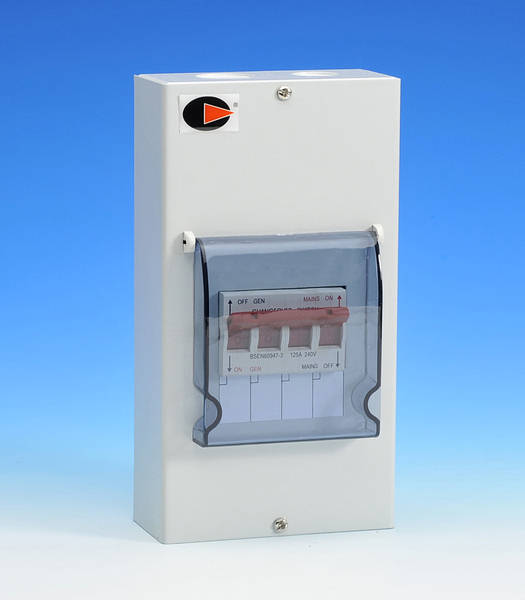
Changeover Switch

but are quite happy to talk about a "32 amp switch" as if it has a rating that does not depend on the duty cycle, installation, or utilisation category. :shock:
Unless clearly indicated in huge letters in the documentation and the switch I would not expect a 32A changeover switch to have a duty cycle of less than 100%.

Given that it is meant to route one of two power sources to an installation I would consider any switch which could not be permanently energised and permanently passing its headline rating as not fit for purpose.
 
but are quite happy to talk about a "32 amp switch" as if it has a rating that does not depend on the duty cycle, installation, or utilisation category. :shock:
Unless clearly indicated in huge letters in the documentation and the switch I would not expect a 32A changeover switch to have a duty cycle of less than 100%.

Given that I would consider any switch which could not be permanently energised and permanently passing its headline rating as not fit for purpose.
I agree BAS, but 'permanently energised and passing its headline rating' is a very benign duty for a switch.
A switch has several ratings, one of which is the thermal current rating Ith, which is the current it can pass continuously, in free air, without excessive temperature rise (usually 60 deg C at the terminals). Another (lower value) rating is IthE (sorry I can't do the subscripts) which is similar but with the switch in an enclosure. neither of these ratings is likely to be achievable if the switch is operated frequently, which was really the point I was trying to make, although perhaps not very relevant in this case. The AC3 rating (switching inductive loads such as motors) can be as little as 10% of the Ith value.

Sorry but I also differ from your assertion that "it is meant to route one of two power sources to an installation". A changeover switch would normally be used to switch a single supply to one of two loads. To switch between supplies the correct device is a transfer switch, which has additional protection to prevent the supplies being connected together.
 
It often surprises me that people will disparage references to, for example, "32 amp cable" since the cable's current carrying capacity depends on the installation method, but are quite happy to talk about a "32 amp switch" as if it has a rating that does not depend on the duty cycle, installation, or utilisation category. :shock:
Given the context (a DIY forum, hence primarily domestic, and certainly not industrial), I'm not at all surprised by that, but I am rather surprised that you're surprised!

The situation with cable is clear-cut, in domestic installations the same as anywhere else. All electricians hopefully know, and anyone installing cables should know, that the current carrying capacity of a given cable varies appreciably between a fair range of installation methods which are encountered in domestic installations. Furthermore this topic is covered in considerable detail in regulations, guides, books, on-line resources and training courses.

In contrast, neither instructions/standard documentation associated with accessories designed for domestic use nor any of the usual reference documents or (AFAIK) training make any mention of the need to consider any dependence of accessory current ratings on any factors (usage, installation method etc.) other than, perhaps, extremes of ambient temperature. The assumption (yes, I know! - so perhaps I should say 'implication'!!) is therefore that the stated/marked current ratings of accessories remain applicable in even the 'worst case' usage/installation situations likely to be encountered in a domestic (or many commercial) installation.

Do you really disagree with that? Taking the example of a switch, do you really think that there are (domestic) situations (other than, perhaps, unusually extreme ambient temperatures) in which an electrician should consider the possibility that a switch's current-handling capacity may be less than its "rated/marked" value?

Kind Regards, John.

Your point about the focus of this forum being domestic installations is a fair one, but the device we are discussing is not really a domestic device.
Accessories designed for domestic use are exactly that. 'Designed for domestic use' imples that they are designed as part of a system. I don't think the device illustrated in a previous post in this thread is really inteded for domestic use. Commercial or industrial installations are a totally different bucket of worms. No, I don't think there are many domestic applications where the electrician needs to check that a switch's ratings are appropriate for the application, but that's because domestic applications usually use devices designed for the sort of loads, switching duty, and environment likely to be found in a domestic situation. Typical domestic situations do not usually include switching between different sources of supply, or switching difficult loads like e.g. large industrial fans.
 
Then buy this.


It is a transfer switch, so it will have the necessary BBM function, and it is sold with a large enclosure so presumably has an adequate Ithe.

Maybe check with Lewden what its Iu (uninterrupted current) rating is, and if there's a recommended maximum interval between operations.
 
[Your point about the focus of this forum being domestic installations is a fair one, but the device we are discussing is not really a domestic device.
Accessories designed for domestic use are exactly that. 'Designed for domestic use' imples that they are designed as part of a system. I don't think the device illustrated in a previous post in this thread is really inteded for domestic use. Commercial or industrial installations are a totally different bucket of worms. No, I don't think there are many domestic applications where the electrician needs to check that a switch's ratings are appropriate for the application, but that's because domestic applications usually use devices designed for the sort of loads, switching duty, and environment likely to be found in a domestic situation. Typical domestic situations do not usually include switching between different sources of supply, or switching difficult loads like e.g. large industrial fans.
I can't disagree with any of that, but would merely point out that my comments have been in the context of the nature of the forum and the matter raised by the OP.

To be fair, this side-discussion all resulted from my asking (for my own purposes, not in relation to the OP) about the size of enclosures for the switches that were mentioned, and pondering the possibility of installing such a switch in a smaller enclosure. There has never been any suggestion (to the OP) that he should consdier anything other than a switch in the 'supplied' enclosure for his purpose (about which there are other concerns, anyway).

Kind Regards, John
 
Sorry but I also differ from your assertion that "it is meant to route one of two power sources to an installation". A changeover switch would normally be used to switch a single supply to one of two loads. To switch between supplies the correct device is a transfer switch, which has additional protection to prevent the supplies being connected together.
I have to say that I was not familiar with that terminology, having always assummed that 'changeover switches' referred to items which could be used either way around. Relaiable break-before-make functionality is obviously required for switching between two supplies, and may also be important in switching between two loads. In context, I would have thought that any rotary DT switch with a centre-off position (such as those linked to) would inevitably have assurred bbm functionality. Ironically, the switch BAS has mentioned which is clearly designed (and labelled) as a 'transfer switch' has lever operation and no centre-off position - although one assumes (and sincerely hopes) that it has been designed for foolproof bbm funcionality, I might have more theoretical concerns than with a centre-off 'chanegeover' switch!

Kind Regards, John
 
This is the changeover switch that i was proposing to use
its obviously got an off position so would imagine there is no chance of any problem??
View media item 51249

Klockner - Moeller 63Amp generator changeover switch with integral 60Amp fuse and holder.
That type of switch must do BBM, so as it's a reputable make I'm sure you'll be OK.

But that photo is clearly of a used one (off fleaBay?) - are you sure that the contacts are OK?

Check with K-M to see if there is a maximum interval between operations which you should observe.
 
Hello, can anybody hear me ?

You have been told it would not be wise to feed a switch with two different domestic supplies !
Yes, but for no good reason as far as I can recall.

In what relevant way are they different?


As you don't get on, who would be responsible for it ?
You could ask the same about the CU common to the outbuildings.


Where would it go so you can both access it ?
My guess would be here:
the buildings are fed by way of 16mm SWA cable that terminates in a secure/weathertight co owned by me and neighbour, communal lean to.


As has been said before what's to stop him (or you) switching it over to 'steal' electricity when one or other of you is out ?
Either party can prevent the other from doing that by turning off the relevant MCB in the CU in their house.
 
--------------------------------------------------------------------------------
that looks like it might be second hand, if it is do you know its history ?

Are its contacts in good condition or are they worn or maybe damaged ?

AND YOU NEED TO DESIGN THE EARTHING AND PROTECTION BEFORE YOU DESIGN THE CHANGE OVER PART

Edit

Is it this one

http://www.ebay.co.uk/itm/271074548...l?_sacat=0&_from=R40&_nkw=271074548992&_rdc=1

Read more: http://www.diynot.com/forums/electrics/changeover-switch.340359/#ixzz296YcH7Id
 
Given that you are on the same phase then use a pair of contactors to decide which house sources the power to the out buildings.

Use auxillary contacts to electrically interlock them so they cannot both be energised at the same time. ...
You'd need to mechanically interlock them as well. Most contactors have mechanical interlock kits as standard accessories since there are many applications where accidental (or otherwise) engagement of both at once would be "a bad thing".


But I find it an interesting situation the OP is in with his neighbour.
 
Thank you posters, espesially BAS, your answers are based on what i asked, not what alternatives can be considered.

You may all be guessing the relationship with my neighbour appears to be odd, well your possibly right!!

My neighbour is someone i grew up with, he comes from a large family of what i can only describe as practical geniuses. If ever a book needs wriying about a family then this is them, they have the ability to make anything work, ressurect any, vehicle, house, gadget, bycycle, electrical device. Not one of them works in the sense that we all think, apart from one of the brothers, who wait for it, owns and runs a very successful electrical installation company.

To some extent the reason for the post is that the changeover switch is my neighbours idea more than mine, and he as slightly more advantage in the ownership of the "lean to" were the switch is to be housed.

To a great extent i can see that there are better, more efficient alternatives, I also see that a changeover switch could also be used, you may say why not get my neighbour to read these posts to determine a different solution?
The fact is my neigh bour is illiterate in our sense of the word, he cannot read, he cannot write..it appears he as only been taught to count,

Thanks to all posted..Russell
 
Out of curiosity, who owns the workshops - one of you, or are they legally down as shared ?
 

If you need to find a tradesperson to get your job done, please try our local search below, or if you are doing it yourself you can find suppliers local to you.

Select the supplier or trade you require, enter your location to begin your search.


Are you a trade or supplier? You can create your listing free at DIYnot Local

 
Back
Top