Self built Boiler timer and SCR

Joined
14 Feb 2013
Messages
6
Reaction score
0
Location
Surrey
Country
United Kingdom
I am building a computer controlled boiler system, so that I can remote control my boiler as well as put in more advanced scheduling (including weather compensation). At the moment I have a Drayton wireless thermostat via a Drayton SCR.

My system will be a Raspberry Pi with WiFi controlling a USB relay. For this I have a spare SCR and thermostat to test with. So, I can build without freezing my house when it goes bang!

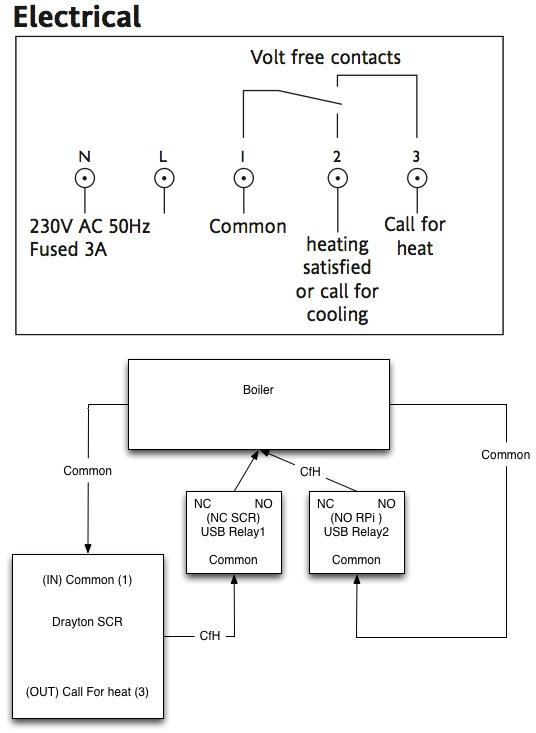
The main question I have is about "Volt Free Contacts" and how the Call for Heat (CfH) works. Probably best to have a look at my planned schematic ...
My plan is that if I can revert back to the normal system by simply powering off the raspberry pi. The first relay will control the thermostat which will be open (NO) during pi control and auto switch to NC when powered off.

So, does the CfH pass current? My relay is rated to 250V and 10A.

Does this all look okay?

I am thinking of building a test circuit using a couple of bulbs to emulate the system. Any ideas on that? I guess it depends on the CfH voltage answer?

I am wary of fiddling with power, but am happy enough that the relay will be okay with what I am planning. Of course, I could stand corrected.

Thanks
 
You can have a two relays in parallel and switch either to operate the boiler.

Not quite sure what you are trying to achieve there are already wireless remote thermostats you can control remotely.

There are also boilers that have in built weather compensation that will adjust the central heating temperature to adjust the level of heating depending on outside conditions.

I'm using my raspberry pi to build a robot lawn mower. :-)
 
You can have a two relays in parallel and switch either to operate the boiler.

Not quite sure what you are trying to achieve there are already wireless remote thermostats you can control remotely.

There are also boilers that have in built weather compensation that will adjust the central heating temperature to adjust the level of heating depending on outside conditions.

I'm using my raspberry pi to build a robot lawn mower. :-)

I'm trying to build my own system, as it will be far cheaper and far more customisable. I already have multiple temperature and humidity sensors and want to use that data to help feed the system data. As a developer, the software side interests me. I'm nearly finished writing the software and just need to get the hardware in.

So, I'm thinking that I want to retain the existing wireless as backup (I know that I have had quite a few RaspPi SD cards corrupt, so need fall back).

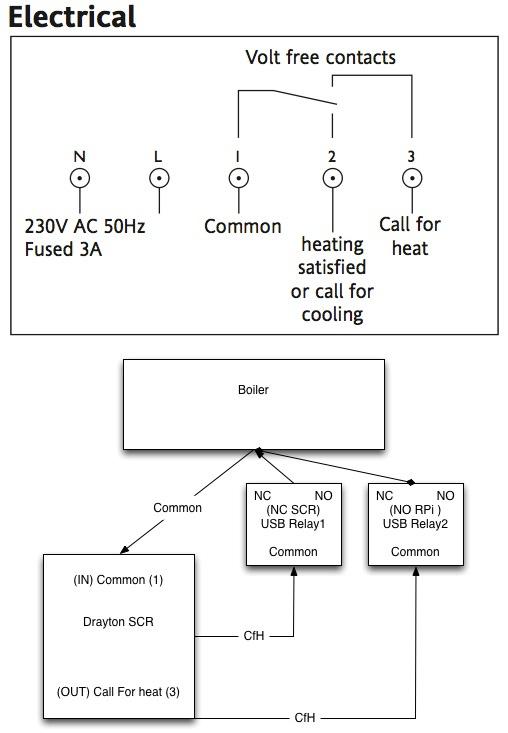
Am thinking that my system drawing is wrong now. Here's an update .. not sure why I had both going through the SCR. It's the SCR i am replacing with the Pi.


So, basically, I just need to have two common wires, one to each of the controllers. I use relay 1 to stop the SCR from communicating, as the NO has no output, and switch on the Pi communications (Relay 2 -> NO). On Pi failure, both revert to NC, bringing the SCR back online.

On opening up my spare SCR, I see that the current relay is lower A than my USB relay .. so it'll be fine to handle anything thrown at it. Just need to replace the capacitor on this spare one to get it working properly again.

I've already got two rasp pi's running duties in my house, and this will be my third in place. I only have a patio, so no need for a laser toting GPS enabled lawn mower. :)
 
You need to control the boilers water temperature that the boiler is producing this will require wiring inside the boilers controller.
As the boiler will be working at it most efficient at lower temperatures in full condensing mode.
Just switching the boiler on and off is only part of it.
The boilers with in built weather compensation just require
an external temperature probe and it's done and working.

The inbuilt weather compensation have heating curves and learn the speed the house heats up at to adjust.
 
You need to control the boilers water temperature that the boiler is producing this will require wiring inside the boilers controller.
As the boiler will be working at it most efficient at lower temperatures in full condensing mode.
Just switching the boiler on and off is only part of it.
The boilers with in built weather compensation just require
an external temperature probe and it's done and working.

The inbuilt weather compensation have heating curves and learn the speed the house heats up at to adjust.

Thanks, yes, I've just read up on the actual meaning of weather compensation. I was thinking more of a simpler system, where I just compute on/off based on existing schedules and external temperature. So, if it's below freezing outside, then switch on 30 mins early etc .. not the whole hog of leaving the boiler on 24hours and adjusting water temperature. It's a combi boiler I have, so hopefully my plan should be as simple as switching on/off...

My main real question is whether the SCR passes a current across the #3 output (Call for Heat) that a Worcestor 28cdi needs to read? Or is it purely completing a wiring circuit .. even then a small current would need to go across it? i.e. like a reed switch.
 
My main real question is whether the SCR passes a current across the #3 output (Call for Heat) that a Worcestor 28cdi needs to read? Or is it purely completing a wiring circuit .. even then a small current would need to go across it? i.e. like a reed switch.

OK, answering my own question .. put a multimeter across N and 1 (common), it's 240v ...
 
What you are describing is "Optimum Start" personally on a Domestic install i would think that Optimum Start should use the internal Room temperature for reference rather than an external sensor, because with good "U" values a House can hold heat very well optimum start with O/S temp a -6'c would cause the heating to start 3 hours ahead of occupancy, whereas by measuring the internal temp say +12'c the heating may be able to start much later!
But there are many control manufactuers that already use this technology the Honeywell CM range has the option for optimised start which is also "self learning" meaning it learns how quickly the house warms at various strart temperatures and modifies its self for the most economic effect! :wink:
 
What you are describing is "Optimum Start" personally on a Domestic install i would think that Optimum Start should use the internal Room temperature for reference rather than an external sensor, because with good "U" values a House can hold heat very well optimum start with O/S temp a -6'c would cause the heating to start 3 hours ahead of occupancy, whereas by measuring the internal temp say +12'c the heating may be able to start much later!
But there are many control manufactuers that already use this technology the Honeywell CM range has the option for optimised start which is also "self learning" meaning it learns how quickly the house warms at various strart temperatures and modifies its self for the most economic effect! :wink:

That's useful, thanks. "Optimum start" .. sounds the same, yes.

I have a number of sensors dotted about (outside, loft, bedroom 1, lounge, bathroom and thermostat location). I can use a mix of these depending on my future plans .. although likely I will mainly use the internal thermostat located sensor. The outside will have an affect on how quickly the house will heat .. so I guess will be a secondary data feed as you suggest.
All the data is stored, so getting a heating pattern from this will be really easy.
All in all, it's costing me next to nothing to build this as I already have the hardware from other projects. The USB relay at £12 was the only thing I've had to buy. Comparing to shelling out £600 for a professional system, I'm happy to give this a go with a fall back to my existing Drayton system.
I also will be able to build my own bespoke software, as I never am happy with the software that comes with hardware like this. It's generally very simple to allow the majority to use. Also, I'm never a believer that these guys have written the perfect software .. everyone needs to update their code again at a later date once they've realised a mistake. I'll be able to update whenever I like ... (probably break it in the process ;) )

From a hardware perspective, it looks like everything is capable. So, I guess I now need to get an electrician in to install :) ..
 
Hi,

Did you get this working? I'm also looking into hacking my boiler a bit using my Pi. I have a Drayton installed currently, as well as some wireless thermometers sending to my Pi (thanks to OpenEnergyMonitor.org).

I was planning on sending signals directly from the RFM12B 433Mhz radio add on on the Pi to the already installed Drayton 433Mhz SCR unit, then the SCR unit went down, so if you've have success with a "custom SCR" I'd be interested learning.

Cheers
 
Hi,

Did you get this working? I'm also looking into hacking my boiler a bit using my Pi. I have a Drayton installed currently, as well as some wireless thermometers sending to my Pi (thanks to OpenEnergyMonitor.org).

I was planning on sending signals directly from the RFM12B 433Mhz radio add on on the Pi to the already installed Drayton 433Mhz SCR unit, then the SCR unit went down, so if you've have success with a "custom SCR" I'd be interested learning.

Cheers

Hi, yes I did get it working. I managed it with two raspberry pi's. One as the controller running alongside the existing drayton SCR (which will come back online if power fails to the controller pi). I then have a management pi that is running a basic website to allow me to control it all.
They contact each other over the local network and I went with hard wired as was having issues with WiFi staying up reliably. There is meant to be a method where it checks they can talk to one another, and if not, go back to the original controller.

Controller code : https://github.com/elyobelyob/heating
Management : https://github.com/elyobelyob/boiler-scheduler-php

Hope this helps .. .
 

If you need to find a tradesperson to get your job done, please try our local search below, or if you are doing it yourself you can find suppliers local to you.

Select the supplier or trade you require, enter your location to begin your search.


Are you a trade or supplier? You can create your listing free at DIYnot Local

 
Back
Top