Electrical ring off a ring..?

Joined
1 Sep 2015
Messages
377
Reaction score
6
Country
United Kingdom
I've recently begun ripping out a converted (previous owner DIY bodge) garage conversion as the plasterwork in there needs redoing, however upon doing so, I think I've discovered something nasty.

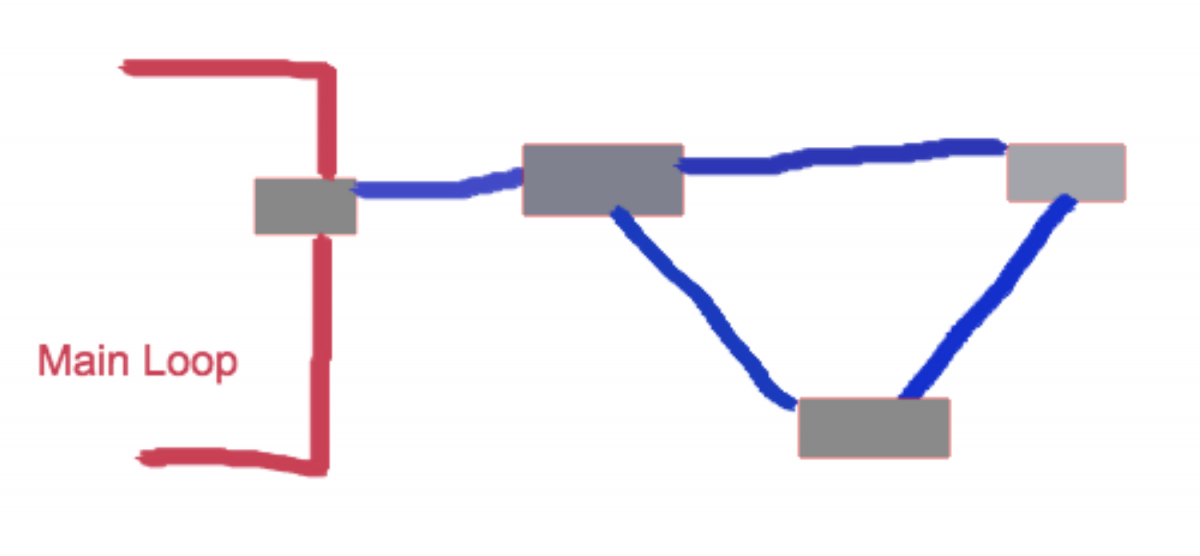
I believe that the original socket in the garage was a spur off a kitchen socket. What I've discovered seems to now be a spur off the same socket, with a loop like so:

upload_2017-5-30_20-34-29.png


I don't know if this is safe or compliant, however figured I'd ask for some rough advice before I call the sparkies to sort out the mess.

Can anyone advise?
 
Not compliant and probably not safe either. What size are the cables, and the rating of the MCB/fuse for the circuit?
 
Not compliant and probably not safe either. What size are the cables, and the rating of the MCB/fuse for the circuit?

Pretty much what I assumed.

The cables are 2.5mm, however I'm not sure what the rating of the fuse for the circuit is off the top of my head. If I recall from when we had the kitchen redone (where the spur comes from) is a 32A.

Is there an easy way to make it compliant without going all the way back to the consumer unit?
If thats the case then we'll have to settle with a single socket!
 
Is there an easy way to make it compliant without going all the way back to the consumer unit?
Connect the garage cables via a 13A FCU. This will ensure the cables are not overloaded. You can then have as many sockets in the garage as you want, but the total load can't exceed 13A.

If you need more than 13A in the garage, then the wiring will need to be significantly changed and this will cost significantly more.
 
We were told when doing the inspection and testing course that we should test for a figure of 8 however I can't find a regulation to say there is anything to stop you using a figure of 8 as long as steps are taken to stop overload.

If the neck of the figure of 8 is near the centre of the primary ring and is big enough to take the load, then there is not any real problem so if the cable between the two rings will take the load, likely 4mm² or 6 mm² depending on the route used then it would be OK, or putting a fuse better where it leaves the primary ring, but as long as the short length of cable is protected from damage it could be where it forms the second ring.

Most fuse connection units (FCU) are size of a single socket, however using the grid system one can build a socket and fuse and switch or blank into a double socket size I used a unit made by LAP, however building one up, one needs to know what you are doing.

Anyway the point is there are ways to correct the problem, and you have to decide if your going to DIY or not, since clearly there are problems with the installation so it would be better in my mind to get some one who could check for any other faults at the same time.
 
We were told when doing the inspection and testing course that we should test for a figure of 8 however I can't find a regulation to say there is anything to stop you using a figure of 8 as long as steps are taken to stop overload.

If the neck of the figure of 8 is near the centre of the primary ring and is big enough to take the load, then there is not any real problem so if the cable between the two rings will take the load, likely 4mm² or 6 mm² depending on the route used then it would be OK, or putting a fuse better where it leaves the primary ring, but as long as the short length of cable is protected from damage it could be where it forms the second ring.

Most fuse connection units (FCU) are size of a single socket, however using the grid system one can build a socket and fuse and switch or blank into a double socket size I used a unit made by LAP, however building one up, one needs to know what you are doing.

Anyway the point is there are ways to correct the problem, and you have to decide if your going to DIY or not, since clearly there are problems with the installation so it would be better in my mind to get some one who could check for any other faults at the same time.

Thanks. We had sparkies in to do rewire the kitchen when we did it, so I'm happy that the house itself is fine. It's just this modification to the garage which is a bit dodgy!
Like said before, I wouldn't be too concerned as i'd stick a fuse to prevent overloading, however up until the other day there was a freezer, chop saw etc hooked up to it which I've now stopped using after my discovery!

I'll get the sparkies out to take a look!
 
One has to be careful with freezers, volt drop is a problem, the freezer can only start if there is no pressure in the system, there is a start delay to allow the pressure to drop before it tries to start, and also an overload which should the motor stall will switch off the motor and once cooled try again, this overload has a limited life, and if the freezer has to try to start multi times then the overload will burn out. Volt drop can also cause the freezer not to start and have to re-try, for this reason nearly every freezer has a warning not to use it on an extension lead as extra fuses means more volt drop.

This has been compounded as of late, due to solar panels, our voltage is officially 230 volt, but for many years it was 240 volt, and in real terms the main transformers never had their tapping changed to drop to the harmonised 230 volt, however solar panels have to be designed to auto switch off should the voltage go too high or too low, it's all part of the safety system, so if the tapping on the transformer is too high, the solar panels auto shut down, so now the DNO have to drop the voltage to the correct 230 volt.

This means that freezers which have for years worked in a garage or shed, fail due to low voltage, it is only one small part which needs changing once they fail, but the domestic refrigeration trade tends to be van based and it costs around £60 for a call out even if the part is cheap. Modern freezers are now starting to use three phase motors and inverter drives which removes this problem, but as yet only the more expensive models.

So to use a freezer in a garage or shed, one has to be careful that there is not an excessive volt drop, old type freezer has a load of around 10 amp on start, so the loop impedance (L - N) needs to be 1.87Ω or less so at 10A the voltage does not drop more than 11.5 volts which is maximum allowed, in general if old fluorescent lamps work OK then freezer also OK. New fluorescent lamps now also use inverters so don't have a problem with volt drop.

 

If you need to find a tradesperson to get your job done, please try our local search below, or if you are doing it yourself you can find suppliers local to you.

Select the supplier or trade you require, enter your location to begin your search.


Are you a trade or supplier? You can create your listing free at DIYnot Local

 
Back
Top