Outside Tap Kit from B&Q stopped working

***** decent bit of kit

Deano 0501 - 3 months ago
fitted over 20 of these take your time do it right make sure everything is nice and tight you should never have a problem

----------
If "Deano" has fitted over 20, he either moves house a lot or is (OMG) doing these as a part of his job. I hesitate to say he is a plumber.

Are you on this site, Deano. ?

I saw that comment and thought it odd.

I suspect that Deno is the kind of person that gets his work through those checkatrade/rated people sites and pretends to be a plumber in his profile.
 
Have looked at some youtube videos on the job, and this way seems the best.


Will need some tools and parts but will be well worth the effort and cost?
 
Have looked at some youtube videos on the job, and this way seems the best.


Will need some tools and parts but will be well worth the effort and cost?

Sorry haven't watched the video but just wanted to suggest that you fit an internal isolating valve so that you can turn off the water to the outside tap when the temperatures drop. When we get the freezing weather, you can turn off the internal valve and leave the out door tap slightly open. Doing so will hopefully allow the frozen water to expand without bursting the fittings.
 
Hi

Got the kit a couple year ago, and installed according to the instruction.
It worked OK for a few weeks, but it stopped working when turned on after a few months not using it.

No water coming out at all.

Is this known problem with this kit? I have seen many people complaining about the same problem with this kit.

Is it possible to fix it by replacing part or working on something? Or would it be better to bin it, and just get new tap?

Thanks
is it one of the kits with the self cutting tap ? these tend to block if it is
 
is it one of the kits with the self cutting tap ? these tend to block if it is

Good call, the curved copper disk that is cut has to go somewhere. I'd never thought of that before.
 
DO NOT COPY THE BLOKE IN THE VIDEO!

Call a plumber

Andy

Why?

*disclaimer* I haven't watched the video, it would however help others if you explain what is wrong with the video. Don't forget that someone might read your reply in 10 years from now and 5 years after the video is pulled from youtube.

Sorry Andy, that was my long winded way of asking you direct the OP in the right direction- yes you recommended they call a plumber but if they wanted do it themselves it might be useful if you point out the flaws in the video.

/notTtryingToBeCombative
 
It was terrible... Muppet didn't know the difference between 1/2 and 3/4 inch threads. Plus, he's using a schitty Flexi house to join the tap supply to a washing machine valve.
 
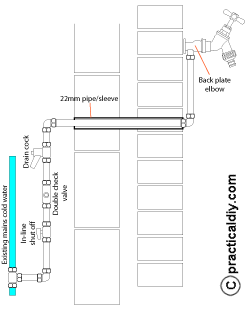
Installing the pipework etc for an outside tap is as follows:
outside-tap-connection.gif

  1. Decide on the position for the tap outside the house – ideally it needs to be near the internal cold water mains supply to reduce the plumbing required. Usually, the outside wall behind the kitchen sink is ideal, if the tap can be positioned above an open drain gully, so much the better.
  2. Mark the height for the tap on the outside wall, ensure that it is high enough above ground level for a watering can to be held underneath to fill.
  3. Inside the building, identify suitable positions (i.e. clearing waste pipes, shelves etc) to take the plumbing through the outside wall and to make a connection to the cold water pipe – ideally it should be directly under the tap position on the outside wall to keep the pipe run simple.
  4. From the inside, drill a hole through the outside wall at the required position using a long (150mm) masonry drill. Once you have a pilot hole through to the outside, open it up to 22mm using a 22mm masonry drill-bit in a hammer action drill.
  5. Measure the thickness of the wall and cut a piece of 22mm copper pipe to length so it can be inserted through the wall to be a protective sleeve for the actual water pipe.
  6. Inside the building:
    • Turn off the water supply.
    • Cut into the cold water supply pipe (some water will come out, so have a piece of rag to hand).
    • Fit a coupling to connect the new pipe.
    • Along the new pipe-run to the hole through the wall, fit an inline shut off valve, then a double check-valve (if not incorporated in the outside tap) and a drain cock.
  7. Run the pipe through the wall (inside the sleeve) and route it to a back-plate elbow, secure the elbow to the wall using wallplugs and screws after the pipe work has been cut to length and the couplings (except for the pipe to the elbow joint) tightened.
  8. Screw the outside tap into the back-plate elbow using some plumber’s compound on the thread .
  9. Before turning the water supply back on, check the tightness of all the compression joints, close the drain cock, the outside tap and the inline shut off valve.
  10. Turn the water supply back on and check for leaks. Open the inline shut off valve and check for leaks. Open the outside tap and check the flow of water. Close the outside tap and check for leaks.
  11. Apply some mastic sealant to the gap between the 15mm pipe and the 22mm sleeving, and between the sleeving and the masonry.
  12. Finally, fit some insulation material around the pipework to protect it from winter frost.

Andy
 

If you need to find a tradesperson to get your job done, please try our local search below, or if you are doing it yourself you can find suppliers local to you.

Select the supplier or trade you require, enter your location to begin your search.


Are you a trade or supplier? You can create your listing free at DIYnot Local

 
Back
Top