Two Consumer Units, one off peak only

Joined
2 Nov 2021
Messages
5
Reaction score
0
Country
United Kingdom
Hi

We have recently moved house.
The new house has two consumer units.
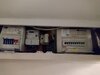
One for the main electrics (lights, plugs, kitchen etc) on right side of photo.
The other is purely for electric radiators (not storage heaters) on left side of photo.
The one for electric radiators only gets power during economy 10 off peak hours.

We want to keep the electric radiators but be able to use them when we want.
Any ideas on what is required to do this? (in dummy terms) :)

Thanks
 

Attachments

  • IMG_20211102_203327342.jpg
    IMG_20211102_203327342.jpg
    162.2 KB · Views: 623
... The new house has two consumer units. ... One for the main electrics (lights, plugs, kitchen etc) on right side of photo. ... The other is purely for electric radiators (not storage heaters) on left side of photo. The one for electric radiators only gets power during economy 10 off peak hours.
That sounds a bit daft, the E10 off-peak hours are presumably the very time when you do not want electric heaters to be on, aren't they (unless you are a permanent 'night worker'!)? I would guess that there once were storage heaters.
We want to keep the electric radiators but be able to use them when we want.
Any ideas on what is required to do this? (in dummy terms) :)
Probably very little. You probably simply need to get an electrician to move the connection to the second (heaters) CU to the same electricity source that is powering the other CU. An electrician who had seen the current setup could easily advise what would be needed.

You then will need to decide whether it is in your interests to retain E10. I (with my E7, but no storage heaters) am seemingly an exception, but for the great majority of people E7/E10 tariffs end up being more expensive if one does not have storage heaters.

Kind Regards, John
 
Hi John
Thanks for your reply.
Yes I believe originally storage units were in the property. The previous owner changed them all to electric radiators, however the wiring was not changed/tariff remained on economy 10. Exactly as you said heating comes on at completely the wrong times.
We definitely want to change to a one rate "normal" tariff, however the energy company aren't much help.

Would it be better to combine both consumer boards into one? Or does that not really matter?

Thanks
 
Hi John Thanks for your reply. Yes I believe originally storage units were in the property. The previous owner changed them all to electric radiators, however the wiring was not changed/tariff remained on economy 10. Exactly as you said heating comes on at completely the wrong times.
Indeed.
We definitely want to change to a one rate "normal" tariff, however the energy company aren't much help.
You perhaps need to suggest to them that you are seriously considering 'swapping' to a supplier who is prepared to change it to a single-rate tariff - they might then become 'more help'!
Would it be better to combine both consumer boards into one? Or does that not really matter?
The latter, really - "doesn't really matter". If/when it comes time to have your electrical system upgraded (or completely re-wired) you might then want to 'tidy' it all into one CU.

Just one point. Not unreasonably, regulations require that there be a 'single means of isolation' of an entire electrical installation. You therefore probably need to talk to your electrician about having an 'isolator' fitted upstream of the two CUs, otherwise you would have to 'switch off' two CUs separately to kill the whole installation.

Kind Regards, John
 
I'm glad I joined this forum now, great help.
So I assume the order would be:
1. Electrician to move the connection
2. Current or new energy supplier to change tariff
3. Current or new energy supplier would change existing dual rate meter to a "normal" single rate meter?

Thanks
 
Not unreasonably, regulations require that there be a 'single means of isolation' of an entire electrical installation.
Are you sure, I know where I work we have a collection of meters for the same building as originally they were council starter units, but now all belong to railway.

It seems the cost of removal is rather high, so over 20 years to break even standing charge to removal fee, and at least one is now used for EV charging.

It is common for buildings to have multi-supplies, and only real way to have common isolator for an economy 10 and standard supply would be the fuse or isolator provided by the supplier, it would be impossible for anyone but the DNO to arrange it.

What I see as a problem is the single RCD, can't read what size, may be 100 mA or 30 mA, but seems likely some one has changed the isolator for an RCD, personally I would use RCBO's but the off peak box has no RCD or enough room to fit one unless it replaces the isolator.
 
I'm glad I joined this forum now, great help.
So I assume the order would be:
1. Electrician to move the connection
2. Current or new energy supplier to change tariff
3. Current or new energy supplier would change existing dual rate meter to a "normal" single rate meter?

Thanks
4. Look forward to much larger bills.

Assuming gas is not available I would consider going back to storage heaters.
 
Last edited:
What I see as a problem is the single RCD, can't read what size, may be 100 mA or 30 mA, but seems likely some one has changed the isolator for an RCD, personally I would use RCBO's but the off peak box has no RCD or enough room to fit one unless it replaces the isolator.

Hi
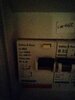
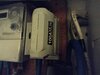
Have put a photo attached of what I think is the RCD?
 

Attachments

  • 16358925762073102341476842987778.jpg
    16358925762073102341476842987778.jpg
    215.9 KB · Views: 147
  • 16358929219164587271093680303436.jpg
    16358929219164587271093680303436.jpg
    316.9 KB · Views: 141
This
upload_2021-11-2_22-34-27.png
is the RCD, as to off peak will save money there are many factors. One is how quickly the home cools, the other is when do you want it heating. My central heating can be off for 8 hours and the house has only cooled 4°C if that, but daughters flat no heating and at 0°C outside and starting at 20°C it was down to 10°C within 2 hours, not permitted to fit double glazing as a listed building.

My old house had two radiators in living room 3 kW each one fan assisted and a 4.5 kW gas fire, so could heat up fast, but this house to heat fast need to heat in stages, so living rooms first.

A home can have between 60 and 100 amp supply, if we are going to cook using 30 amp, then between 30 and 70 amp for heating, so around 3 to 8 heaters switched on together if also cooking. The advantage with storage heaters is not using them at same time as cooking.

I am sure things can be improved, but need to give it some thought, not just rush in.
 
Are you sure ...
Well, it's what I have always understood, and it certainly sounds reasonable/sensible to require a single point of isolation for an installation. Do you not interpret ...
BS7671:2018 said:
462.1 Each electrical installation shall have provisions for isolation from each supply.
462.1.201 A main linked switch or linked circuit-breaker shall be provided as near as practicable to the origin of every installation as a means of switching the supply on load and as a means of isolation.
... as having that meaning?
It is common for buildings to have multi-supplies, and only real way to have common isolator for an economy 10 and standard supply would be the fuse or isolator provided by the supplier ...
I must say that I've never really thought of that issue. However, what you say is not really true, since it would be simple enough to isolate both supplies (standard and E10) together with a 4-pole isolator (i.e. one 'designed as'a 3P+N one).

Kind Regards, John
 
... as to off peak will save money there are many factors. One is how quickly the home cools, the other is when do you want it heating.
If the heating is all electric, and it is only run during what would be 'off-peak' hours with a dual tariff, then it would almost certainly 'save money' to have a 'dual tariff' such as E7 or E10.

However, as I implied before, I think it is equally true that, unless one was essentially a permanent 'night worker', it would be crazy having the heaters on only during E7/E10 hours if they were not storage heaters, wouldn't it? - i.e. one would 'save money' by having a dual-rate tariff but would have a house that was too cold during most of the day+evening.

Kind Regards, John
 
4. Look forward to much larger bills.
Well said, except OP hasn't yet used the heating.
Assuming gas is not available I would consider going back to storage heaters.
I'm not sure gas is that economical now and getting worse.

As a landlord I recently went through night storage heater replacement in a flat, it was suggested by 2 heating 'experts' that I replace all 3 heaters with panel heaters. luckily I consulted my EPC inspector who advised the property would've become unrentable without E7 and NSH and she also gave excellent advice on suitable replacements/combinations.

The current NSH's are unbelievably more effective than the 35 year old versions, so much so the lounge area now has only 1 NHS, consulting with the tenant we settled on a panel heater in the bedroom. According to my EPC inspector what I've done should push the property up the ratings.

Getting back to the original question it is a fairly simple thing to rewire the main feeds but it is most definitely not a DIY thing. You will require a new meter from your supplier and a henley block, I'd suggest if you purchased one and plied the meter fitter with tea and biscuits he may do the whole job (but bear in mind it's not his job and they're not all friendly).
 
Well said, except OP hasn't yet used the heating.
Whatever happens to the price of gas, I very much doubt that it will become as expense as, let alone more expensive than, electricity - not the least because rises in gas prices will inevitably be at least partially mirrored by rises in electricity prices.

I presume that looking at the gas/electricity price difference will become more difficult/complicated in the presence of heat pumps. Electricity will presumably continue to charged on the basis of the kWh actually supplied - but, unlike the present situation, with a heat pump that is a totally different matter from the kWh delivered to the house (which is what one would want to compare with gas kWh)??

Kind Regards, John
 

If you need to find a tradesperson to get your job done, please try our local search below, or if you are doing it yourself you can find suppliers local to you.

Select the supplier or trade you require, enter your location to begin your search.


Are you a trade or supplier? You can create your listing free at DIYnot Local

 
Back
Top