• Looking for a smarter way to manage your heating this winter? We’ve been testing the new Aqara Radiator Thermostat W600 to see how quiet, accurate and easy it is to use around the home. Click here read our review.

Method or madness in this CH installation?

Joined
22 Feb 2025
Messages
156
Reaction score
20
Country
United Kingdom
Looking into the theory of non-condensing boilers i found out that its important to have a fairly high return temperature to reduce the chance of corrosive condensation.

The system in the house we bought has 11 rads. Its is 22mm for about a meter then splits to 15mm. One branch goes to a single radiator in a room above and the other branch does all the other rads in the house. I thought that was mental but now I'm wondering if it was deliberate as what it does it raise the temp of the return pretty much as soon as the heating starts. If it wasn't like that it would be cool much longer. The rest of the house never gets hot but it is sufficient.

The boiler is over 20 years old and has zero corrosion inside. Could this design choice be why?

I was going to change it but now I'm thinking leave that as it is but add an always on towel rail in the bathroom we're making next to it. So its still a short loop and in effect a bypass valve. The system doesn't have a bypass valve at the moment but I expect the TRVs in the distant rads never close so it probably doesn't really need one. But having one on a short loop will allow the single rad to be closed while still having the warm return. That said even if the TRV on the single rad does close, by that time warm water will be returning from the main loop...

One thing I could improve on is making it 22mm until the main loop splits to the 2 floors. The short loop can come off that instead of it splitting to 2x 15mm. I guess that would reduce some flow through the short loop but hopefully not enough to negate the benefit

Is this sounding familiar to an installer of non-condensing boilers?
 
Is it a conventional or combi system? If conventional, do you have a 3 port valve or 2x two port ones?
 
Is it a conventional or combi system? If conventional, do you have a 3 port valve or 2x two port ones?
Its a non-condensing combi with a 3 port valve. I think I understand it quite well but I'm not sure what the bypass tube under the plate heat exchanger is for, or the pressure pipes, do you know?

boiler image.jpg

boiler image2.jpg
 
Well I know roughly what they are for, clues in the name, but not exactly how it interacts with each other and which point. I take it the bypass isn't doing the function a bypass valve would? Though if it can't go around the CH system, if it can go around inside the boiler it would shut off due to temperature anyway though the pump keeps going when that happens at least its not working against a dead end. Not ideal though. I'm thinking this boiler might benefit from a bypass in the system?
 
I didn’t think combi's needed a bypass? I’m no heating engineer though!
 
I can't see why it would really need one as if there is no flow a micro switch is deactivated and the boiler should shut off, but maybe with a lock out needing a reset I'm not sure.

I'm more interested if it used to be a part of normal design to have a short loop to keep return temps up
 
1) You don't want to pump against a closed valve.
2) Something must tell the boiler when to switch off.

How the system is configured to switch off varies. I was reading yesterday a boiler manual which said with all TRV control there should be no by-pass valve, 1740956824007.png this was rather a surprise, I always thought the boiler used the by-pass valve so once all the TRV's were nearly all closed return water temperature would raise and the boiler would modulate then switch off.

But non condensing does not mean non modulating, my boiler does neither, same with last house, and last house I had a fan assisted radiator this had no restriction so was when fan was not running, hot water would return.

We tend to use near enough engineering, I know the best option is all linked electronic TRV heads, but this is expensive, so key rooms have or will have linked TRV heads, but most rooms are simple programmable heads, so they will not make boiler run, I have two wall thermostats which will run boiler, so unless those areas are cold other areas will not warm up.

Looking at how many and what type of motorised valve can lead one astray, as my system runs a C Plan but has two x two port valves, also two pumps.
 
In 45 years in the trade i have never seen a domestic non condensing boiler suffer corrosive condensation . Your looking too deep into it
 
What’s the purpose of the 3 port valve, Combi boilers don’t normally have motorised valves at all.
yep quite a few makes did have motorised valves back in the day
But the one in that boiler is not a motorised valve and a pretty standard valve for a lot of combis
 
yep quite a few makes did have motorised valves back in the day
But the one in that boiler is not a motorised valve and a pretty standard valve for a lot of combis
The diverter valve I can understand, I thought the OP was talking about a motorised valve as in a Y plan system.
 
1) You don't want to pump against a closed valve.
2) Something must tell the boiler when to switch off.

How the system is configured to switch off varies. I was reading yesterday a boiler manual which said with all TRV control there should be no by-pass valve, View attachment 374996 this was rather a surprise, I always thought the boiler used the by-pass valve so once all the TRV's were nearly all closed return water temperature would raise and the boiler would modulate then switch off.

But non condensing does not mean non modulating, my boiler does neither, same with last house, and last house I had a fan assisted radiator this had no restriction so was when fan was not running, hot water would return.

We tend to use near enough engineering, I know the best option is all linked electronic TRV heads, but this is expensive, so key rooms have or will have linked TRV heads, but most rooms are simple programmable heads, so they will not make boiler run, I have two wall thermostats which will run boiler, so unless those areas are cold other areas will not warm up.

Looking at how many and what type of motorised valve can lead one astray, as my system runs a C Plan but has two x two port valves, also two pumps.
I suspect boiler is a Vokera Maxin 24 or 28.
The system doesn't have a bypass
It does. Is fitted in the diverter valve
Is this sounding familiar to an installer of non-condensing boilers?
My suspicion is the boiler lacks proper system balance and if there is no room thermostat, installation will benefit if one was added.
Certain parts may be difficult to get though some parts are Vokera items ( ie main heat exchanger etc) others are used by a few models 5hat utilise this set up
 
In 45 years in the trade i have never seen a domestic non condensing boiler suffer corrosive condensation . Your looking too deep into it
Good to hear. I think it was a fair concern though when the boiler has lasted so well I don't want to think i'm being clever, improve the balance and then 6 months later find its started rotting out. It has a very short and very clean straight flue, no condensate trap that I can find despite seeming to say there should be one in the installation manual. But it aint broke so i wont fix it
 
I suspect boiler is a Vokera Maxin 24 or 28.
You should get a prize, its a maxin 28e
It does. Is fitted in the diverter valve
Looking at where the CH flow and return are i can see the return goes to the pump, through the exchanger and back out through the flow valve. For DHW it is diverted through the plate exchanger and back up through the main heat exchanger in a loop,

that leaves the bypass tube, Have i got this right. First the pump comes on, if the flow is through the system it operates the micro switch on top of the valve and the burner can light. When does the bypass tube come into it? Just as a pressure relief, if the water can't leave by the flow valve? There is a bobin 0852 with a weak spring that doesn't seem much like it would resist the normal pressure in the system so maybe that tube is in action more? Just realised an easy way to understand it would be to feel the pipes when it starts I suppose
boiler image3.jpg
boiler image4.jpg


My suspicion is the boiler lacks proper system balance and if there is no room thermostat, installation will benefit if one was added.
There isn't a room thermostat, its on a 24 hour timer and we change the heat setting occasionally if its a warmer or colder day. If it would reduce having to do that it might be worth it. Where would the best place be to have one? A hall with a rad without a TRV?

I've no interest in being pampered where it has to be 21 degrees in every room. Its an old victorian house. We wear jumpers if its a cold day. As long as the house is warm enough to avoid damp and we're not cold we're fine.
Certain parts may be difficult to get though some parts are Vokera items ( ie main heat exchanger etc) others are used by a few models 5hat utilise this set up
The only thing I found obsolete was the 0873 Non Return Nylon Body but found Ariston used the same part in the EUROCOMBI. I've now got basically a whole new boiler in new old stock (give away prices) and some smaller new stock parts. But if you come across one of these that you're replacing I'd buy a complete unit from you just in case.

But I'm very impressed how long these are being supported with parts, Italian make so I guess they are common in Italy where its not so cold and the boilers aren't driven as hard and they're maybe not so easy with getting in debt for new stuff all the time, and the non-condensing ban wasn't until 2015 there.

These were supposed to be budget boilers but I can't see any cheap parts where they scrimped on quality. Compared to new boilers I suppose I'd have to pay a premium for not having any plastic parts like this
 
if there is no room thermostat, installation will benefit if one was added
It depends on what you call a "room thermostat"?
I expect the TRVs in the distant rads never close
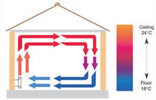
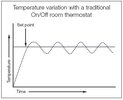
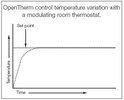
TRV = thermostatic radiator valve, so clearly it does thermostats in the rooms. As to wall thermostats, or freestanding thermostats, I would say you are looking at how thermals more the air around the rooms. circulation.jpgOpposite wall to radiator will detect warm air before low down and to the side of radiator, so what we are looking at is speed and the hysteresis. How fast you can heat the radiator to still avoid a significant hysteresis? These Temp_variation_on_off.jpgTemp_variation_OpenTherm.jpg are designed to show how good OpenTherm is, but if the lock shield valve is open too wide you will get the first one, but if trimmed spot on, the second one.

While setting the TRV and lock shield, you want the boiler or at least pump to be running. Look at target and current, TRV_report.jpg if the current exceeds the target, then the lock shield valve needs closing a bit. As long as the modulating boiler is required to deliver over its minium output, each room should show a straight line graph.

If however the boiler has to use a mark/space ratio to control output, the TRV then it will show more like this 1741012621132.png the one shown the boiler does not modulate at all, so the troughs are where the boiler has switched off.

We are told where not using linked TRV heads, a wall thermostat should be put in a down stairs room, as heat raises, with no alternative heating, and no opening doors to outside, and kept on the cool side so with a warm day the heating will not fire up.

Don't know your house, but I have no such room. So we need a diffrent method.

Clearly linked TRV heads is the best. But you could get the same with a whole series of wall thermostats, all connected in parrellel so if any room under temperture the boiler will run. but why?

Drayton wiser will allow multi wall thermostats or multi TRV heads or both, but why get wall thermostats when TRV heads are cheaper
1741013499093.png
What is the point? £45.74 so you can adjust temperature without using phone.
 

If you need to find a tradesperson to get your job done, please try our local search below, or if you are doing it yourself you can find suppliers local to you.

Select the supplier or trade you require, enter your location to begin your search.


Are you a trade or supplier? You can create your listing free at DIYnot Local

 
Back
Top